I Spent Too Much Time Looking for the “Perfect” Ecommerce Platform — Here’s What Actually Matters
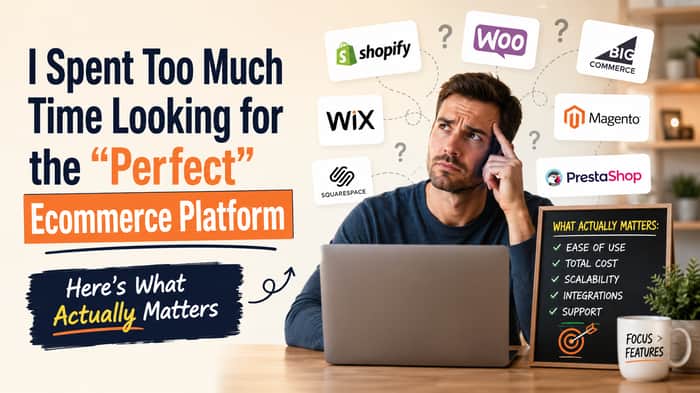
When I first started exploring ecommerce platforms, I thought choosing the right platform would decide whether a business succeeded or failed.
So I did what most people do.
I opened dozens of tabs.
Compared features.
Read reviews.
Watched YouTube videos.
Looked at pricing pages.
Compared free plans.
Compared transaction fees.
Compared templates.
Compared integrations.
Compared opinions.
Pretty quickly I found myself trapped in endless research.
And eventually I realized something:
I was spending more time choosing a platform than actually building anything.
The Problem With Too Many Choices
Years ago, choices felt simpler.
Now there are platforms for almost everything.
Some focus on:
- beginners
- creators
- dropshipping
- digital products
- subscriptions
- physical products
- marketplaces
Every platform claims to be:
- easier
- faster
- cheaper
- more scalable
After reading enough comparisons, everything starts sounding the same.
You begin thinking:
"What if I choose the wrong one?"
That question keeps people stuck much longer than it should.
I Thought Features Were Everything
Initially, I paid attention to things like:
- number of templates
- plugin libraries
- customization
- advanced features
- dashboard design
I thought:
"More features must be better."
But after spending more time building websites, I noticed something.
Most people never even use half the features they compare.
What Actually Matters More
Eventually I stopped asking:
"Which platform has more features?"
And started asking:
"Which platform helps me start faster?"
That changed everything.
1. Ease Of Use Matters More Than Endless Features
A complicated platform creates friction.
If basic tasks become frustrating:
- creating pages
- uploading products
- changing settings
- managing content
you start wasting energy on tools instead of growing the business.
Simple systems usually win.
2. Speed Matters More Than People Think
Slow websites create problems quickly.
Visitors leave.
User experience suffers.
Conversions drop.
Many people spend weeks comparing designs while ignoring performance completely.
3. Flexibility Matters Long-Term
In the beginning your website may be simple.
But things change later.
You may eventually add:
- email marketing
- affiliate systems
- memberships
- digital products
- blogs
- SEO content
A platform should grow with the business.
4. Content Matters More Than Platform Choice
This was probably my biggest realization.
You can have:
- beautiful design
- premium themes
- advanced features
But if nobody discovers your website, none of that matters.
Many creators focus heavily on setup and very little on:
- traffic
- SEO
- content
- distribution
What I See Beginners Doing Often
I see many people spending weeks asking:
"Which platform should I choose?"
while still having:
- no products
- no content plan
- no traffic strategy
- no audience
That feels backwards.
Because a platform supports the business.
It isn't the business itself.
My Current Rule
Now I ask myself:
"Will this decision still matter after six months of building?"
If the answer is no, I stop overthinking it.
Because many early decisions can be changed later.
Progress usually matters more than perfect setup.
Biggest Lesson I Learned
I think many creators delay starting because they believe they need perfect tools before taking action.
I've done that myself.
Looking back, I think execution mattered far more than choosing the perfect platform.
The businesses that grow usually aren't the ones with perfect setup.
They're the ones that simply keep building.
I also published a deeper breakdown of the ecommerce platform comparisons, features, pricing differences, and use cases on Freqwebs for anyone interested in the full comparison and detailed analysis.

This reads like an SEO article published to IH for distribution rather than a founder post — generic structure, no specific product context, no founder story, ends with a link to your blog for the "fuller version." Which is fine as a content strategy, but worth knowing the format limits the engagement you'll get here.
The "execution > perfect setup" thesis is also well-traveled territory. Sharp founder posts on IH usually start from a specific number or story, not a definitional reframe of choice paralysis.
This is one of the most accurate lessons for beginners.
Many people spend months comparing platforms, frameworks, and features before even validating whether customers want the product.
I’ve seen developers over-optimize tech stacks while ignoring:
traffic
distribution
SEO
customer acquisition
real business problems
Execution speed matters more than “perfect setup.”
Most successful businesses evolve their tools over time anyway.
The platform supports the business — it is not the business itself.
100%. I wasted more time choosing tools than finding traffic. A simple setup + distribution usually beats a perfect stack with zero users.