I stopped asking my team for "daily updates." Here is what happened.
A few months ago, I was stuck in a frustrating loop.
Every evening, I would look at Slack and wonder: What did everyone actually accomplish today?
This wasn't because I didn't trust them, but because we operate as a remote team. Some people prefer working in the morning, while others work late at night. When replies are slow, you cannot tell if they are deeply focused or completely checked out. Managing attendance and daily tracking became a huge headache.
So, I started demanding daily written updates. Unfortunately, it backfired. My best people felt micromanaged, and the updates turned into a boring checklist that didn't show real progress.
That’s when I realized the real problem isn't laziness it's just ambiguity. We needed a clear way to handle attendance and see shared progress without spying on anyone.
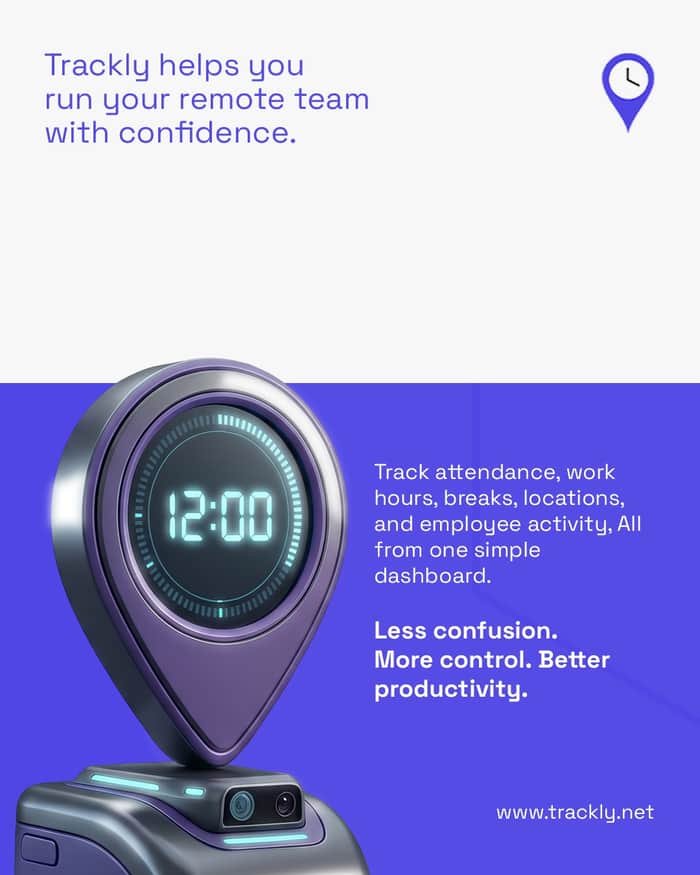
To fix this, I started using Trackly for my team. It provides simple, GPS-verified check-ins for easy attendance and a shared dashboard that both sides can see. It completely removed the guessing game, and my team doesn't feel like they are being watched in secret.
If you manage a remote or hybrid team, how do you handle daily updates and attendance? Do you use a tool like this, or do you just trust everyone blindly?

The "daily updates backfiring" problem is so common and you nailed the root cause — it's ambiguity not laziness. The moment you make people feel watched they either check out or start gaming the system with fake updates. Shared visibility that both sides can see is exactly the right solution because it removes the power dynamic. I'm curious — did your team's actual output change after switching to Trackly or did it mostly just reduce your anxiety as a manager?
Thank you! You are so right about the power dynamic. To answer your question, it did both! It definitely reduced my anxiety as a manager. But at the same time, because the team felt trusted, they worked better and our actual output also increased. It's a win-win.
That win-win outcome makes total sense —
trust is actually a performance multiplier.
When people feel watched they spend energy
managing perception instead of doing actual
work. Good luck with the growth — sounds
like you've found the right balance.
I completely agree. When a team spends their energy managing perception rather than focusing on actual work, everyone loses. Trust really changes the entire dynamic and lets people focus on what matters.
Thanks for the support!
If you are facing similar challenges or are interested in checking out how we set this up, I'd love to connect. Are you open to sharing your LinkedIn profile so we can stay in touch?
Completely agree — perception management
is such a productivity killer.
I don't have LinkedIn yet but I'm
on Indie Hackers. Would love to
stay connected here — feel free
to follow my profile!
Also building something in the
agency space if you're ever curious
to chat about that.
ok that's great. Let's stay connected on Indie hackers.
Absolutely! Following you now.
Looking forward to seeing what
you build next 🙏
That's Amazing!
Thank you! 🙌 Appreciate you saying that.
This nails it. In a remote setup the bottleneck is rarely remote vs in-office, it's visibility, and honestly the fear we have of visibility too. The default is that to know what's happening someone has to interrupt someone, and the info comes back biased. What fixes it isn't attendance tracking, it's making visibility a byproduct of the work: progress measured by what's actually completed, tied to the objectives it's meant to move. To answer your question directly, I'd trust outcomes over hours every time.
Working across borders I noticed how easily people default to being relational instead of pragmatic. A culture of delivery, and recognition based on delivery, gives the company a different bar, and honestly a fairer environment for people too, since it rewards outcomes, not who's online the longest.
After 12 years in the market I ended up building a tool called PeopleSighted for exactly this angle (visibility from the work, not surveillance), that helps remote teams connect people, objectives and initiatives in one place.
Daily standups are often more about manager anxiety than team productivity. The real question is: did you replace them with async updates or just remove the overhead? I've found that dropping the status ritual forces better documentation habits, which is harder but more valuable long term.
You’re right that daily standups often end up solving manager anxiety more than productivity problems. We didn’t remove visibility altogether; we replaced it with asynchronous updates and a shared source of truth.
What changed was that updates became tied to actual work progress instead of a ritual everyone had to perform at the same time. Interestingly, that also pushed us toward better documentation habits because information had to be captured in a way everyone could access later, not just mentioned in a meeting.
For us, the goal wasn’t reducing accountability, but reducing unnecessary interruptions while still keeping progress visible across the team.
This is an interesting problem, but I think the wording matters a lot here.
Daily updates can easily turn into busywork, and tracking can easily feel like surveillance if the team doesn’t understand the purpose.
What I’ve seen work better is focusing on clarity instead of control: what changed, what’s blocked, and what needs attention.
For remote teams, the goal shouldn’t be proving people are online. It should be making progress visible without making good people feel watched.
Curious how your team reacted when you moved from daily written updates to Trackly — did it feel lighter for them, or did it take time to build trust around it?
That makes sense. I like the distinction between transparency and surveillance.
When the team can see the same information, it feels less like being monitored and more like everyone has shared context.
I think that’s the key: the tool should reduce uncertainty for both sides, not make people feel like they’re constantly being checked.
Sounds like the adjustment period was worth it once the purpose became clear.
I completely agree that wording and intent make all the difference. The problem with many tracking systems is that they unintentionally communicate control instead of clarity.
The biggest change for our team was that attendance and visibility stopped feeling subjective or dependent on constant check-ins. Instead of asking people to repeatedly prove they were working, we created a shared view of attendance and progress that everyone could access.
There was a short adjustment period, naturally, but once the team realized the purpose was transparency rather than surveillance, it actually felt lighter than the daily written updates we were doing before.
I think you've highlighted an important balance. Most people don't mind sharing progress, but they don't want to feel like every minute is being monitored. I'm curious, how did your team respond when you switched from written updates to Trackly? Did adoption happen naturally, or was there some initial resistance?
Honestly, there was some initial resistance, which is totally natural. When people hear "GPS check-ins," they immediately worry about micromanagement.
We smoothed adoption over by focusing on two things:
The Trade-off: We explained that this completely replaces the hassle of writing daily status updates.
Full Transparency: The dashboard is two-way. Employees see exactly what managers see, so nothing is hidden.
Once the team realized it respected their flexible hours and stopped the constant tracking, the friction disappeared. Within two weeks, it just became a normal part of their routine.
The “daily updates backfiring” part hits home — most teams aren’t lazy, they’re operating in a fog. Forced checklists just create performative work where people learn to write good updates instead of do good work.
I really like that you framed this as solving ambiguity rather than “catching slackers.” Shared dashboards with GPS check‑ins feel way healthier than shadow monitoring. Curious: after switching to Trackly, did you notice any change in actual throughput, or was the big win mostly in trust and reduced management anxiety?
Thank you! That is a great question. After using Trackly, the biggest win was definitely better trust and less anxiety. But because the team felt more trusted, their actual work and output also became much better. Transparency really helps everyone!
I like that the problem you're solving isn't attendance—it's uncertainty.
The interesting balance is giving managers enough visibility to coordinate work without making high-performing employees feel like they're constantly proving they're working. That's a much harder product problem than simply tracking check-ins.
You explained it perfectly. Balancing visibility and trust is the hardest part. We don't want good employees to feel stressed or feel like they always have to prove themselves. Trackly is built exactly to fix this uncertainty and bring peace of mind to both sides!
This is exactly the tension I hear about constantly from other founders and managers, laziness is rarely the real issue, ambiguity is. The daily-checklist trap you describe is so common too, it looks like accountability but it usually just measures who's good at writing updates, not who's actually getting things done.
Glad the GPS check-ins and shared dashboard removed that guessing game for your team. That "both sides can see it" part is the piece most tools miss, they build for the manager's view only and wonder why employees resent it.
Thank you so much! You are completely right. Daily checklists can be tricky because they don't show real work. That's where Trackly help both managers and teams to see everything clearly and trust each other. I'm really glad you liked that part.
This comment was deleted 3 months ago