I Stopped Building Apps and Built the Infrastructure Instead
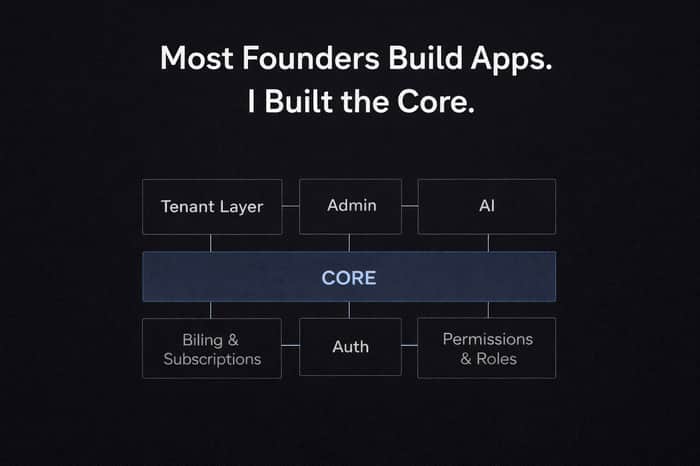
For years, every time I started a new SaaS idea, I rebuilt the same foundation. Authentication, user management, roles and permissions, billing, subscriptions, admin panels, multi-tenant architecture. The product on the surface changed, but the underlying structure was always the same.
After repeating this cycle enough times, I stopped thinking about the next feature set and started thinking about the repeated layer underneath every product. Instead of launching yet another standalone application, I focused on refining the core infrastructure that powers them.
What emerged is not a single SaaS product, but a production-ready infrastructure layer that already handles the operational complexity most founders spend months building before they can even test their idea. When someone wants to build on top of it, they don’t start from zero. The foundation is already in place. The focus shifts from rebuilding technical basics to defining the product logic, positioning, and business model.
This approach changes the economics of launching software. Time to market decreases. Technical debt is reduced. Strategic flexibility increases. Instead of betting everything on one product, you create a system capable of supporting multiple products.
The challenge, however, is that infrastructure is invisible. End users do not buy architecture; they buy solutions to their problems. That creates a strategic question: do you use the infrastructure to launch vertical products yourself, do you partner with founders who want to focus on distribution rather than backend complexity, or do you position the core itself as the primary asset?
I didn’t build another app.
I built the layer underneath all of them.
Now the question is simple:
Would you build on top of it, or would you build it again from scratch?

This resonates. rebuilding the same plumbing over and over is exhausting, and having a solid foundation lets you focus on what actually differentiates the product instead of auth and billing for the tenth time
Exactly. The hidden cost isn’t writing the code once - it’s rewriting it every time you start something new. A solid foundation changes what you spend your energy on.
the invisible infrastructure problem is real — you can't sell architecture, you sell what it enables. but i think there's a third path beyond 'launch vertical products yourself' or 'partner with founders': use it as a moat while you figure out which vertical actually has demand. the infrastructure gives you the luxury of testing multiple ideas fast without rebuilding from scratch every time.
have you already launched anything on top of it or still deciding what to build first?
It already powers multiple vertical experiments. The real advantage isn’t just reuse -it’s the ability to test ideas without touching auth, billing, or tenant logic again. Now it’s about deciding which vertical deserves full focus.
that's exactly the advantage. skipping the rebuild tax every time you test something new. sounds like you're at the interesting stage now where the infrastructure is proven and the real question is just which vertical has the most pull. are you letting demand guide that decision or going with your gut on which one to focus on
Demand leads.
The infrastructure removes technical friction, but it doesn’t replace market validation. I track early revenue velocity, acquisition cost, and retention signals across experiments. The vertical that shows repeatable pull without requiring structural changes gets the focus. The core creates optionality.
Market traction decides direction.