I stopped building Visario like a chatbot. Here’s what changed after early feedback
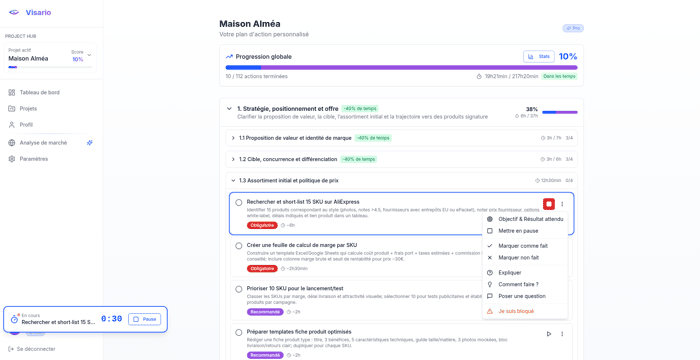
A few days ago, I shared my first post here about Visario. For context, Visario is an AI execution mentor that helps people turn an idea into a clear action plan, then guides them step by step when they get stuck or do not know what to do next.
When I started building it, I thought the main goal was to create a better AI assistant for projects. Something more structured than a generic chatbot, but still close to the way most AI tools work today: you ask a question, the AI gives you an answer, and you use that answer to move forward.
After working on the product and thinking more about how people actually start projects, I realized that this was not enough. The real problem is not that people lack access to AI or information. The real problem is that they often do not know what to do next, especially when the project is still messy, unclear, or intimidating.
Most AI tools are still centered around conversation. You open the tool, write a prompt, get a response, and then you still have to decide what to do with it. That last part is where many projects slow down or disappear completely. The user has ideas, notes, answers, and maybe even motivation, but there is still too much friction between “I want to build this” and “I know exactly what I need to do now”.
That changed the way I think about Visario. At first, I was building it like a powerful AI assistant with project features around it. Now I am trying to build it the other way around: the plan is the core product, and the AI supports the execution of that plan.
The chat should not be the center of the experience. The plan should be.
The user should always know where they are, what they are working on, what comes next, and why it matters. This is why I am now focusing much more on the “next action” logic inside Visario. Instead of giving users a long list of possible things to do, I want Visario to give one clear action at the right moment.
For example, if someone wants to launch a SaaS, Visario should not only generate a big plan with many steps. It should also be able to say: “Write one sentence that explains the main problem your product solves.” Then, once that is done, it can guide the user toward the next useful action, like talking to potential users, creating a simple landing page, or defining the first version of the product.
The goal is to reduce mental load as much as possible. I do not want users to open Visario and wonder what they should do now. I want them to open it and immediately understand the next step.
This also changed how I prioritize features. In the beginning, I wanted the product to feel complete. I was thinking about more pages, more automations, more settings, more advanced AI behavior, and a better interface. All of those things can be useful, but when you are building alone, they can also become a trap. You can spend weeks improving the product without actually making it more useful for the user.
So now I use a much simpler filter: does this help the user move forward?
If a feature does not make the next step clearer, it can wait. If a design improvement does not reduce confusion, it can wait. If an idea does not help the user make progress on a real project, it can wait.
This is probably one of the biggest lessons I have learned so far while building Visario. A product does not become valuable because it has many features. It becomes valuable when it helps someone get a real result.
For Visario, that result is progress. Not just a nice AI answer, and not just a generated plan, but actual progress on a real project.
That is why I am now trying to build Visario less like a chatbot and more like an execution system. The user brings the idea, Visario helps turn it into a structured plan, then it keeps helping the user move through that plan step by step, especially when things become unclear.
The more I work on this, the more I think the real competitor is not another AI tool. The real competitor is abandonment: the project people keep thinking about but never start, the idea they save in a note and forget, the product they want to build but keep postponing, or the business they imagine for months without taking the first concrete step.
That is the problem I want Visario to solve.
I do not know yet how far this product will go, but I am more convinced than before that people do not only need more information. They need clarity, structure, and a system that helps them take action.
I will keep sharing the journey here. I would love to get your thoughts, especially if you have built productivity, AI, or project management tools before: what do you think helps users move forward the most? A better plan, a better interface, reminders, accountability, or one very clear next action at every step?
You can try Visario here: visario.fr
Free trial, no credit card required.

This direction feels much sharper than the earlier “AI assistant for projects” framing.
The real problem you’re describing is not lack of information. It is the gap between having an idea and knowing the next concrete action. That makes Visario more interesting as an execution system than as a chatbot. The plan should be the center, and the AI should support movement through the plan.
I’d also keep pressure-testing the naming/domain side while it is still early. Visario is not bad, but if this becomes a global product for solo founders, visario.fr can quietly make the product feel more local than the problem actually is. That is why I still think Beryxa.com is a strong comparison point: broader SaaS feel, serious enough for execution/clarity, and not tied to France or a planning-app frame.
Also sent you a quick LinkedIn note on this earlier, worth checking when you get a moment.