I Stopped Checking Revenue Every Day. Here's What Happened to the Business
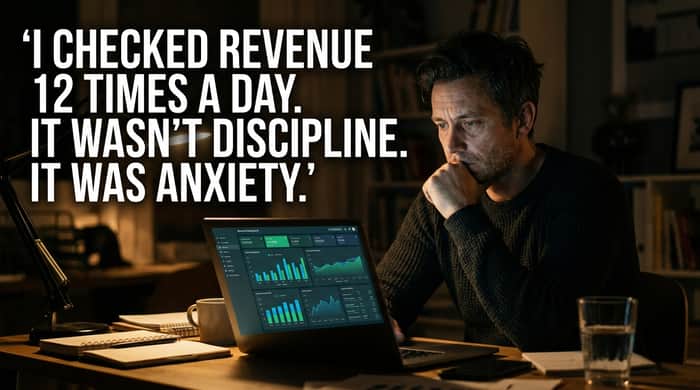
For the first eighteen months of running Exact Solution, I checked our revenue dashboard before I checked anything else in the morning. Before email. Before messages. Before coffee.
Some days I checked it six or seven times before noon. Not because the numbers changed that fast — in a physical products business they don't. But because the act of checking felt like doing something. It felt like staying on top of things. It felt like control.
It was none of those things.
What Daily Revenue Checking Actually Is
Most founders assume they check revenue obsessively because they need the information. But the checking is rarely about information — it's about anxiety. The refresh is a soothing behaviour, not a productive one.
I didn't want to believe that when I first read it. I told myself I was data-driven. That staying close to the numbers was good practice. That knowing our daily revenue made me a better operator.
Then I asked myself a harder question: what decision had I ever made differently because of what I saw on a Tuesday morning revenue check that I wouldn't have made on the weekly review anyway?
The honest answer was almost none. Daily revenue in a refurbished electronics business is noisy. A good day followed by a slow day followed by a good day tells you almost nothing meaningful. The signal is in the weekly trend. The weekly trend is in the monthly pattern. The daily number is noise dressed up as information.
I was spending twenty minutes a day — sometimes more — consuming noise and calling it management.
The Experiment
I decided to stop checking daily revenue for thirty days. Not as a productivity hack. More as an experiment in what I actually needed to know versus what I was using to manage anxiety.
The rules were simple:
No daily revenue dashboard
Weekly review every Monday morning — full numbers, trends, unit economics
Daily operational metrics only — orders processed, returns initiated, inventory levels, customer service tickets open
The operational metrics stayed daily because they're actionable. If returns spike on a Tuesday, something happened on Monday that I need to investigate. If customer service tickets double overnight, something is wrong that needs fixing today. Those are leading indicators that connect directly to decisions I can make in real time.
Revenue is a lagging indicator. It tells you what already happened. Checking it daily in a business with a weekly sales cycle is the equivalent of checking your bank balance every hour to see if you're getting richer.
What Actually Happened
Week one was uncomfortable.
Not because anything went wrong. Because I had removed a habitual coping mechanism without replacing it with anything. The urge to check was persistent. I caught myself opening the tab twice in the first three days and closing it without looking.
By day five the urge was quieter. By day ten I'd stopped noticing it.
Week two I started noticing something else.
The mental space that had been occupied by revenue refreshing was filling up with something more useful — thinking about the business rather than watching the business. I spent time that week rewriting four product listing descriptions that had been on my to-do list for two months. Those listings had a measurably higher conversion rate the following week.
I'm not claiming causation. But the time came from somewhere.
Week three the Monday review changed character.
When you check revenue every day, the weekly review becomes a formality. You already know the rough shape of the week. There's nothing to discover.
When you haven't looked all week, the Monday review becomes genuinely informative. You're seeing the full week's pattern for the first time. You notice things you wouldn't notice if you'd been watching the number move incrementally. That week I noticed our Saturday conversion rate was significantly below our weekday average — something I'd never spotted because I'd been looking at daily snapshots, not weekly patterns.
We tested a small change to our Saturday listing strategy. Conversion rate improved 18% the following Saturday. The startups that succeed are not those that chase every metric but those that focus on the right ones — understanding that growth without efficiency is fragile. I'd been tracking the wrong frequency of the right metric.
Week four I had the clearest head I'd had since launching.
Not because the business was doing better or worse. Because I'd stopped creating low-grade cognitive noise for myself twelve times a day.
What I Track Now — and When
After the thirty-day experiment I built a new rhythm that I've kept for eight months:
Daily — operational only:
Orders processed vs orders pending
Returns initiated in last 24 hours
Customer service tickets open and unresolved
Inventory below reorder threshold
These are actionable. Each one connects to a decision I can make today.
Weekly — Monday morning, 45 minutes:
Revenue vs previous week and 4-week average
Conversion rate by product category
Average order value trend
Return rate by product grade
DIO (Days Inventory Outstanding)
Top 3 performing listings and bottom 3
This is where strategy lives. One focused hour beats seven scattered check-ins every time.
Monthly — first working day:
Full P&L
Cash position and 60-day forward model
Confirmed revenue vs gross revenue
Customer acquisition by channel
Review of the previous month's Monday metrics for patterns
The monthly review is where I make structural decisions — pricing changes, inventory strategy adjustments, category expansions.
The Thing Nobody Tells You About Metric Obsession
Many founders secretly believe the next milestone will finally bring peace. The revenue check is a proxy for that belief — if the number is good, everything is okay; if it's bad, everything is at risk.
The problem is the number is always either good or bad. And when it's good, the relief lasts about four minutes before the next check. When it's bad, you've given yourself a bad start to a day that might have been fine operationally.
Neither outcome serves the business. Both outcomes serve anxiety.
The metric that actually tells me whether Exact Solution is healthy isn't daily revenue. It's the 4-week rolling average conversion rate. It moves slowly, it's hard to distort, and it reflects the genuine quality of our listings, our grading, and our customer experience — the things we can actually control.
Daily revenue tells me what happened. The 4-week conversion rate tells me what's coming.
What I'd Tell Founders Who Check Revenue Obsessively
You're not being disciplined. You're managing anxiety with a dashboard.
The check feels productive because numbers feel like information and information feels like control. But daily revenue in most businesses is noise. The signal is in the trend. The trend requires a week of data at minimum to be meaningful.
Build a review rhythm that matches the actual decision-making cadence of your business. Ask yourself: what is the fastest I could meaningfully act on this number? If the answer is "not today" — stop checking it today.
The business won't deteriorate in the 24 hours you're not watching the revenue number. But your thinking might improve considerably.
Exact Solution sells professionally refurbished MacBooks, iPhones, and laptops across the UK, Poland, and Europe — tested, graded, warranty backed.
https://www.exactsolution.com/collections/laptops
