I stopped treating my AI tools site like a blog. That’s when things changed.
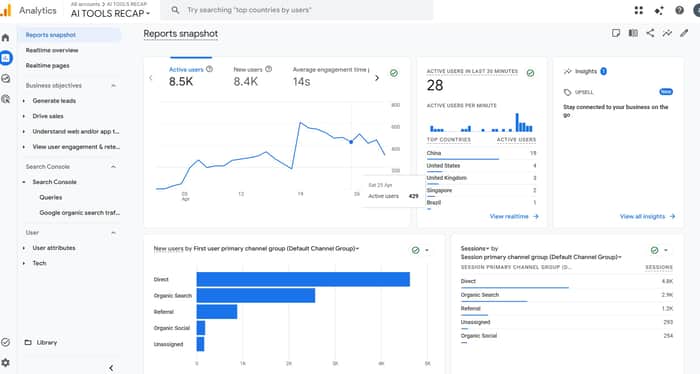
I crossed 8.5K users in ~1 month building an AI tools discovery platform
Interesting thing I noticed while building AIToolsRecap over the last ~1.5 months.
The project now has:
- 8.5K users
- ~812K Google impressions in 28 days
- Rankings across hundreds of AI-related queries
- Recurring “X vs Y” comparison searches
- 4–5 organic signups/day
- Real users submitting reviews without paid ads
What surprised me most:
Google AI Overview recently started describing the project as a “community-driven platform” instead of simply listing pages.
That made me realize AI search feels very different from traditional SEO.
I’ve basically spent the last month:
- Publishing AI tool comparisons
- Tracking GSC hourly
- Analyzing user flows
- Studying comparison intent
- Improving CTR/title structures
- Building topical clusters around AI tools
- Growing Reddit/community discussions
And the pattern I keep seeing is:
AI search seems to reward:
- Topical consistency
- Active ecosystems
- Comparison intent
- Ongoing discussion/activity
- Recognizable entities
- Real user interaction
more than just “publishing content.”
The interesting part is that clicks are still relatively low compared to impressions because AI Overviews absorb a lot of informational traffic.
But semantic visibility keeps expanding rapidly.
Makes me think the future moat may not be:
“Who publishes the most.”
But:
“Who becomes the decision layer when users compare AI tools.”
Still very early, but fascinating to watch in real time.

Hi Pat, I came across your post about AIToolsRecap and how you grew it to 8.5K users. Great work.
I recently launched X-Trend, an AI writing assistant Chrome extension for creators, freelancers, and small businesses. It helps users create captions, rewrite content for different platforms, generate hashtags, reply to reviews, fix email tone, and draft proposals.
Would love for you to review it or consider it for AIToolsRecap if it fits your criteria.
Website link is in my profile.
hey — already got you covered! saw your IH post earlier and went ahead and listed X-Trend:
🔗 Product page: aitoolsrecap.com/Product/x-trend
⭐ User review already live on the product page too
new tools typically appear on Google within 24h — will share a screenshot once indexed.
a bit of context on the platform:
• 2M Google impressions since we launched March 18
• ChatGPT citing us 200+ times
• Microsoft Copilot citing us 34 times
• MSN syndicates our AI news as a trusted source
• 70K+ daily impressions on Google alone
if you want to boost X-Trend’s visibility further, we have paid placement options available — featured homepage spotlight, category top slot, do-follow backlink + email blast to 300+ active reviewers, 7-day priority boost, and article publication.
you can either:
💬 reach out via our contact form: aitoolsrecap.com/contact
📧 email us directly: aitoolsrecap@gmail.com
🔐 or create an account and manage your listing yourself: aitoolsrecap.com/register
no pressure at all — the listing is yours regardless.
cheers
Hitting 812K impressions in a month is seriously impressive! Your insight about AI Overviews rewarding "active ecosystems" over static SEO content is a massive shift in how we need to think about growth. It totally makes sense that becoming the trusted "decision layer" is the ultimate moat now. Since AI is eating up those top-of-funnel clicks, what specific feature or hook is converting your visitors into actual daily signups?
Honestly, still figuring that part out in real time 😅
But one pattern I’m noticing is that comparison intent converts much better than pure informational traffic.
Pages like:
seem to attract users who are already trying to make a decision, not just browse.
Another thing helping a bit:
the platform feels active.
New reviews, comparisons, updates, rankings, discussions — even at a small scale — create trust that the ecosystem is alive.
I also started nudging users after signup instead of waiting passively, and surprisingly some users return and actually submit reviews.
So right now the “hook” is less a single feature and more:
high-intent comparison traffic + visible ecosystem activity + continuous iteration.
Still early though. I think the real challenge now is converting semantic visibility into a recognizable brand people intentionally come back to.
It’s smart that you’re leaning into comparison intent since that’s basically the "final boss" of conversion. Seeing live reviews and nudges makes the site feel like a bustling workshop rather than a static library, which is a huge trust builder. Moving from a helpful search result to a "must-visit" brand is definitely the next big mountain to climb. Are you thinking of adding any specific community features to make that brand loyalty stick even more?
That “bustling workshop vs static library” framing is actually a great way to describe the shift I’m trying to create.
Right now I’m thinking less about “social features” in the traditional sense and more about creating continuous participation loops around AI tools.
Things I’m experimenting with:
I think AI search changes user behavior a bit too.
People don’t necessarily want endless feeds/community noise anymore — they want faster confidence when making decisions.
So the challenge becomes:
how do you make the platform feel alive and trustworthy without overwhelming users?
Still figuring that balance out in real time 😅
I agree. People want faster and more reliable information when making decisions. While RAG is becoming more stable, wouldn't results based on actual 'human' user data and unbiased be more trustworthy?
Yeah, I think that’s where things get really interesting.
RAG improves retrieval, but if the underlying ecosystem is biased, outdated, or artificially generated, the answers still feel “thin.”
That’s partly why I think community-driven decision layers may become more important in AI search over time.
Not endless social feeds — just enough real human interaction to create confidence behind the answers.
I fully agree with your point. Our team has also developed a product to address these issues. Although there are still areas for improvement, we would appreciate your candid feedback with a keen eye.
I will also provide feedback on your project. bunzee.ai or (https://www.indiehackers.com/post/roast-my-ui-ux-my-app-is-beautiful-but-got-only-8-upvotes-on-ph-why-bef9cc88a8)
Appreciate that 🙏
I’ll take a proper look through Bunzee and share honest feedback after exploring it a bit more.
And honestly, Bunzee probably fits well on AIToolsRecap too since I’m building out the comparison/review ecosystem around AI products actively being used and discussed by founders.
Would be happy to feature/list it there as well while the platform is still growing organically.
Thank you for readily agreeing to meet with me. With so many AI agent products flooding the market, I’ve been looking forward to connecting with someone who shares the same concerns and values as our team. By the way, when are you planning to launch your project? I'd love to keep an eye out for it!
Really appreciate that 🙏
And honestly, I think a lot of builders are starting to feel the same thing right now — there’s an overwhelming amount of AI products appearing, but trust and clarity are becoming the harder problem.
That’s a big part of why I started building AIToolsRecap the way I did:
less “content for algorithms,” more helping people evaluate tools with confidence.
The platform is already live and still evolving pretty rapidly:
https://aitoolsrecap.com
A lot of the interesting parts (comparisons, reviews, community signals, decision layers) are still being refined in real time 😅
Definitely looking forward to exploring Bunzee more deeply as well.