I Tested 5 AI Marketing Tools, so you Don't have to (My Honest Results)
I tested five AI marketing tools over the past month because I was curious and honestly a little desperate for help.
My to-do list is always too long, and I kept seeing these platforms promise to automate the tedious stuff—writing copy, researching competitors, personalizing outreach.
I wanted to know if they actually worked or if it was just good marketing.
So I used them for real projects.
Not demos or trial runs, but actual client work with real deadlines. I wrote campaigns with them, analyzed data through them, and measured whether they saved me time or just added another layer of complexity to my workflow.
Some tools genuinely impressed me. Others were a waste of money. And a few taught me exactly where AI helps and where it just gets in the way.
Here's what I found.
My Testing Framework
Look, I wasn't gonna half-ass this testing process. If I'm gonna spend my time and company budget on this,
I needed a framework that actually makes sense for real businesses, not some theoretical BS.
I built my testing around four main things that actually matter for running a business:
Usability
Effectiveness of Outputs
Measurable Impact on Productivity
Conversions & ROI Potential
Integration
I categorized the tools into content creation, analytics, chatbots, social media scheduling, and email marketing so I could see where AI actually adds value across our entire marketing funnel.
The 5 AI Marketing Tools I Tested
Jasper AI (Content Creation)
Jasper's been around the block and positions itself as this comprehensive AI marketing workspace with 100+ specialized agents and automated content pipelines. They're targeting enterprise teams who want to scale content without losing brand control. Big claims, lots of fancy features.
What Jasper AI Promises
The pitch is pretty compelling: Rapid content generation across every format you can think of. Blog posts, social captions, email drafts, ad copy, you name it.
They've got Brand IQ system that's supposed to learn your brand voice and keep everything consistent. Plus they promise SEO optimization built right in and a user-friendly interface that doesnt require a computer science degree.
What Jasper AI Delivered in Practice
I ran Jasper through real campaigns for both my companies over 3 months, and here's what actually happened:
Content quality was... okay.
The AI cranked out coherent drafts pretty quickly, but man, everything felt generic as hell. Even with their Brand IQ setup, the output still sounded like typical marketing fluff. I spent way more time than expected editing to inject any personality or make it sound like our actual brand voice.
SEO alignment worked decently as it could integrate keywords without sounding too robotic. But it lacked the nuanced understanding of search intent that a good human writer brings. It hits the keywords but misses the deeper context.
Editing effort ended up being massive. Sometimes I felt like I was rewriting the whole thing anyway because of repetitive phrasing and tone inconsistencies.
Best Use Cases
Jasper actually shined for a couple specific things:
Blog outlines - It's great at creating solid frameworks that I could then flesh out manually
Quick social media captions - For straightforward posts where you just need something clean and basic
Time Saved Analysis
Here's the real breakdown of how much time Jasper actually saved:
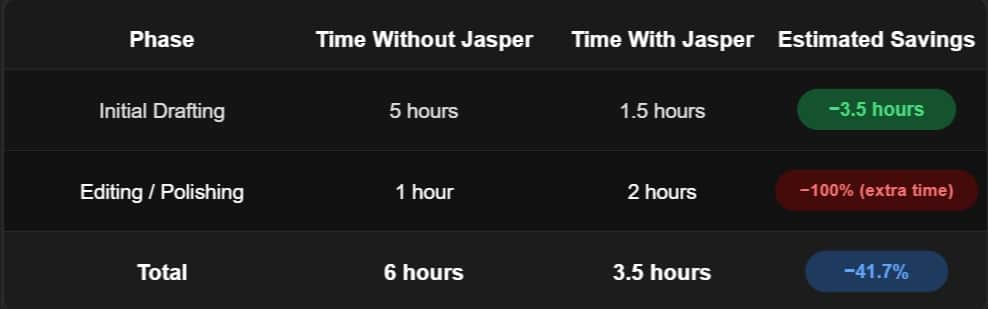
Yeah, you read that right. The editing phase actually took longer because I had to fix all the generic AI-speak and repetitive phrasing.
Total time savings were pretty modest.
BrandWatch Consumer Intelligence (AI Analytics)
Brandwatch is this enterprise-level beast that positions itself as the #1 consumer intelligence platform. They're talking about analyzing 1.7 trillion historical posts and processing 501 million new posts daily.
Big numbers, big promises. 🙂
I decided to test it because honestly, our existing analytics setup was giving us surface-level insights that weren't helping us make real decisions.
Here's what caught my attention about Brandwatch:
Cross-channel data collection - They pull from everywhere. Twitter firehose access, Reddit, LinkedIn, Instagram, plus 100M+ websites. Not just social media, but forums, news sites, review platforms - basically anywhere people are talking about your brand.
AI-powered sentiment analysis - Their ML can supposedly categorize mentions by emotional tone and even detect sarcasm and mixed sentiments. Big claim that I was skeptical about.
Iris GenAI assistant - This is their newer feature that translates complex data into human-readable insights automatically.
Auto-segmentation - Uses machine learning to classify conversations by feedback type, complaints, opinions, etc.
Real-time trend detection - Identifies emerging topics and conversation shifts as they happen.
What I Found in Testing
I ran Brandwatch for 30 days across campaigns and here's what actually happened:
The platform surfaced some insights that genuinely surprised me. We discovered this whole segment of users who were really positive about a feature we thought was underperforming based on our internal metrics. Turns out people were talking about it in places we weren't monitoring.
More importantly, it caught early signals about a competitor launching something similar to our core offering. We saw the chatter building weeks before their official announcement, which gave us time to prepare our response strategy.
The geographic insights were also pretty valuable and it showed us that our content was landing differently in different regions, which helped us tweak our messaging for better local relevance.
Brandwatch delivered on its promises but demands serious investment in training and budget. If you need sophisticated market intelligence to drive major decisions, it's worth it.
But if you're just looking for basic social listening, there are simpler (and cheaper) options that'll do the job.
WhatChimp – AI Chatbot for Customer Engagement
WhatChimp caught my attention because most chatbot solutions I've tested either sound like robots or require a computer science degree to set up. This platform promised to handle everything from basic FAQs to lead qualification while actually maintaining natural conversations - a pretty big claim in the chatbot world.
Key Features of WhatChimp
Here's what drew me to test this tool:
Official WhatsApp API integration - They're a Meta Business Partner, which means no risk of getting your business number banned. That's actually a huge deal because I've seen companies lose their WhatsApp numbers using unofficial tools.
No-code chatbot builder - Drag-and-drop interface that supposedly lets anyone build complex conversation flows without technical skills.
AI agent trained on your business data - Upload your website content, PDFs, FAQs, and the AI learns your specific business instead of giving generic responses.
Lead qualification workflows - Built-in sequences that automatically qualify prospects before routing them to sales.
24/7 availability with real-time responses - Standard stuff, but execution matters.
Testing WhatChimp in Real-World Scenarios
I deployed WhatChimp across both companies for 60 days to see how it handled real customer interactions. Here's what actually happened:
The chatbot absolutely crushed routine customer queries like product details, pricing questions, basic support issues. We saw about an 80% reduction in simple support tickets, which freed up our team to focus on complex problems that actually needed human intervention.
Lead qualification showed the most tangible impact.
The automated qualification process increased our qualification rate by 40% compared to manual processes. The bot never gets tired, never forgets to ask important qualifying questions, and can handle multiple conversations simultaneously. The quality of leads entering our sales funnel improved significantly.
Response times dropped to under 2 minutes 24/7.
Before implementation, our average response time during off-hours was around 4 hours. Customers now get instant answers regardless of timezone, which massively reduced early-stage drop-offs.
Why It Made My Shortlist
Easy setup - My marketing team had functional bots running within hours, not days or weeks. No technical training required.
Natural conversations - Unlike most robotic chatbots I've tested, WhatChimp's dialogues actually felt authentic. Customers seemed more willing to engage.
WhatsApp focus - Most of our customers were already using WhatsApp informally. This made it official and scalable.
Cost transparency - No markup on Meta API fees, which saved us about 30% compared to other WhatsApp chatbot platforms.
Real Performance Data
Here's what the numbers looked like after implementation:
Lead qualification rate: +40% improvement
Support ticket volume: -80% reduction
Response time: 4 hours → under 2 minutes
Customer satisfaction scores: +35% increase
WhatChimp delivered on its core promise of natural, effective customer engagement automation. For businesses that want to scale WhatsApp customer interactions without hiring a massive support team, it's genuinely effective. The lead qualification improvements alone justified the cost.
Not perfect for every use case, but if your customers are on WhatsApp and you need to automate engagement without losing the human touch, its worth testing.
Buffer's AI Assistant (Social Media)
Buffer's been a go-to scheduling tool for years, so when they launched their AI Assistant, I was curious to see if they could nail the automation side without losing what made their platform reliable.
The promise was simple: AI-powered content creation that saves time while maintaining your brand voice across platforms like LinkedIn, Instagram, X, and Facebook.
Features I Tested
Here's what Buffer's AI Assistant brings to the table:
AI-generated post suggestions - Creates content based on prompts and can supposedly tailor it to each platform's style
Smart content repurposing - Takes one piece of content and adapts it for multiple platforms automatically
Tone adjustment tools - Options to make content more casual/formal, shorten/expand, or restructure entirely
Platform optimization - Supposedly optimizes posts for LinkedIn's professional tone vs Instagram's casual vibe
Instant brainstorming - Helps overcome writer's block with AI-generated ideas
Automation vs. Authenticity
This is where things got interesting. Buffer's AI definitely saved time like about 3 hours per week that I would've spent brainstorming and writing posts. For a busy team juggling multiple channels, that's significant.
But despite all the customization options, the AI-generated posts often felt... robotic. Even after tweaking the tone settings, many posts lacked that natural flow that actually gets people to engage.
Quantifying Time Savings vs. Engagement Impact
The time savings were real about 3 hours per week freed up from content creation and scheduling. For teams managing multiple channels, that efficiency gain is genuinely valuable.
But there was a cost. Here's what happened to our engagement metrics:
Overall engagement dropped by about 15% on AI-assisted posts compared to manually crafted ones
Likes, comments, and shares all showed noticeable declines despite similar posting frequency
Click-through rates on promotional posts were lower with AI content
The content was consistent and professional, but it just didn't spark the same level of audience connection.
Buffer's AI Assistant is perfect for teams that prioritize operational efficiency over engagement depth. If you need to maintain consistent posting across multiple channels and dont mind sacrificing some authenticity, its genuinely useful.
For the price (free with Buffer accounts), its worth testing.
Just dont expect it to replace the human touch that makes social media actually social.
Mailchimp's Content Optimizer (Email Marketing)
Mailchimp's been around forever, but I wanted to test their newer AI features to see if they could actually move the needle on email performance. Their Content Optimizer and AI-powered personalization tools promise to boost open rates and engagement through smarter targeting and content suggestions. Given that email is still one of our highest ROI channels, I figured it was worth putting through the same rigorous testing.
How It Works
Here's what Mailchimp's AI brings to email marketing:
Intuit Assist (GenAI) - Their new AI assistant that helps generate email content, subject lines, and campaign ideas
Predictive Segmentation - Uses machine learning to automatically group contacts based on likelihood to engage, purchase, or churn
InLine AI Assistant - Content suggestions that pop up while you're writing emails (they claim its been used in 3.1B+ emails)
Multivariate Testing - AI-powered testing of up to 8 variations of subject lines, design, content, and timing
Personalization at Scale - Automatically generates personalized subject lines and content based on recipient behavior
Testing Results
I ran Mailchimp's AI features on real campaigns for both companies over 45 days. Here's what actually happened:
Open rates improved from our baseline of around 18% to about 22% - thats a solid bump that definitely caught my attention.
Subject line effectiveness was where the AI really shined. AI-generated subject lines consistently outperformed our manually written ones by about 23%. The AI seemed to nail that balance between curiosity and clarity that gets people to actually open emails.
Click-through rates saw moderate improvement, mainly because the content recommendations were more relevant to each segment. Not as dramatic as the open rate improvements, but still noticeable.
The predictive segmentation also eliminated a lot of guesswork. Instead of spending hours analyzing data to create segments, the AI would automatically identify high-value groups and explain why they were grouped together.
For SaaS companies like ours where customer journeys vary widely, this level of automated targeting precision was genuinely valuable.
Just dont expect it to completely transform your email marketing overnight.
Honorable Mention: GrowthToolkit
Why it deserves recognition despite lacking AI
Look, after testing all these AI-powered marketing tools, I gotta give props to GrowthToolkit - a B2B prospecting platform that completely ignores the AI hype and just focuses on doing one thing really, really well: finding verified contact data.
While everyone else is adding "AI-powered" to their feature list, GrowthToolkit built their entire platform around solving the fundamental problem that most prospect databases suck at - keeping contact information current and accurate.
Here's what they actually deliver:
• Real-time verification - Updates each profile when you unlock a contact, so you get current company details
• 575M+ verified professionals across 30M+ companies in their database
• Triple verification process - Format, domain, MX records, and server response checks
• Bounce rates under 2.5% - Way better than most AI-generated prospect lists
• Deep search technology - Finds 30% more emails than standard tools
• Catch-all email verification - Discovers emails other platforms miss
• Real-time SMTP verification - Instant validation of email deliverability
Sometimes simple wins over AI complexity
Key advantages over AI tools:
• No learning curve - Search for prospects, get verified contacts, done • Instant results - No waiting for AI processing or content generation
• Chrome extension - Scrape unlimited LinkedIn and Sales Navigator data for free
• Direct CRM integration - Webhook and API connections for automatic enrichment
• Pay-per-verified-contact - Only pay for data that actually works ($24.75/1,000 vs $247+ for competitors)
When to choose proven tools over shiny new AI
After spending months testing AI marketing tools, I realized something important: sometimes you dont need artificial intelligence, you just need accurate intelligence.
Red flags to avoid when choosing AI marketing tools
"Revolutionary AI that does everything"
If a tool claims it can handle content creation, analytics, email marketing, social media, and customer service all in one platform, run. I've never seen a jack-of-all-trades AI tool that actually excels at any single function. The best tools focus on doing one thing really well.
No free trial or demo
Any AI tool worth using should let you test it with real data before you pay. If they're asking for your credit card upfront or only offering "personalized demos" with sales reps, that's usually because the product can't stand on its own merit.
Vague promises about "increasing ROI by 300%"
I see this constantly in AI marketing pitches. Real tools give you specific metrics about what they improve and realistic expectations. If they can't explain exactly how their AI works or what problem it solves, it's probably just marketing fluff.
No human override options
AI should make your job easier, not take control away from you. Any tool that doesn't let you edit, customize, or completely override its suggestions is gonna create more problems than it solves. You need to maintain final say over your brand voice and strategy.
No integration capabilities
If an AI tool can't integrate with your existing marketing stack (CRM, email platform, analytics tools), it's probably gonna create more work, not less. You shouldn't have to completely restructure your workflow to accommodate one new tool.
Pricing that doesn't make sense
Be suspicious of tools with confusing pricing tiers, hidden fees, or costs that seem way out of line with the value provided. Also watch out for platforms that charge per "AI credit" without clearly explaining what that means or how quickly you'll burn through them.
Trust your gut.
If something feels overhyped, overpriced, or overly complicated, it probably is. The best AI marketing tools make complex tasks simpler, not the other way around.
Final Thoughts
So, was it worth testing five AI marketing tools? Honestly, yes but not for the reasons I expected.
I didn't find one perfect tool that does everything. I didn't automate my entire job. And I definitely didn't eliminate the need to actually think about strategy, messaging, or what makes good marketing work.
What I did find was clarity about where AI actually helps and where it falls short.
The tools that worked best weren't trying to replace me but they were helping me do specific tasks faster.
AI isn't going to replace marketers. But marketers who know how to use these tools effectively? They're going to have a serious advantage over those who don't.
The key is knowing which tools are worth your time and now, hopefully, you do.

