I Tested Agenmatic for Finding Customers in Communities — Here’s What I Learned
Finding customers is one of the hardest parts of building a startup.
Many founders spend a lot of time building products, improving features, and creating content, but eventually they all face the same question:
Where are the people who actually need what I built?
For a while, I used a traditional approach to find customers:
Open Reddit.
Browse Hacker News.
Check Indie Hackers.
Look for people discussing problems that my product or service could solve.
This process is essentially manual community research and customer discovery.
But the problem is:
Most discussions are just conversations.
Only a small percentage of posts contain real buying signals.
For example:
“Is there a tool that can solve this problem?”
or:
“I’m looking for someone to help me with this project.”
These conversations are completely different from normal discussions.
Because these users are already showing signs of demand.
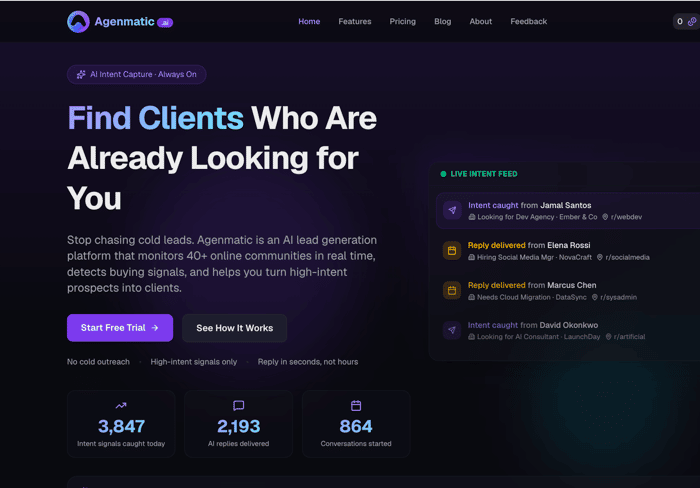
That’s why I started testing Agenmatic as an AI lead generation tool.
What Is Agenmatic?
In my opinion, Agenmatic is not a traditional CRM, and it is not just another email marketing platform.
A more accurate description would be:
An AI sales assistant + community lead discovery tool.
The core idea is simple:
Don’t spend all your time searching for random people.
Find people who are already expressing problems and actively looking for solutions.
Agenmatic monitors communities like Reddit, Hacker News, Indie Hackers, and other online discussions to help identify conversations with stronger buying intent.
Why Community Lead Generation Can Work Better Than Traditional Outreach
Many traditional B2B lead generation methods usually look like this:
Find a list → Send outreach messages → Wait for responses
The problem is:
Many people you contact may not have any immediate need.
Community-based customer discovery works differently:
Users share problems → AI detects intent → You join the conversation → Build relationships
This is why I believe AI prospecting tools can become increasingly valuable for founders and small teams.
They are not about contacting more people.
They are about finding the right people who are more likely to become customers.
How I Use Agenmatic
Step 1: Define My Target Customers
Before using any AI customer acquisition tool, the most important thing is understanding:
- Who are my ideal customers?
- What problem do I solve?
- Why would someone need my service?
For example:
- SaaS founders who need customer acquisition help
- Indie hackers looking for growth advice
- Businesses that need marketing, development, or consulting support
If your positioning is unclear, any customer discovery tool will generate a lot of irrelevant information.
Step 2: Let AI Monitor Relevant Communities
Previously, I spent a lot of time:
Searching Reddit.
Checking Hacker News.
Browsing Indie Hackers.
Looking for potential opportunities.
Now, I can let Agenmatic help monitor these communities.
The goal is not to find every post.
The goal is to find discussions that contain clear demand.
Examples:
- “Looking for a tool for...”
- “Need help with...”
- “Best solution for...”
- “Alternative to...”
- “Can someone recommend...”
These conversations are usually much closer to a buying decision.
Step 3: Find High-Intent Leads
One of the biggest values of Agenmatic is helping discover high-intent opportunities.
This is where an AI prospecting tool for finding potential customers becomes useful.
I usually pay attention to:
Clear Problems
For example:
“We launched our SaaS product, but we don’t know how to get our first users.”
This is much more valuable than:
“How do people usually market SaaS products?”
Time Pressure
Examples:
- ASAP
- Before launch
- Need this week
These often indicate that someone is actively searching for a solution.
Buying Signals
Examples:
- Looking for paid tools
- Have budget
- Need professional help
These signals usually mean:
The person is not just learning.
They actually want to solve a problem.
A Real Example
Imagine a founder posts on Reddit:
“We just launched our SaaS product, but we’re struggling to get our first customers. Any advice?”
A traditional search tool might only see keywords like:
“SaaS”
“customers”
But AI intent detection can understand the deeper context:
Problem:
Customer acquisition is difficult.
Current situation:
They already have a product.
Potential need:
SaaS customer acquisition solutions.
This person may be looking for:
- Growth services
- Marketing tools
- Customer acquisition strategies
This is where I see the value of AI customer discovery.
Step 4: Use AI to Help Write Replies
Finding opportunities is only the first step.
The next challenge is joining the conversation.
The quality of your reply matters.
A simple promotional message like:
“Check out our product. It can help you.”
usually does not work.
A better approach is:
- Understand the person’s problem
- Provide useful advice
- Start a real conversation
Agenmatic can help generate reply drafts based on the discussion context.
It works like an AI sales assistant that helps you start conversations faster.
However, I still edit the final response manually.
Because:
AI can improve efficiency.
But authentic conversations build trust.
Who Do I Think Agenmatic Is Best For?
Based on my experience, I think it is useful for:
SaaS Founders
Looking for:
- First users
- Product feedback
- Potential customers
Indie Hackers
Looking for:
- Product opportunities
- User needs
- Growth ideas
Agencies and Freelancers
Looking for:
- Project opportunities
- B2B clients
- Service requests
Small Growth Teams
Using it for:
- Customer research
- Market analysis
- Lead discovery
What It Cannot Solve
Tools like this are not magic.
They cannot create demand from nothing.
If your target customers never discuss their problems on Reddit, Hacker News, Indie Hackers, or similar communities, the results will naturally be limited.
Also:
AI-generated replies should not be copied blindly.
People can quickly recognize generic marketing messages.
The most effective approach is still:
Understand the problem.
Provide value.
Build relationships.
Final Thoughts
The biggest lesson I learned is:
Finding customers is not about reaching more people. It is about finding people who have already expressed a need.
Traditional sales asks:
“How many people can I contact?”
AI intent capture asks:
“Who is already looking for the solution I provide?”
For SaaS founders, indie hackers, and B2B service providers, community lead generation with AI could become a more efficient customer acquisition strategy.
Agenmatic will not replace sales.
But it can help you discover the right people faster and spend more time having meaningful conversations.

Great write-up. I think the biggest insight here is that customer discovery is shifting from “finding people to contact” to “finding people who already have a problem.”
A lot of founders spend too much time doing cold outreach, but communities like Reddit and Indie Hackers already contain valuable signals if you know how to identify them.
I also agree that AI shouldn’t replace the human conversation. The best results probably come from combining intent detection with genuine, personalized replies.
Appreciate your perspective!
That’s exactly what stood out to me while testing this approach. The value isn’t replacing outreach, but making the discovery process more focused by helping find conversations with existing demand.
The human side is still the most important part — AI can find the opportunity, but the conversation is what builds trust.
The buying-signal keyword list you gave (ASAP, looking for a tool, have budget) is exactly the stuff that gets people auto-flagged and then replied to with something that reads slightly off. I've had this happen to me on a few subs already, someone reads like a real person for two sentences and then pivots hard into a pitch that clearly wasn't written for the specific thing I said.
The "I still edit the final response manually" line is doing a lot of work here, because the value of the whole approach depends entirely on how much editing actually happens versus how much gets shipped as-is once someone's running fifty of these a week. Curious how you're checking reply quality over time rather than just intent-detection accuracy, since a technically correct match on "looking for a tool for X" can still produce a comment that reads like it skipped the part where it actually helps.
This is a really good point. Finding a buying signal is only the first filter — it doesn’t mean every conversation should turn into a pitch.
The biggest mistake is treating “looking for a tool” as the whole context and ignoring why the person is asking. I still think the human editing step matters a lot because the goal is to contribute something useful first, not just convert.
For me, the quality check is less about “did we find the right keyword?” and more about “would this reply still be helpful if the product mention was removed?” That’s usually a better signal of whether the conversation is worth joining.
That is the boundary I care about too. A high-intent keyword is not automatically permission to pitch, and the visible workaround gives much better context. We are testing whether pain, workaround, and decision horizon predict a useful conversation better than keywords alone. Have you found a reliable way to estimate that horizon without turning the tool into a scoring black box?
The "AI drafts, you edit" workflow is the right shape, but the calibration matters a lot by community. Reddit and IH are relatively tolerant of founders joining relevant conversations; Hacker News and specialized Slack communities have strong norms against this pattern — even helpful, non-promotional replies from new accounts get flagged if the timing looks automated.
The most durable version of this approach is using the intent detection to find the conversations, then waiting a beat and responding as yourself with something that proves you read the thread. The AI-drafted reply is a starting point to edit heavily, not a template to lightly polish.
Really useful breakdown — the "clear problem vs generic question" split matches what I've seen doing this manually. The strongest signal for me isn't the keyword, it's the workaround: someone describing the tool they're using now and what it costs them weekly. That's worth ten "looking for a tool" posts, because the person has already paid the price of the problem.
One thing I'm curious about from your testing: thread freshness. When Agenmatic surfaces a conversation, does it distinguish an active thread from one where the intent was real but the moment has passed? In my experience a big share of high-intent threads are already weeks old by the time I find them — the person solved it, went a different direction, or stopped checking. Replying to those reads like you're working an ad board instead of joining a conversation. Is recency part of the scoring, or is that still a manual filter?
Having done this manually for about six months before trying any tooling, the bottleneck for me was never detection — it was standing. Something like half the high-intent threads these tools surface sit in subreddits where a low-karma account posting anything link-adjacent gets nuked by automod before a human reads it, so the practical constraint becomes "which 6-8 communities do I have enough history in to credibly participate," which is a far shorter list than the one the tool hands you. Two adjustments that helped more than better intent scoring: I stopped replying to the OP and started replying to the top-voted comment in the thread, because that's where later readers actually stop scrolling, and I logged every reply in a sheet with the thread URL so I could check 30 days out which ones were still producing clicks. Roughly two-thirds of the inbound traced back to people who found the thread through search weeks later rather than the original poster, which flipped my prioritization toward threads with durable, search-friendly titles instead of the freshest ones. Does Agenmatic surface anything about a community's moderation posture or your account's existing history there when it ranks opportunities — and in your own testing, did you get more out of a large weekly volume of leads or a small set in places you were already recognized?
That point about manually editing the AI drafts is key. The second people spot a raw, copy-pasted AI pitch in Reddit comments, it’s an instant downvote. Using AI just to spot high-intent threads and then writing like a real human is definitely the way to go.
The "find people who are already looking" vs "broadcast to everyone" framing is the real shift here. Most founders get customer acquisition backwards - they optimize for volume (how many people can I reach) when the constraint is actually relevance (how many of the people I reach have the problem I solve). The buying signal examples you listed (ASAP, have budget, looking for paid solutions) are demand signals founders often miss because they're scanning for the wrong patterns. They see 100 Reddit threads and focus on the 95 that are questions, ignoring the 5 that contain someone explicitly saying "I need this, who has it." The real skill isn't finding more conversations - it's recognizing which conversations already contain the customer's admission that they have the problem.
I liked that you shared both what worked and what didn't instead of making it sound effortless. One thing I've realized is that finding the right conversation is only half the job. You still need to show up with something genuinely helpful, otherwise it's just another sales pitch. Curious if you found certain communities converted better than others over time.
Totally agree. Finding the right conversation is only half the battle. I found that communities where people are actively asking for recommendations or sharing specific problems usually convert much better than broad discussions.
The hard part is consistently finding those conversations early enough. That’s where tools like Agenmatic help — not replacing the human side, but making it easier to spot where you can actually add value.
the clear-problem vs generic-question split is the whole thing. pulling complaints for research in bunzee, same pattern most threads are noise. how many good ones do you find in a week?
Exactly. Most threads are noise, and the valuable ones are usually the ones where someone is already frustrated or actively looking for a solution.
I don't really focus on volume — even a few strong conversations per week can be more valuable than hundreds of random mentions. The hard part is filtering those signals consistently, which is why I started looking at tools like Agenmatic for finding the higher-intent discussions faster.
I like the distinction between finding conversations and finding buying intent.
One thing I'm curious about is how you handle false positives. For example, someone might say, "I'm looking for a tool," but they're really just exploring options rather than actively trying to solve the problem.
Have you found any signals that consistently separate genuine purchase intent from general curiosity? That feels like the hardest part to get right.
Great question. I think this is actually where keyword matching falls short. Someone saying “I’m looking for a tool” alone doesn’t mean much — they could just be researching.
The stronger signals usually come from the context around it: the specific problem they’re trying to solve, urgency, current workaround, asking for recommendations, or comparing solutions. A single phrase is rarely enough; it’s the combination of signals that makes a conversation interesting.
I see tools like Agenmatic less as a “find buyers” button and more as a way to surface conversations worth paying attention to, then you still use judgment before jumping in.
That makes sense. Treating it as a conversation discovery tool rather than a lead generator sets much more realistic expectations.
I also imagine timing matters. Someone who mentions the same pain point multiple times over a few days, or comes back after trying other options, is probably much closer to taking action than someone who's just asking a one-off question.
Have you noticed any patterns like that when using it?
Is there any data on how effective Agenmatic is at attracting new customers? For example, what kind of results could someone expect after using it for a month?
Good question. I think the results vary a lot depending on the product, target audience, and how much effort goes into the actual conversations.
I wouldn’t look at Agenmatic as a tool that magically brings customers overnight. The biggest value is reducing the time spent searching through communities and helping you find more relevant conversations earlier.
A good way to measure it is by tracking things like: how many high-intent discussions you discover, how many meaningful conversations you start, and how many eventually turn into users or customers. The conversion part still depends on the value you provide in those conversations.
The distinction between problem language and buying intent is the most useful part here. I would score four signals separately: how specific the pain is, whether there is urgency, what workaround they already use, and whether they mention budget or willingness to pay. A post saying “we need this this week and currently spend four hours doing it manually” is far stronger than a keyword match for “looking for a tool.” The reply also has to solve part of the problem publicly before asking for anything. Which of those signals has been the best predictor of an actual response in your testing?
I like the way you break it down. From what I’ve seen, the strongest signals are usually the combination of a specific pain point and an existing workaround.
Someone saying “I need a tool” is often just exploring, but someone saying “I’m spending 5 hours every week doing this manually” usually gives much more context and creates a better opportunity to help.
Urgency helps too, but I’ve found that understanding the actual problem behind the request is what makes the conversation worth joining. The goal isn’t just finding people who might buy — it’s finding people where you can genuinely provide a useful answer.
Intent detection is a useful first filter, but I think it needs a second score: how much context you can add before recommending yourself. “Need a tool” is not automatically an invitation to pitch.
We use a three-part check: is the pain concrete, is the current workaround visible, and is there a decision horizon? If we cannot answer all three, we treat the thread as research, not outreach. For Speechara, people describing the context lost after customer calls have been far stronger signals than generic “AI meeting tool” keywords. It keeps the community contribution useful and protects trust.
This is a great framework. I especially like the distinction between research and outreach — not every relevant thread deserves a reply.
I’ve found that the context behind the problem is usually much more valuable than the keyword itself. Someone saying “I need an AI tool” tells you very little, but someone explaining what they’re struggling with and what they’ve already tried gives you a real starting point.
That’s also where tools like Agenmatic are most useful: helping surface conversations with stronger signals, while still leaving the judgment and contribution part to the person joining the discussion.
Speed matters as much as intent detection here. The first genuinely useful reply in these threads usually wins the relationship, and everyone who shows up later with a pitch gets ignored. At SocialPost.ai we found replying within an hour or two converted far better than next-day, so the real question is how fresh Agenmatic's alerts are.
Interesting. We're solving at scale, and timing is key to us as much as relevance at Sygnal. It's from a personal story. Got a perfect lead after 8days of showing the pain, sent an email, they replied "not anymore". That got me thinking and birthed Sygnal
Interesting review. AI is great for surfacing high-intent conversations, but I agree the real value still comes from personalized, helpful replies. Tools can save time, but genuine engagement is what ultimately converts leads.
Exactly. I think the biggest mistake is treating AI as a replacement for the conversation itself.
The hard part has always been finding the right people at the right moment. Once you find those conversations, the human part — understanding the context and actually being helpful — is what builds trust.
That’s where I see tools like Agenmatic fitting in: reducing the time spent searching, so you can spend more time on meaningful interactions.
The number that changed how I do this: one comment I left in somebody else's already-hot thread took 62 points in about 15 hours. My own post in a different sub the same day was downvoted to zero. Same account, same day, same amount of effort.
So the variable I would test is not which tool finds the communities. It is whether you are arriving in threads that already have momentum versus starting your own. Finding the community is the easy half, and arriving in a dead thread is the same as not arriving.
The other thing I check before sending anything now: would this comment still be useful if my product did not exist. If the answer is no, it reads as an ad regardless of how carefully it is worded, and the sub can tell immediately.
This is a great observation. I’ve noticed the same thing — the opportunity is often not just finding the right community, but finding the right moment inside that community.
A thread that already has people discussing a real problem usually creates much better conversations than starting from zero. And I really like your “would this still be useful without my product?” test. That’s probably one of the best ways to avoid sounding like a sales pitch.
That’s also how I think about tools like Agenmatic: not as a way to push more messages, but as a way to find conversations where you can genuinely contribute.
The consensus in these comments is spot on: intent detection is awesome, but account suspensions are the real boss battle here. Using AI to find the needle in the haystack saves tons of hours, but the second you try to scale the replies, sub moderators and algorithms will wipe you out. Keeping it strictly 100% manual on the typing side feels like the only safe way to go
Totally agree. Finding the right conversations is only one part of the process — the way you participate matters even more.
I think the mistake is trying to turn community engagement into an automated outreach machine. Communities are built around real conversations, so copying the same reply at scale usually hurts more than it helps.
The better approach is using AI to reduce the research time, then keeping the actual interaction thoughtful and human. The goal is fewer, better conversations, not sending more messages.
Interesting experiment. I’m currently building AI tools for small businesses and always looking for better ways to get the first real users. Thanks for sharing the data.
Glad you found it useful. Getting the first real users is usually the hardest part because you’re still figuring out who actually has the problem you’re solving.
One thing I’ve found helpful is spending less time trying to convince random people and more time finding conversations where someone is already describing the pain point. Those early users often give the best feedback because they’re already looking for a solution.
it's an interesting idea! and thinking there would be people looking for something like this because of the trend for more software engineers starting the solo building journey. and we are generally the group that selling is a bit difficult
I think that’s exactly the challenge a lot of solo builders face. Building the product is often the comfortable part, but finding people who actually need it feels much harder.
The good thing is that early customer discovery doesn’t have to start with traditional selling. Finding people who are already discussing the problem, understanding their situation, and joining the conversation with something useful can be a much better starting point.
That’s why I think intent-based discovery is becoming more interesting for solo founders.
this is what I wanted as well. And this is the hardest problem for the indie hackers. I also think that build in public is brilliant, yet I just couldn't start doing this. anyone has the same idea for this...?
amazing
so good
The step most people skip is that the reply only converts if it would've been worth posting with no product behind it. I've found the ratio matters more than the targeting — if the first 20 things an account does in a community are genuinely useful answers with nothing attached, the one time you do mention what you built, people actually check it out. Automation finds the threads fine; it's the "would I upvote this comment if a stranger wrote it" bar that AI drafts usually miss, and communities smell it instantly.
This is a great point. The “would I upvote this if there was no product behind it?” test is probably one of the best filters for community engagement.
I think this is where the balance matters. AI is really good at helping people find relevant discussions and understand where the pain points are, but the actual contribution still needs to come from a human perspective.
The goal shouldn't be automating comments or forcing product mentions — it should be reducing the time spent searching so founders can spend more time adding real value. Communities reward people who contribute first, and the product mention becomes a natural extension of that trust.
this tracks with what I've noticed doing community engagement manually, the highest-intent conversations are pretty rare compared to general discussion, so anything that surfaces them faster makes sense. the point about not copying ai replies blindly is the important part though, people can tell instantly when a reply doesn't actually engage with what they said. genuine back-and-forth is still what builds actual trust, tools can maybe speed up finding the conversation, but not the trust part
Here's a polished version of your title that reads more naturally:
I Tested Agenmatic for Finding Customers in Online Communities — Here's What I Learned
Or, depending on the tone you're aiming for:
I Tried Agenmatic to Find Customers in Online Communities — Here's What Happened
How Agenmatic Helped Me Find Customers in Online Communities: My Honest Review
I Tested Agenmatic's Community Customer Discovery — Here's What I Found
Can Agenmatic Find Customers in Communities? I Tested It
My Experience Using Agenmatic to Find Customers in Online Communities.
Thank u for your suggestion.
Worth adding a concrete data point to the spam-filter warning above: this site gates it directly. A new account here can't create a post at all until moderators see a pattern of genuine comments — no threshold you can grind, an actual human decision.
That's not a bug in your workflow, it's the direction communities are moving. Every platform worth finding customers in is building the same gate, because they all got flooded.
Which I think supports your own conclusion harder than you put it. If replies have to be manual and genuinely useful anyway, the tool's value isn't scale at all — it's a shortlist. Ten conversations a week you'd never have found, that you then show up to as a person. Anything that promises more than that is selling you into the filter.
The missing variable is permission. High problem intent and high permission to recommend are not the same thing. As the founder of iPulse AI, I’ve been testing community participation, and the strongest opportunities are often the ones where we should not mention the product at all.
I’d score each thread on three separate axes: problem fit, permission to recommend, and account/context fit. AI can detect the first reasonably well; the other two require reading the community rules and the conversation. A perfect pain-point match inside a no-promotion community is still a bad lead. The long-term signal I care about is whether people recognize the name and ask better follow-up questions—not how many links were clicked that day.
This is a really important distinction. A lot of customer discovery workflows focus heavily on finding the right problem, but ignore whether the context actually allows for a meaningful recommendation.
I like the three-axis framework you mentioned — problem fit, permission to recommend, and account/context fit. The best opportunities are not always the threads with the strongest pain signals, but the ones where adding value actually improves the conversation.
I think AI can help with the research layer: finding patterns, surfacing relevant discussions, and understanding where demand exists. But the judgment of “is this the right moment to participate or just listen?” is still something humans need to handle carefully.
The goal isn't to maximize mentions. It's to build enough trust that people remember you when the need comes up.
The timing point cravveo raised is the one that stuck with me most. I'd add: the same logic applies in reverse for launch day itself. Everyone piles into a Reddit/HN thread the moment a product goes live, but the actual conversation window where people are still forming an opinion is usually way narrower than we think. More like the first hour, not the first day.
The "detection vs reply" split people keep circling back to feels right too. An AI can tell you where the conversation is happening, but it can't tell you whether your reply would hold up if you deleted the link at the end and it still read like something worth saying. That's a good gut check regardless of what tool surfaces the thread.
Curious about the account suspension thing a few people mentioned. Did the pattern that got flagged look more like posting frequency, or was it more about showing up across too many unrelated subs in a short window?
This resonates more than I expected.
I just launched FitForge (solo-built fitness tracker) on Product Hunt yesterday. The thing that surprised me: my single best signup source was
a stranger's repost on X — not my own posts. Distribution > product polish when you're at zero users.
The "join the conversation" risk you flagged is real. I had a Reddit account suspended last week for showing up in too many fitness threads too
fast, exactly the pattern an intent tool makes easy. Took the appeal route, got it back, but the lesson stuck: detection is the asset, the
reply is where you earn it.
One question for your framework: how do you tell "high intent" from "high venting"? Most fitness subreddit threads are people complaining, not
asking for tools. Filtering intent from noise feels like the actual hard problem.
Third community-signal tool I've seen this week, which tells you where this market is heading: intent detection is becoming table stakes, and the tools will all surface the same threads. When five founders show up in one Reddit post with helpful replies drafted by five different AIs, the winner is whoever has real authority in that niche, so the durable asset is still your track record and name, not the alert. Your "what it cannot solve" section is more honest than most paid case studies, and it's the best part of the post.
Jumping off what cravveo said about timing — this hits so close to home.
I used to manually scroll Reddit looking for relevant threads, only to find the perfect post… from three days ago. Comments are dead, the OP probably already picked a solution, and jumping in late just makes you look like you’re digging up old posts to drop a link. Awkward.
The biggest win for me with Agenmatic hasn’t been “finding more leads” — it’s not missing the ones that just went live. In communities, the first 30 minutes are everything. After that, the window closes fast.
That said, I’m 100% with cravveo and the guy who got shadowbanned earlier: the tool can speed up discovery, but it can’t save you from lazy replies. I now have a hard rule — AI surfaces the thread, but I rewrite the response myself. At minimum, I explain why I actually understand their specific struggle, not just “hey try my tool.”
People come to communities to talk to humans, not bots. The tool saves me time; the relationship still has to be built by hand.
Want me to draft a quick “high-trust reply template” you can reuse? It keeps the tone human and non-salesy while still opening the door for a conversation.
Great breakdown of how AI can shift lead gen from volume to intent. The emphasis on identifying real buying signals in conversations—rather than spraying generic outreach—is spot on. Tools like this make community discovery more efficient, but the human touch in replies still matters most.
The intent-detection half of this I fully buy — "someone already asking for a tool like mine" beats any cold list, no argument. Where I'd push back a little is the "join the conversation" half, because that's where it quietly gets dangerous.
I learned this the hard way last week: a brand-new account of mine got suspended (later reversed on appeal) basically for showing up in the right places but showing up wrong — too promotional, too fast, pattern-matched as spam. Platforms are tuned to catch exactly the behavior an intent-tool makes easy to scale: find thread → drop reply → repeat.
So my honest read is the real value here is the detection, not the outreach. Finding the high-intent thread saves hours. But the reply still has to be a genuinely human, useful comment that would stand on its own even if you sold nothing — the moment it's templated, the same targeting that helps you gets you flagged.
Curious how Agenmatic handles that last step — does it draft/send replies, or just surface the threads and leave the commenting to you? That distinction feels like the whole ballgame.
The missing piece here is timing. Intent detection finds someone with a problem, but catching the conversation while it's still active is what actually gets a response. A perfectly matched opportunity from 3 days ago is cold.
The real compound advantage comes from combining intent signals with temporal relevance — knowing not just who to talk to, but when to show up.
The core insight here is powerful: you're solving for warm vs cold. Traditional outreach assumes the person has a problem; community discovery assumes they've already acknowledged it publicly. That's a massive difference in conversion potential.
What stands out is how you frame it around "who is already looking for the solution I provide" vs traditional sales asking "how many people can I contact." In my experience, the second question always leads to spray-and-pray. The first actually builds customer relationships.
One thing I'd add: the quality signal goes both ways. When someone posts a specific problem on a community forum, you get two pieces of info: (1) they have the problem, (2) they're willing to discuss it publicly. That second bit means they're likely to respond if you join the conversation authentically.
This is why genuine, specific replies matter way more than volume. You're not looking for 1000 leads - you're looking for the 10-20 people in each community who are actually in the market right now.
Great write-up. You’ve basically tackled the first step of “distribution is king” — figuring out where your potential customers are and how to reach them.
Thanks for the comment! I agree — having a great product is only part of the journey. The harder part is often understanding where potential customers are already talking about their problems and how to join those conversations.
What I found interesting about this approach is that it shifts the focus from simply reaching more people to finding the right people who already have a need. For early-stage founders, that can make customer discovery and distribution much more efficient.
I think the interesting shift here is that customer discovery is becoming less about “searching for leads” and more about “detecting intent”.
There are thousands of conversations happening every day, but the real challenge is separating people who are just discussing problems from those who are actively looking for solutions.
Curious to see how AI tools like Agenmatic evolve — especially around understanding context and helping founders join conversations without making them feel like ads.
I’m curious about the results after using it for a longer period of time.
Did you notice more success from finding brand-new leads, or from discovering conversations you would have normally missed?
Great question. From my experience testing it, the biggest value was probably discovering conversations I would have normally missed.
I think finding completely new leads is only part of the equation. The harder problem is that many potential opportunities already exist in communities, but they are buried among thousands of unrelated discussions.
What I found interesting about this approach is that it helps surface those hidden signals faster. Of course, the quality of the outcome still depends on how well you understand your target customers and how you engage in the conversation.
I’m also curious to see how AI tools like this improve over time, especially in understanding context and intent.
Thanks for checking it out! I built Agenmatic because I personally struggled with finding the right conversations and potential users while building products. Still exploring how to make this process easier for indie hackers, and glad to see others find it useful.
Thanks for sharing the background behind Agenmatic!
I think that’s also what stood out to me while testing it — the hardest part of community customer discovery isn’t finding more discussions, but identifying the conversations where there is real intent behind them.
Especially for indie hackers and small teams, spending hours manually searching communities is difficult to scale. I’m interested to see how Agenmatic continues to evolve, especially around understanding context and improving the quality of discovered opportunities.
Great breakdown! I’ve tested Agenmatic after reading this post and the results are impressive. Manually scanning communities for high-intent leads used to eat up hours of my week, and this tool has drastically cut down my research time. It does an excellent job surfacing genuine prospect conversations instead of irrelevant general chatter. Definitely worth trying for founders doing community customer discovery!
Glad to hear you had a similar experience!
I had the same feeling when testing it. Manually searching communities is possible, but the time spent filtering irrelevant posts is the biggest pain point.
The interesting part about Agenmatic is that it focuses more on finding existing demand rather than just collecting mentions.
That’s an interesting perspective on community-based lead discovery. Reducing the time spent manually searching through discussions could be valuable for founders and small teams. I’m curious how well the tool performs across different communities and whether it helps identify genuinely relevant opportunities consistently.
The moment framing is the right one, and I would push it one step further: the moment is not just when people are discussing the problem, it is when they are discussing it and have not yet settled on an answer.
A thread where the top comment already solved it is closed, even if it is active. Replying there is arguing with a consensus, which reads as contrarian for its own sake. A thread where four people describe the same problem differently and none of the replies stuck is open, and it is usually much quieter than the closed one.
Which inverts the obvious heuristic. The hottest thread is often the worst place to say something, because the useful thing has already been said and upvoted.
The test I use has the same shape as yours but with the timing added: would this be useful in this thread if the answer were already known? If yes, it is a comment. If it only works because nobody has answered yet, it is a land grab.
This comment was deleted 2 months ago