I Thought More Fertilizer Would Fix My Farm—Turns Out I Was Using the Land Wrong
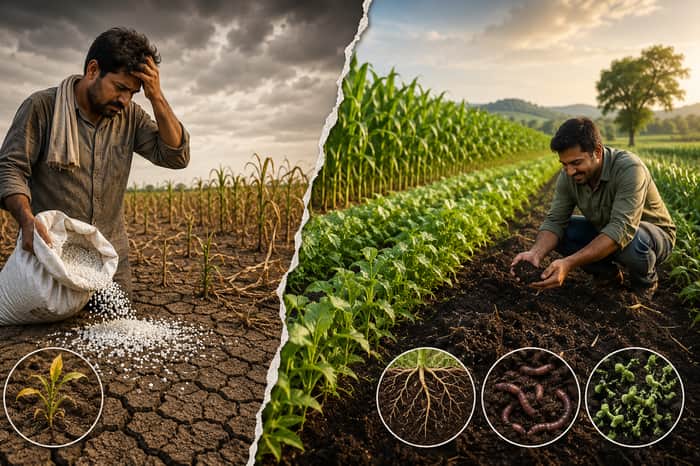
For a long time, whenever yields dropped, my first reaction was simple:
Add more.
More fertilizer.
More inputs.
More effort.
It felt like the logical solution. If something isn’t working, you try harder.
But season after season, I noticed a pattern:
the more I added, the less predictable my results became.
The soil didn’t feel the same. Crops weren’t as consistent. Costs kept rising.
That’s when I realized the issue wasn’t how much I was putting into the farm—it was how I was using the land itself.
That realization led me to crop rotation. Not as a theory, but as a practical system that changed how my farm behaves.
1. The Hidden Cost of Growing the Same Crop
It’s easy to stick with one crop.
You understand it.
You know the market.
It feels safe.
I did the same.
But over time, I started seeing:
- Soil losing its natural balance
- More pest attacks targeting the same crop
- Increasing dependence on fertilizers
Nothing failed overnight. It just slowly got worse.
That’s the tricky part—repetition feels productive, but it quietly weakens the system.
Crop rotation breaks that pattern.
Instead of repeating the same crop, you switch to different ones across seasons, giving the soil time to recover naturally.
2. Soil Doesn’t Need More Inputs—It Needs Balance
Earlier, I treated soil like a base layer.
If something was missing, I added it from outside.
But soil is not empty—it’s active.
It has:
- Nutrient cycles
- Microbial life
- Natural processes that support growth
When you grow the same crop repeatedly, you disrupt that balance.
Crop rotation restores it.
For example:
- Legumes can naturally add nitrogen
- Other crops use different nutrients
- Some crops improve soil structure
Once I started rotating crops, I noticed the difference not just in yield, but in how the soil behaved.
It became easier to manage. More responsive. Less dependent.
3. Pest Problems Reduced Without Extra Effort
One of the biggest surprises for me was pest control.
Earlier, pest attacks felt unavoidable. The same crop attracted the same problems every season.
And the usual response was:
more pesticides.
But crop rotation changes the environment.
When crops change:
- Pest cycles get disrupted
- Diseases don’t get the same conditions to spread
- Pressure reduces naturally
It’s not about eliminating pests completely—it’s about making your farm less predictable for them.
And that makes a big difference.
4. It Reduced My Costs Without a “Cost-Cutting Plan”
I didn’t start crop rotation to save money.
But over time, that’s exactly what happened.
Because:
- Soil health improved → less need for fertilizers
- Pest cycles reduced → fewer chemical interventions
- Land stayed productive → more consistent yields
The result?
Lower input costs without compromising output.
In fact, things became more stable.
That’s something most farmers underestimate—stability is more valuable than occasional high yield.
5. It Forced Me to Think Beyond One Season
Crop rotation changes your mindset.
You can’t plan just one harvest—you have to plan sequences.
At first, this felt complicated.
But eventually, it became a strength.
Instead of reacting every season, I started:
- Planning ahead
- Understanding how one crop affects the next
- Thinking in cycles, not isolated decisions
That’s when farming starts feeling less chaotic and more structured.
What Changed for Me
After consistently following crop rotation:
- Soil quality improved without heavy inputs
- Pest issues became manageable
- Costs became more predictable
- Yields stabilized across seasons
But more importantly, I stopped trying to “fix” the farm every season.
I started building a system that works over time.
A lot of solutions in farming focus on adding more—more inputs, more technology, more cost.
But sometimes, the real solution is not addition—it’s adjustment.
Crop rotation is one of those adjustments.
It doesn’t require big investment.
It doesn’t promise instant results.
But it builds something stronger in the long run.
And in farming, that’s what actually matters.
If you want a deeper, step-by-step breakdown of crop rotation, including practical combinations and how to apply it on your farm, I’ve explained it in detail here:
Crop Rotation: Maximizing Yields and Soil Health
This will help you move from understanding the idea to actually applying it.
