I tracked my time for 3 months. Here’s what I learned.
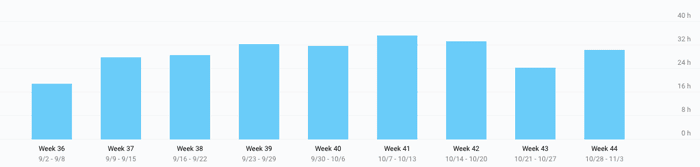
At the end of last year I started an experiment: I was going to track my time for three months. Despite being good at prioritizing tasks, I was feeling very unproductive at the end of the workday, as if reactive tasks had eaten most of my time. I also wanted to spend more time focusing on personal projects, something very hard for me to do while I'm employed full-time because I feel guilty that I'm not spending time on the things I'm being paid to do. This is so wrong that companies incentivize side projects for employees, but I was raised with a no-slacker, loyalist ethic and such is the power of nurture.
To check my time I used Toggl, a very popular time tracking software with a generous free tier that is perfect for personal time tracking. The hard thing about time tracking is remind yourself to do it, so having a service that works across devices and minimizes friction is key. Toggl turned out to have some cool reporting features that made it easy for me to look at the data and realized three things I would have never guessed.
- Our productive time is less than we think
The traditional workday is 8 hours per day, but only a part of it is "billable", meaning spent working on projects and tasks. Moving around the office, bathroom breaks, hallway conversations, and natural distractions eat about an hour each day. I averaged a mere 6 "billable" hours a day.
This exercise made me rethink the definition of productive time. I have a creative role. Part of my job is read about what's happening and anticipate trends and competitor moves. I took long lunches with my mentor and mentees. Was that unproductive, just because the outcome wasn't defined? Maybe not, but realizing I only had 6 hours to execute my top priority projects was a revelation: I was able to better forecast my time, and give better estimates to people who were asking for help.
Rest of article here. https://veronica.substack.com/p/i-tracked-my-time-for-3-months-heres
Have you done a similar experiment? What have you learned?

I signed up to Toggl ages ago, and now revisiting it but I think is fairly basic when it comes to the free tier, did you upgrade? Or did you add your Projects as Categories?
I was able to do everything I wanted with the free tier. Pro features are mostly for business / team features. Just found out about Clockify, which looks exactly the same. I used Clients, Projects, and tags.
That's why some countries only work 5-6h a day, working 8h is so old and unproductive, you can't be productive straight 8h, that's not possible...
That's good insights. Time is the most important asset that we have as human beings, and probably the thing that most people mismanaged. If you could measure your time well, that's how you well you manage your outcomes. In a nutshell, if you can measure, you can manage :)
Wow, 6 hours! That feels like more than the average employee, good on ya!
I just started time tracking at the beginning of the month, so have done it for just 3 days. I quit my SW job and I am fully focused on indie hacking. But I am in the explore phase and there are many little experiments and side projects and initiatives I've added to my plate that I am hoping time tracking will allow me to see what % of the time I am spending on each category of activity that is important to me(coding vs. writing vs. connecting/marketing, etc.). So far it's a little tedious, I've just been using pen/paper. I'll have to check out that app you mentioned. Thanks for sharing! :)
I'm also a SW, full time employed, how do you quit? I mean, how do you get money from to keep living? Having to pay cars and houses? Would it not be safer to keep the work and working on the side project? I mean, I could do it also, I have quite a lot of money saved, but doesn't make it more sense to keep working until your side project makes enough revenue?