I tried AI agent platforms and found three dealbreakers — so I built my own
I started with OpenClaw.
The idea of an AI agent working directly in my terminal was compelling, and the first few sessions were impressive.
But three things kept bothering me.
First, the security model. My API keys and credentials were sitting in plaintext - accessible to any code the agent generated, any dependency it pulled, any prompt injection hidden in a GitHub issue. For a tool that executes arbitrary shell commands, that felt like a time bomb.
Second, the setup was cumbersome. Getting multi-agent workflows working meant opening multiple terminals, coordinating by hand, and keeping mental track of what each agent was doing. There was no task board, no persistent memory across sessions - just a chat log that scrolled away.
Third, it was a chat interface. I wanted long-term memory docs my agents could reference across runs. I wanted a task dashboard where I could see who was working on what. And I'd noticed something important: priming an agent with a specific role and system prompt gets consistently better output than reusing the same agent for different kinds of work. Persistent dynamic agent teams - each agent specialized for its role - was clearly the better pattern, but nothing made that easy to set up.
So I built Hezo - a self-hosted platform that runs an entire team of AI agents on your own hardware. Not a SaaS. Not a framework. A single binary that starts a server, a web app, and an AI organization with an org chart, budgets, and memory. It's GPL v3 open source - the full codebase is on GitHub.
What it does
You run one command. That gives you a CEO agent that scopes work, a Captain that prioritizes and assigns tasks, specialized agents that do the hands-on work, and a Coach that reviews completed work and writes learned rules so the team improves over time. You manage everything through a web app - task board, realtime CEO chat, budget panel, project dashboard.
Hezo ships with a software development team template, but that's the default - you can set up teams for any kind of knowledge work. Writing, research, data analysis, design - there are no limits on what kinds of teams you can build.
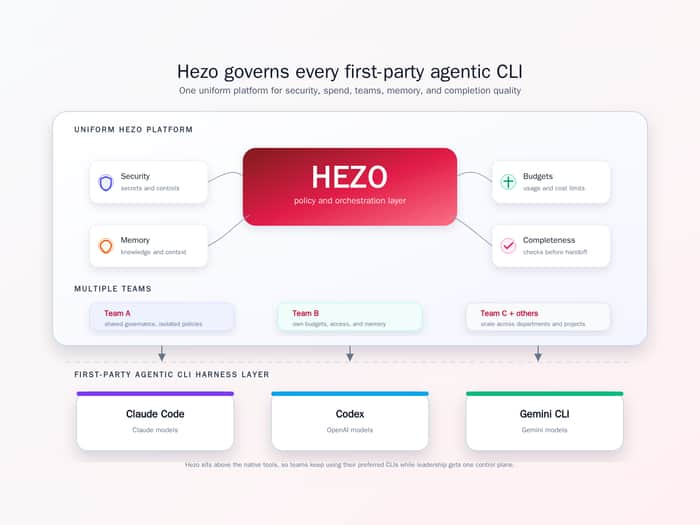
The big idea: each AI model runs in its native first-party CLI. Claude runs in Claude Code. GPT runs in Codex. Gemini runs in Gemini CLI. Hezo provides a uniform platform layer on top - security, budgets, documents, skills, and a completeness check that stops agents from shipping broken work. You get the full power of each model's native tooling, plus everything those CLIs were never designed to provide: persistent memory, persistent team coordination, and structural security.
The security model
Most agentic platforms store your API keys in plaintext and give agents unrestricted access. Hezo does the opposite: agents never see real API keys. They get opaque placeholder tokens - e.g. __HEZO_SECRET_GITHUB_TOKEN__. A host-side egress proxy intercepts outbound requests, checks the destination against that secret's allowed hosts, and substitutes the real value only at the network boundary. The agent never touches the actual credential.
Every secret is encrypted at rest with AES-256-GCM behind a 12-word master key only you hold. Each agent runs in its own Docker container with an isolated filesystem and network stack.
This means your host system is far less likely to get compromised, and your agents can never see your secrets and leak your credentials to third parties. The agent can't leak what it doesn't have.
Budget controls
Budget caps - daily, weekly, monthly - pause agents automatically when limits are hit. You set the caps per agent, and the platform enforces them. No surprise API bills.
What's working
The core loop is solid - create a project, set goals, the team ships work. The Coach reviews every completed task and writes durable learned rules back onto agent prompts, so the team gets better at your project over time. After a month of use, your team has adapted to your project and your standards.
Hezo is early. This is GPL v3 open source, and it needs real-world feedback to improve.
You can run Hezo locally on your laptop, deploy it to any VPS with the included cloud-init scripts (see hezo.ai/docs), or wait for the hosted version that's on the roadmap. OpenCode support for any backend model is also coming.
Try it
I'm looking for honest feedback. Try it - curl -fsSL https://hezo.ai/install.sh | sh - and star the repo at github.com/hezo-ai/hezo. Tell me what's broken, what's missing, what would make you actually use this.

I like the local only approach, I made a hybrid where the developer version is running on localhost with Claude subscription, and the SaaS version is running Claude API (can't reuse a subscription for multiple users).
The security architecture is compelling, but I think the deeper strategic question is what developers are ultimately buying. I'd keep validating whether Hezo wins because it coordinates AI agents better, or because it gives engineering teams enough governance and trust to let autonomous agents become part of their production workflow.
Good points.
I think software dev is one of the hardest things to get right with an agent team. I think the less complex work could be handled in this way, leaving higher levels of complexity to me.
That being said, Hezo can be used to coordinating teams in general on any kind of task - I'm currently using it for both marketing as well as investment portfolio analysis and slowly iterating on those two.
Appreciate the context.
The interesting part is seeing whether the strongest pull comes from AI coordination itself or from the specific workflows teams use it for.
This comment was deleted a month ago