I Tried to Build Faster. It Didn’t Work. So I Changed the Game.
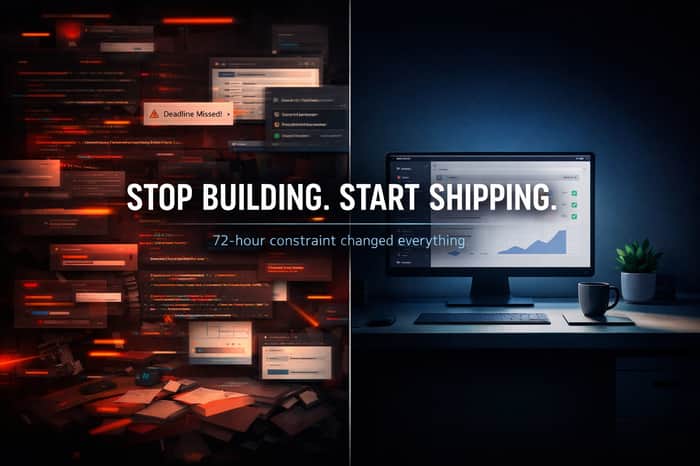
I Tried to Build Faster. It Didn’t Work. So I Changed the Game.
8 months.
That’s how long I spent trying to “get it right.”
- Better ideas
- Better stacks
- Better timing
- Better research
I was building constantly.
But not shipping consistently.
Not because I couldn’t code.
Because I was building without constraints.
The Real Problem (That Nobody Talks About)
Most solo devs don’t fail because they lack skill.
They fail because:
- No structure
- No pressure
- No clear finish line
You wake up, open your editor, tweak something, scroll a bit, maybe “optimize” a detail…
Day ends. Progress feels fake.
Repeat.
It’s like running on a treadmill that shows speed, but not distance.
What Actually Works
Constraints.
Not motivation. Not discipline. Not inspiration.
Constraints.
So I started experimenting with one idea:
What if building a product felt like a timed challenge instead of an endless task?
The Shift
Instead of “I’ll build this app someday”, I tried:
- Fixed time window
- Clear milestones
- No scope creep
- No perfectionism
Suddenly:
- Decisions got faster
- Overthinking disappeared
- Shipping became the only goal
It felt less like “working on a startup”
and more like playing a high-stakes game against the clock
The Unexpected Insight
When time is limited:
- You don’t chase perfect architecture
- You don’t rewrite things 3 times
- You don’t open 15 tabs to “research more”
You build what matters.
And weirdly… the output is often better.
Why This Matters More Now
AI changed something fundamental:
Execution is cheaper.
Ideas are easier.
Starting is trivial.
But finishing?
Still rare.
Maybe even rarer.
Because now you can start 10 things instead of 1.
A Different Way to Build
What if instead of asking:
“What should I build?”
You asked:
“What can I finish in 72 hours under pressure?”
That question filters everything:
- Scope
- Complexity
- Priorities
It forces clarity.
This isn’t just a theory.
It’s the exact mindset behind how I’m building my current project.
Short cycles.
Clear constraints.
Forced shipping.
It completely changed how I work.
Final Thought
Most people are stuck in infinite mode.
No deadlines. No structure. No urgency.
But products don’t come from infinite loops.
They come from constraints, pressure, and closure.
I’m curious:
- Have you ever shipped something under a strict time limit?
- Did it turn out better or worse than expected?

Building faster isn't the constraint for most solopreneurs - the constraint is building the RIGHT thing and then distributing it effectively.
The game change that matters most for solos: switching from output-mode (shipping features, writing content, building) to signal-mode. Spending time where your ICP is, listening for the exact language they use to describe their pain, tracking what resonates when you post about the problem. That signal informs everything else.
The other game change worth making: stop measuring activity and start measuring outcomes. Comments written, features shipped, hours worked are activity. Revenue, pipeline, upvotes on problem posts - those are outcome signals. A solo founder with clear outcome tracking and 4 hours of focused daily work will consistently outperform one burning 12 hours without visibility into what's moving the needle.
As a software development provider, we consantly deliver under tight deadlines, but structured process helps. Another thing that makes difference is an AI-assisted engineering approach our developes use. We implement AI into the development process when it makes sense along with tailored validation mechanism and human oversight.
It shows good result. For example, we managed to modernize the back-end of a complex B2B platform 2x faster.
I’ve learned the same thing — pushing for speed usually just breaks things, and changing direction is often what actually helps progress.
The "treadmill that shows speed but not distance" line is superb.
What nobody mentions is that constraints don't just help you ship faster. They help you stop second-guessing what to ship at all. As an engineer and then PM in tech, I spent years making prioritization calls with frameworks, data, and a team to push back on me. Solo founding with the same instincts feels like playing chess without an opponent. You can make any move. That's the problem.
The 72-hour question works because it collapses the decision space. Not just scope, but which thing even matters right now. That's the part I underestimated.
Did your build quality actually hold up once real users showed up, or did the constraint create debt you had to pay back eventually?
That chess-without-an-opponent analogy is spot on.
For me, constraints didn’t just speed things up, they killed the constant “what should I build?” loop.
On quality:
Yeah, there was some debt but mostly surface-level (UX, small shortcuts), not core issues.
The rule I followed was:
build for real users, not hypothetical scale.
Once users showed up, fixing things became way clearer and faster than overthinking upfront.
Built Budgia in 48 hours last week. Same exact principle.
I had been "working on it" for months in FlutterFlow. Rewrites, tweaks, never shipping.
Then I set one constraint: a working product by end of weekend. No scope creep. No perfectionism.
Result: voice input → AI parsing → Firebase → Stripe →...
The constraint didn't limit the product. It defined it.
Still rough around the edges. But real users are logging expenses today. That's worth more than another month of perfect architecture.
Love this.
“The constraint didn’t limit the product. It defined it.” — exactly.
You went from building in theory to users logging expenses. That’s the real milestone.
Once it’s alive, you can improve it.
Before that, it’s just a draft loop.
8 months is a familiar trap. I kept rewriting the same bot instead of shipping a version that worked well enough. The moment I set "good enough to run overnight" as the bar, things actually got done. Constraints aren't a compromise — they're the reason anything ships at all.
Exactly.
“good enough to run overnight” flips everything.
You stop building, start operating.
That shift alone is the difference between infinite loop and shipped product.
the 72-hour constraint question — yes. i built my entire agency outreach pipeline in a weekend. 540 agencies across 41 countries, email scraper, SEO scanner for personalization, automated follow-ups, reply monitoring. forced shipping meant i skipped all the things that didn't matter (perfect code, nice UI, edge cases) and focused on the thing that did: actually sending emails. the code is ugly but it works and it runs on cron every day without me touching it. constraints > motivation every time.
This is it.
You didn’t build a system, you built a machine that runs without you.
…but it ships value daily.
That’s the trade most people avoid.
Constraints force you to ask one brutal question:
“does this actually run in the real world?”
Everything else becomes optional.
I’m applying this idea in a project I’m building.
It’s about structured, time-constrained builds.
There’s a free way to try it if you’re curious:
https://devmarathon.ai