I turned Notion AI into a knowledge service charging €497 - built it in one afternoon, here is exactly how.
The problem
Most companies don't realize their internal documentation has quietly become an operational liability.
Wrong answers from support. Stale pricing in sales decks. New hires learning broken processes. AI agents running on outdated logic.
It doesn't start as a crisis. It starts with an SOP nobody updated, a pricing page nobody maintains, an FAQ pointing to someone who left two years ago.
Then one day a customer gets the wrong answer. A new hire learns the wrong process. An AI agent automates the wrong logic.
That is not a documentation problem. That is an operational risk.
What we do at OpsFlow Studio:
We run a Knowledge Audit using an AI agent that scans every internal doc in your workspace and identifies which ones have become operational liabilities — before they cause real damage.
Every doc gets scored, prioritized, and flagged. You get a live dashboard showing exactly what's at risk and what needs fixing first.
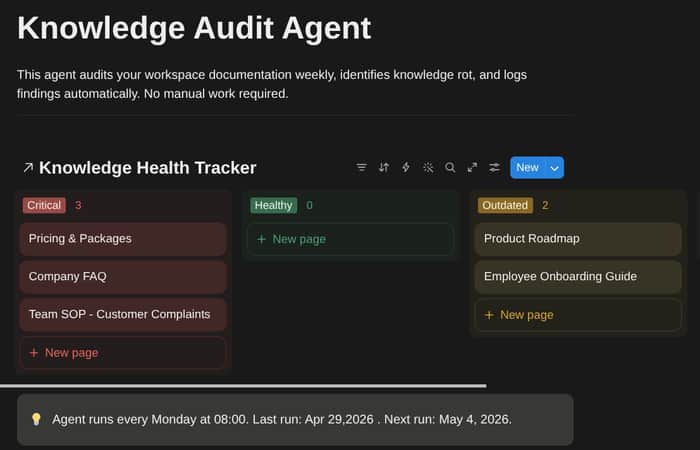
The agent then runs automatically every Monday and sends your team a report. No manual work. Ever.
Real output from an audit we ran this week:
🔴 Pricing & Packages — Rot Score 10 — Critical
🔴 Company FAQ — Rot Score 9 — Critical
🔴 Customer Complaints SOP — Rot Score 9 — Critical
🟡 Employee Onboarding Guide — Rot Score 8 — Outdated
🟡 Product Roadmap — Rot Score 8 — Outdated
🟢 Healthy docs — 0
The client had no idea any of this was happening.
Each one of those red flags is a place where their team was making decisions, answering customers, and onboarding people — on wrong information.
What you get:
→ Full AI audit of your internal knowledge base
→ Every doc scored, prioritized and flagged as operational risk
→ Live dashboard updated automatically every Monday
→ Weekly Slack report sent to your team
→ Zero manual work after setup
Pricing:
→ €497 one-time for the full audit and setup
→ €800/month to keep the agent running weekly
The retainer exists because operational knowledge risk doesn't stop after one audit. Docs drift. People leave. Processes change. The agent keeps watching so you don't have to.
Running 3 free audits this week
I'm offering free audits to 3 companies this week to build case studies with real data.
If you want to see exactly where your internal knowledge has become a liability — DM me. No pitch. Just the audit and the results.

Notion as service delivery layer is underexplored. Most people use it as a personal wiki but it can hold full client-facing workflows.
The key insight here is packaging - the €497 isn't for Notion, it's for the structure and judgment baked in. That's the part that's hard to replicate. The AI query layer is just the interface.
I've been building in a similar direction - using Notion's relational databases (clients, projects, decisions, revenue all linked) as the ops core for a solo founder system. The AI on top becomes much more useful when the underlying data is actually structured. What's your retention looking like at that price point?
Your wedge is strong, but the offer is still framed like an internal cleanup service.
That undersells what this actually is.
This is not “documentation maintenance.”
It is operational trust infrastructure.
Because once internal knowledge drifts:
support gives wrong answers
sales quotes outdated pricing
new hires learn broken process
AI agents automate stale logic
That is not doc decay.
That is decision risk.
The stronger framing is not “we fix messy docs.”
It is:
“we stop internal knowledge from becoming operational liability.”
That lands higher, sells faster, and justifies the €800/month more cleanly.
Also worth tightening the company name.
OpsFlow Studio sounds like an agency wrapper.
The product is sharper than that.
Something tighter like Exirra would carry this much better if this becomes the core product.
This is the most useful comment I could have received.
You're right. I've been describing the symptom (messy docs) instead of the consequence (operational risk).
The reframe from "documentation maintenance" to "operational trust infrastructure" is sharper and I'm going to use it.
The cascade you described is exactly what happens:
Support gives wrong answers → sales quotes outdated pricing → new hires learn broken processes → AI agents automate stale logic.
That's the real pitch and I undersold it.
On the company name — noted. OpsFlow Studio was always meant to be an umbrella for multiple products. You may be right that if this becomes the core product it deserves its own identity.
Genuinely appreciate you taking the time to break this down. This is the kind of feedback that changes how you position something.
Would love to hear your thoughts on the pricing angle — does €800/month land better with the "operational liability" framing in your view?
Yes — €800/month lands much better with the operational liability framing.
“Messy docs” sounds like cleanup.
Cleanup gets priced like service work.
“Operational knowledge risk” sounds like something that quietly costs the company money every week.
That can justify recurring spend.
The pricing should not be anchored to hours saved.
It should be anchored to avoided failure:
wrong support answers
stale sales collateral
broken onboarding
AI agents using outdated logic
That is the difference between:
nice-to-have documentation help
and
risk control for internal knowledge.
Same reason I’d separate the product identity from OpsFlow Studio if this becomes the main offer.
OpsFlow Studio sounds like the builder.
The product needs to sound like the system companies trust to keep internal knowledge accurate.
That’s where a name like Exirra fits better.
It carries more authority than a studio label.
I really appreciate you coming back with more depth on this.
The distinction you drew is the one that changes everything — cleanup is a one-time cost, risk is recurring. That's exactly the framing I needed to justify the €800/month retainer properly. I'm updating my positioning around this.
On the name — I hear you on Exirra and I understand the logic. I'm not ready to rename yet while the product is still finding its first customers. But I'm keeping the principle: whatever this becomes needs to sound like something companies trust at an infrastructure level, not a studio service.
For now I'm focused on getting the first 3 paying clients with the right positioning. The name conversation will come back once there's revenue behind it.
One thing I'd genuinely value your view on — with the operational risk framing, where would you focus outreach first? COOs, Heads of Ops, or IT managers?
I’d start with Heads of Ops and COO-type roles.
IT managers may understand the tooling problem, but they often won’t feel the business risk as sharply.
The buyer pain is not “docs are messy.”
It’s:
teams are making decisions from stale internal knowledge.
That sits closer to Ops, Support Ops, RevOps, and COO.
Best wedge:
companies where knowledge drift already has visible cost.
Support teams giving inconsistent answers.
Sales teams using outdated collateral.
Fast-growing teams onboarding badly.
AI agents being introduced on top of messy internal knowledge.
That last one is probably the sharpest.
If a company is adding AI internally, stale knowledge becomes more dangerous because the AI does not just read bad information — it scales it.
That is the pain I’d lead with.
And on the name, fair. Get the first 3 clients first.
But once revenue starts proving this is more than a service, I would not leave it under OpsFlow Studio for long. That is when Exirra starts making more sense as the infrastructure-level identity.
We can connect on LinkedIn too if useful — easier to go deeper there.
This is the clearest targeting advice I've received and I'm writing it down.
Heads of Ops, Support Ops, RevOps, COO. Not IT. The pain lives with the people who feel the business consequence, not the people who manage the tooling. That distinction alone changes who I'm messaging on LinkedIn tomorrow.
The AI angle you ended with is the sharpest wedge I haven't been using yet. Companies rushing to deploy AI internally are unknowingly scaling their stale knowledge at the same time. That's not a future problem — that's happening right now for anyone who has connected an AI agent to a messy knowledge base. That's the opening line of every outreach message from here.
Would like to Connect with you on LinkedIn here is my profile id: https://www.linkedin.com/in/rohit-s-21900a407/
Perfect — I followed you on LinkedIn.
And yes, that AI angle is the one I’d lead with hardest.
“AI doesn’t just use stale knowledge — it scales it.”
That makes the risk instantly obvious.
Get the first 3 clients with that wedge first.
Once this starts proving itself as recurring infrastructure rather than service work, that’s when the identity should probably move beyond OpsFlow Studio.
That’s the point where Exirra makes the most sense.