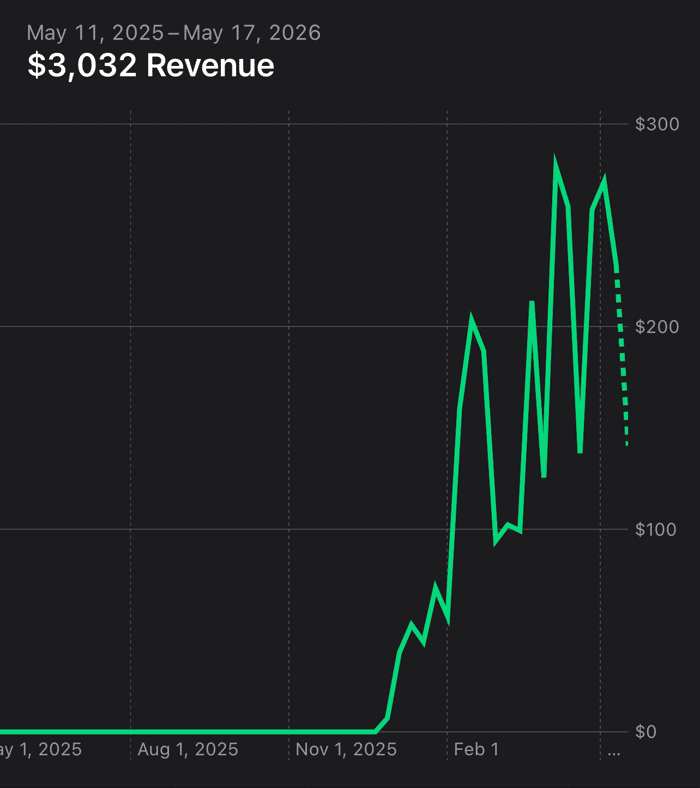
I turned someone’s tweet into an app idea and it has made ~$3000 so far in 4 months.
A guy on X, posts app ideas every day. I stumbled upon one of his post about making a workout import app to import workouts from social media.
The tweet was basically:
“Why is there no Recime for workouts?”
And honestly…
I had the exact same frustration.
I had hundreds of saved workout videos across Instagram and TikTok.
But when it was time to actually work out:
- I couldn’t find anything
- forgot exercise order
- switched between apps constantly
- wasted more time scrolling than training
So after work and on weekends, I started building FitSaver.
An app that turns saved workout videos into structured routines you can actually follow.
The first version barely worked.
Imports failed constantly.
The backend broke during traffic spikes.
Android subscriptions randomly stopped working at one point.
But people immediately understood the problem.
Not:
“another fitness app.”
But:
“I save workouts constantly and never use them.”
That became the real positioning.
Most growth came from Reddit posts, sharing the journey publicly, and shipping features directly from user feedback.
Today:
- 3000+ workout imports
- hundreds of active users
- 88 active subscriptions
- ~$3000 revenue so far
- built solo from India
Still early.
Still improving every week.
But seeing strangers use something that started from a random tweet and my own frustration feels surreal.

nice work dude! this is something I could see myself using. lmk if you can share a promo code for fellow builders. happy to give feedback too.
Appreciate that a lot man 🙌
Honestly fellow builders and early users have shaped a huge part of the app already, the app has 7 day free trial.
Would genuinely love your feedback once you try it — especially around onboarding/import flow.
Great work, I am going to download FitSaver now. I have some app ideas I am currently working on.
What is the X account where you got the idea from?
The useful lesson here is how quickly people understand a problem when the wording is concrete. I’m applying the same idea to Kinetic Override: “no-root Android macro recorder for repeated taps/swipes” lands faster than “automation utility,” because users can picture the exact workflow.
The architecture that changed this for our use case: move the data out of their portal and into your own store via webhook. goffer.ai exposes a webhook that fires structured JSON on bill events - vote result, committee assignment, hearing scheduled, amendment filed. We pipe that into a Postgres table. Now the data is in our system and we can query it, join it to other tables, build dashboards, trigger internal workflows. The read-only portal model locks the data in their UX. Once it is in your database you can build on top of it. The filter setup on the goffer.ai side is the key part - you configure which events and which bills you want, otherwise the webhook volume is too high to be useful.
how did you do this ?
The feature evolution you described in the replies is worth looking at closely: users asked for timers, scheduling, and follow-along guidance, and you built them. With 88 active subscriptions from 3,000+ imports, I'm curious which of those features is actually crossing the 'worth paying for' threshold. Is it people who primarily use FitSaver as a follow-along workout tool who stay subscribed, or is the import function still doing most of the heavy lifting for retention?
The under-discussed part of this story: you had the exact same frustration. The tweet didn't give you the idea, it surfaced one you already had buried. As an investor I see the difference all the time. Founders who picked up someone else's problem burn out at month 8. Founders solving their own keep going through broken imports and random Android subscription failures. The $3K is small now. The fact that you kept shipping through three different ways the product could have killed itself is the real signal.
I have an app that I’m building and right now I’m in the validation stage with a landing page and a waitlist.
I’ve been relying heavily on AI (Claude in this case) to help me with getting the word out but to be honest it’s been a let down so far. (I.e I feel we should be moving faster with posting about it in more places and should be focused on getting signups because it confident in the app)
How do you “market” your app/ideas? I’m very new to this and I really want to get this launched ASAP
The positioning shift is the whole story here, and it's easy to skim past. "Another fitness app" is a category — you're competing with everyone. "I save workouts constantly and never use them" is a specific moment of self-recognition — the user finishes the sentence in their own head before you do. That's not marketing copy, that's a mirror, and mirrors convert.The fact that it came from someone else's tweet matters too: the demand was already articulated out loud before you built anything. You didn't guess the pain, you watched someone post it. That's the cheapest validation there is.88 subscriptions from a problem you personally had is a real signal, not luck. Curious — did the "saved but never used" framing come to you early, or did you launch with the generic version first and only find the real words after talking to users?
This is what great startups look like
Simple idea.
Real problem.
Clear positioning.
Consistent shipping.
“I save workouts constantly and never use them.”
That line alone explains why this works.
Huge respect for building this solo and turning a random tweet into real revenue
Good work.. the real win is cracking that positioning
which subreddits got you the most traction?
Got inspired by your post . I am building TokenWatch from india — Its a tool for solo founders where you paste your API key, get a weekly email showing exactly where your AI spend is going. I am still validating , figuring out if people need what i am building.
hey can you share the twitter account from where you got the idea
great achievement
That's a smart and impressive job you've done. Your targeted audience really needs that workout app which means there is room for growth and expansion. Reddit traffic might not be consistent. If possible try focusing on getting organic traffic for more $$$.
Appreciate this a lot 🙌
Honestly I think the biggest validation came from realizing I personally had the problem REALLY badly.
I had hundreds of saved workout videos but still ended up repeating the same workouts because actually using saved content was painful.
Before building the app, I posted about the problem itself on Reddit and Twitter:
“Does anyone else save workouts constantly and never use them?”
The response was surprisingly strong.
People weren’t asking for:
“another fitness app.”
They were describing chaos:
That’s when I realized the pain was organization, not motivation.
Really inspiring! I'm building Scarlyfy in Peru — an AI WhatsApp bot that schedules medical appointments and sends automatic phone call reminders. Finding the first customers in Latin America is tough but seeing stories like yours keeps me going. How did you validate the idea before building?
This comment was deleted 3 months ago
Great execution on micro-bootstrapping. Building highly focused, isolated utility tools is where the real value is right now. It cuts down systemic tracking risks and returns actual utility to the end user. Best of luck scaling it!
Users started requesting:
And now a lot of those features are live because users kept pushing the product forward.
That’s probably been the coolest part:
the app today is very different from the app I originally thought I was building.
thanks mate
Two things stood out:
"Not 'another fitness app' but 'I save workouts constantly and never use them.'" That repositioning is the whole game. People don't buy categories, they buy out of frustrations they couldn't name before you named them.
The fact that the first version barely worked and people still got it. That's the only real signal worth chasing early. Polished products with no clarity die quietly; broken products with sharp positioning grow.
Good reminder for the rest of us building. Congrats on the traction.
The "same frustration" moment is so underrated as a validation signal. I've been building a tool that stress-tests startup ideas with multiple AI models before founders write a single line of code, and the pattern I see again and again is that the strongest ideas come from founders who personally experienced the pain — not ones who spotted a "market gap" in a spreadsheet. Your instinct to act on that shared frustration with the tweet author was exactly right. Four months to $3k with a real product beats a perfect pitch deck every time.
That’s honestly such a great insight.
I think a lot of founders try to “discover markets” from spreadsheets or trend reports, but the strongest signal for me was:
“I’m already frustrated enough to desperately want this product to exist.”
That usually means thousands of other people probably feel it too.
And honestly the tweet alone wasn’t the validation.
The validation was seeing complete strangers immediately say:
“wait… I have this exact problem too.”
That’s when I knew it wasn’t just a personal annoyance anymore.
Still super early, but I’d take:
real users + real pain + real revenue
over a polished pitch deck any day.
Love this! The journey from "I have the same frustration" to $3K revenue in 4 months is exactly what indie hacking is about. The fact that you identified a real problem (saved workouts but can't organize them) and shipped despite imperfections is inspiring. Solo from India building this—major respect. Keep iterating! 🔥
The tweet-to-product pipeline is underrated as a validation method. You're essentially reverse-engineering proven demand signals. The $3K in 4 months is modest but the methodology is solid — finding an underserved angle on existing demand rather than creating demand from scratch.
I run a marketing agency and getting clients to stop talking about their category and start talking about the specific frustration is the hardest part of the job. The fact that you landed on "that pile of saved videos you never watch" this early is huge. Curious about retention though - fitness apps usually get rough after month 2-3. Are people sticking or is it mostly new subs replacing churned ones?
Relatable on every level. I built Mental Detox — an AI journal for anxiety, stress and sleep — solo, while working factory shifts in Canada. Same story: first version barely worked, fixed bugs in real time, learned everything by doing. The moment strangers start using something you built out of frustration is exactly as surreal as you describe. Reddit was my biggest channel too.
Keep going!
The positioning shift you described is the most useful part of this post.
"Another fitness app" tells someone what category you are in. "I save workouts constantly and never use them" tells them exactly why they would open yours right now. Those are not the same pitch, and most founders never make the jump from the first to the second even after talking to users for months.
The Reddit angle also confirms something I keep seeing: problem-first posts outperform product posts every time, regardless of the subreddit. The moment a post reads like promotion, even a good product loses the room. The moment it reads like someone describing a real frustration, the comments do the selling.
Solo, from India, 4 months, 88 paying subscribers - that is a real signal the problem is real. Still early but not nothing.
Indeed.I frequently save fitness short videos, but whenever I actually want to work out, I can't even find the videos I’ve saved.
Great insight. I hadn’t thought about looking at Twitter that way. People's complaints are a massive opportunity. It's probably worth searching through random questions there. It might even be a better platform than Reddit because people can complain freely without strict rules.
Reddit being your main growth lever is the kind of thing solo founders sleep on. Which subs ended up actually converting for FitSaver, and were you posting raw build-in-public updates or more 'I had this exact problem' style posts? Trying to figure out the right voice there for my own iOS app.
Honestly the posts that worked best were never “look at my startup” posts.
The ones that converted were:
“I personally had this frustrating problem and built something to fix it.”
That angle performed WAY better.
The best subreddits for me ended up being:
What I learned is people don’t care about:
“another fitness app”
But they immediately relate to:
“I have 20 saved workouts and never use them.”
The more honest/problem-first the post felt, the better it performed.
This is a strong example of positioning coming from user behavior, not from the app category.
“Another fitness app” is weak. “I save workouts constantly and never use them” is much sharper because it captures the real pain immediately. That should probably stay at the center of the homepage and launch copy.
The one thing I’d pressure-test now is the name. FitSaver explains the current action, but it may also make the product feel like a small saving/import utility. The bigger product is turning scattered fitness inspiration into actual routines people follow.
Since you already have users, subscriptions, and revenue, the brand starts mattering more. Auryxa .com would fit this direction better if you want it to feel like a polished consumer fitness/productivity brand rather than a utility for saved videos.
The product is already proving people understand the pain. The next step is making the brand feel as strong as the behavior it unlocks.
This is honestly one of the most insightful pieces of feedback I’ve received so far.
You articulated something I slowly realized only after talking to users for months:
I thought I was building a fitness app.
But users kept describing the problem as:
“saved workout chaos”
or
“fitness content overload.”
That shifted a lot of my messaging and onboarding decisions.
And you’re probably right about the brand evolving over time too. “FitSaver” came from the original utility/use-case framing:
save workouts → organize them.
But the bigger vision is definitely closer to:
turning scattered fitness inspiration into an actual system people consistently follow.
Really appreciate you taking the time to write this — genuinely helpful perspective.
One practical thought here.
Since you already have users, subscriptions, and revenue, this is exactly the stage where the name and positioning decision is worth pressure-testing properly before more onboarding, paid users, and product memory build around FitSaver.
The full domain decision may or may not be right today, but the broader brand question is real: is this a saved-workout utility, or is it becoming a fitness execution system people actually follow?
I do focused naming and positioning audits for early products: current name risk, category framing, domain perception, whether the brand can scale, and what stronger direction I’d take before more public assets build around the current name.
Not a long consulting thing. Just a sharp written breakdown with practical recommendations.
I’m doing a few at $99 while refining the format. If useful, connect here and I can give you a clear outside read for FitSaver:
https://www.linkedin.com/in/aryan-y-0163b0278/
That is exactly the shift I’d take seriously.
FitSaver makes sense for the original utility: save workouts, organize content, reduce chaos.
But the product you are describing now is bigger than saving. It is turning scattered fitness inspiration into a system people actually follow. That is a stronger consumer behavior, and because you already have users, subscriptions, and revenue, the brand layer starts carrying more weight than it would at idea stage.
This is where I would separate “do we rebrand today?” from “do we control the stronger long-term name?”
You do not need to change everything immediately. But if the serious direction is a polished fitness execution system rather than a saved-video utility, I would not leave the future brand open while more onboarding, user memory, paid subscriptions, and public examples build around FitSaver.
Auryxa.com is the cleanest fit I’d suggest for that premium consumer direction. It feels broader, more polished, and less boxed into the original save/import use case.
I control Auryxa.com, so if it feels like a serious candidate for the bigger version of the product, it is worth discussing before the current brand gets more revenue and user memory attached to it.
I can keep the acquisition side simple and founder-friendly if the fit is real.
Best place to discuss privately is here:
https://www.linkedin.com/in/aryan-y-0163b0278/