I used to think selling into regulated industries was a “big company problem.”
It’s not.
Even small deals get weird fast once compliance shows up.
You can have:
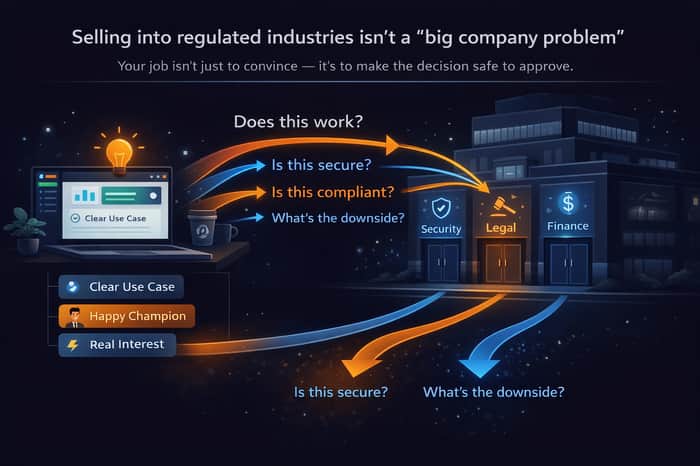
a clear use case
a happy champion
real interest
…and then suddenly things slow down for reasons that don’t show up in product feedback.
What’s actually happening:
You’re no longer selling “does this work?”
You’re now selling:
“can someone inside the company defend using this?”
That’s a completely different problem.
Example pattern I keep seeing:
You answer a security question → feels like progress
Then legal asks something slightly different → feels manageable
Then finance reframes it → now it’s about downside
Nothing is wrong.
But now the decision is harder to justify internally.
This is where a lot of indie founders get stuck:
You think:
“they’re asking more questions = they’re interested”
Reality:
they’re trying to figure out if saying yes creates risk for them
What helped me understand this better:
Don’t just think about your product.
Think about:
who signs off
what they’re afraid of
what they’ll need to explain to someone else
Because in these deals, your real job isn’t just to convince.
It’s to make the decision safe to approve.
Curious — anyone here tried selling into fintech / health / compliance-heavy spaces?
Where did things actually slow down for you?

I know a couple of indie SaaS founders who have sold into compliance-heavy regulated industries, and they'd probably be open to answering some questions for free if you want me to pass them along.
This is spot on — the shift from ‘does it work?’ to ‘is it safe to approve?’ is where most deals quietly die.
What’s interesting is a lot of founders try to solve this with more answers (security docs, compliance, etc.), but the real bottleneck is helping the buyer internally justify the decision.
I’ve been seeing some teams run small, high-intent experiments (fixed low entry, capped participation, strong upside) to reduce that perceived risk — almost like giving stakeholders a low-stakes way to say yes before committing fully.
Feels like that changes the conversation from ‘risk’ to ‘controlled test’. Curious if you’ve seen anything like that work in compliance-heavy deals?”