I used to think SEO was the starting point. I was wrong.
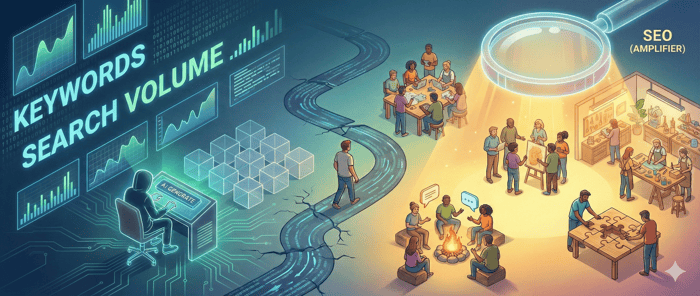
For a long time, I had a very naive understanding of SEO. It looked something like this:
- Find a keyword with decent search volume.
- Use AI to quickly build a product or generate content.
- Fix the basic SEO settings.
- Wait for traffic. Wait for growth. Wait for success.
This logic is not rare. In fact, it is the "default path" for many technical founders and indie hackers.
But recently, I realized something important:
This logic isn't just "not good enough." It is completely backwards.
Here is my reflection on why "building a site and waiting for traffic" doesn't work anymore.
1. Keywords Needs. They are just the "Expression" of Needs.
I used to believe: "If Ahrefs or Semrush shows search volume, the demand is real."
Now I know this is only half true.
A keyword tells you "what" they are looking for. It does not tell you:
- Who they are.
- Why they are searching.
- Are they experts or beginners?
- Are they willing to pay?
A Personal Lesson: The "Image to Prompt" Trap
Let me share a recent experience. I found the keyword image to prompt.
My initial thought was simple: Build a tool where users upload an image, and AI gives them the prompt.
But then I got stuck. I imagined myself posting on Reddit or a Discord community:
"Hey everyone, I built another image-to-prompt tool. Check it out!"
I realized this was meaningless. Why would anyone choose my new site over established ones? It was just a "function," not a solution.
So, I dug deeper. I looked at the real discussions behind the keyword. I found that users had completely different goals:
- Some wanted to study photography lighting.
- Some wanted to learn about composition.
- Some just wanted to copy a style for Midjourney.
If I just built a generic tool, I would fail. But if I built a tool specifically for "analyzing lighting in prompts," I would have a clear message for a specific group of people.
Lesson: Don't just look at the keyword. Look for the living, breathing humans behind it.
2. The SEO Blind Spot: It doesn't tell you "Where the users are"
I realized a hard truth:
After building the product, the most important job is not "waiting for Google," but "finding people."
Search engines solve "Distribution," not "Validation."
SEO helps you get more exposure, but only after you know your product works. It cannot tell you if you understand the user's pain point.
Validation happens outside of Google.
Real users are already gathering somewhere:
- Specific Subreddits
- Discord servers
- Niche forums
If you can find where they hang out, understand their language, and solve their problems, SEO becomes easy later on.
3. Why Small Games Work, But AI Tools Struggle
I noticed a trend:
- Simple web games can still grow fast with just a keyword.
- But generic AI tools (wrappers) are finding it harder to get traffic.
Why?
For games, the "keyword" and the "experience" are the same. You search "Solitaire," you play Solitaire. Simple.
For AI tools, users care about quality, speed, and trust. The big players (the "Head" sites) already dominate generic keywords. If you just make another "wrapper" based on a keyword, you are entering a Red Ocean.
4. The Sustainable Path: Start with "Scenarios," Not "Keywords"
When I shifted my focus from keywords to scenarios, everything became clear.
It solves the "What should I write?" problem.
I used to struggle with writing content for Reddit. Now it's simple: I write about what the people in that specific scenario are already discussing. I am not "promoting a product"; I am joining a conversation.
You don't need to be an expert.
You don't need a PhD in the field. But you must understand the basics:
- Know the terminology.
- Understand what counts as "insider" talk vs. "outsider" talk.
If you don't understand the scenario, you can't build a product that fits.
5. SEO is an Amplifier, Not a Starter
If I had to summarize my new mindset in one sentence:
SEO is never the starting point. It is an amplifier.
- It amplifies your understanding of the user.
- It amplifies value that has already been validated.
- It accelerates what real people are already using.
It does not amplify empty pages or generic features that no one cares about.
Conclusion
Building a website is ultimately a business of human connection.
Search engines are just tools. Users are the core.
If you can find real scenarios, real people, and real problems, SEO is just a matter of time.
But if you start by "building a site and waiting for traffic," you might just be waiting for disappointment.
What do you think? Have you ever fallen into the "Keyword Trap"?
