I Was Picking the Wrong SaaS Tools for Two Years. Here's the Mistake I Finally Figured Out.
Let me tell you something embarrassing.
I've been a cofounder for about two years now. And in those two years, I've paid for tools that were too expensive, too complex, and built for a company three times my size. I've signed up for platforms that took a week to set up before I even sent my first email. I've handed over credit card details for "industry-leading" software that my 4-person team used exactly twice.
The worst part? I kept making the same mistake. Different tools. Same outcome.
I thought I was just bad at picking software. Turns out I wasn't the problem. The way I was searching for software was the problem.
Here's How I Was Doing It (And Maybe You Are Too)
Every time I needed a new tool, a CRM, a project management app, an analytics platform, I'd do the same thing:
Go to Product Hunt. Search the category. Sort by "most popular" or "top of the week." Pick from the top 5.
Or I'd go to G2. Filter by rating. Read reviews. Pick the 4.8-star option.
Or I'd google "best CRM for startups" and click whatever came up first.
Every single time, I ended up with the same result: a tool that looked great on paper, had thousands of reviews from happy customers, and was completely wrong for where I was.
And here's what took me embarrassingly long to understand: those tools weren't bad. They were built for a different company. Not mine.
The CRM with 4.8 stars on G2? The reviews were mostly from 50-person sales teams with dedicated RevOps
What's Actually Broken About Tool Directories:
Product Hunt shows you what's trending. G2 shows you what's most reviewed. Capterra shows you what paid for placement.
None of them show you what's built for where you actually are.
The "best CRM globally" is built for mid-market teams with 200 people and an implementation partner. That's who's leaving reviews. That's who's upvoting on Product Hunt.
If you're a two-person team trying to replace manual processes one by one, you're a rounding error in their pricing model and nobody tells you this until you've paid for six months of something you barely touch.
The Thread That Changed How I Think About This
I found this post on Indie Hackers from Ayush, the founder of SoftRankings, who said something I couldn't stop thinking about:
"Pipedrive at pre-seed is perfect. Pipedrive at Series A is a nightmare."
Same tool. Different stage. Completely different outcome.
What I Found When I Tried SoftRankings
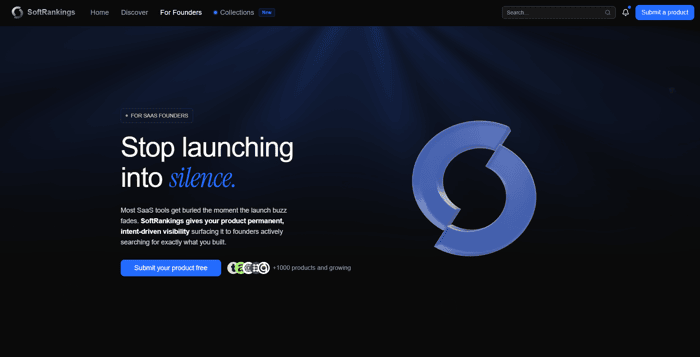
SoftRankings organizes tools by company stage: Solo/Indie, Seed, Series A, Enterprise instead of global popularity or review count.
I went in skeptical. "Built for founders" usually means a slightly cheaper enterprise product with worse support.
What I found was different. Instead of "top CRM globally," it showed me what tools were being used by founders at my actual stage. Tools I'd never seen trending on Product Hunt because they don't have viral launch budgets. They're just quietly doing the job for small teams who can't afford to troubleshoot.
The scoring breaks tools down by things that actually matter early on: How complex is it? Is the pricing founder-friendly? How long before you get real value? Does it work for 3 people or does it need a team of 20 to function?
That last frame will this work for a team my size is the question I should've been asking from day one. I wasn't. None of the directories I was using were asking it either.
What I Do Differently Now
I pick my stage first. Not the category. Not the price. The stage.
That one filter eliminates 70% of the noise. I'm no longer benchmarking my 4-person startup against tools reviewed by 200-person companies.
I'm comparing myself against founders who are actually in my situation.
Then I look at complexity second. Can I get value in 30 minutes? Or does it require a full week of setup and a data migration?
You're welcome in advance.

This resonates. I wasted months trying every new tool that launched on PH, thinking the right stack would make the product better. Turns out the only thing that mattered was talking to users. The tools are just tools.
Totally agree, I’ve been trying SoftRankings lately and the stage-fit angle has been really useful so far.
This resonates hard. I spent way too long evaluating tech stacks for a simple health calculator before realizing the best tool is the one that lets you ship fastest. For indie projects, I've settled on pure static HTML/JS served from a CDN — zero backend, zero cost, instant deploys. No more spending 3 days configuring a database for something that doesn't need one.
@dayu2333jinyul i have added your grammar checker tool to SoftRankings. Check it here at: https://softrankings.com/products/ai-grammar-checker
This hits close. Spent way too long optimizing for "best tool" instead of "good enough and actually ship." The real mistake is picking tools based on features instead of how fast they get you to launch. What clicked for me: the tool you can use today beats the perfect one that takes weeks to set up.
just submitted lets see the magic work
Welcome to SoftRankings @AlloceraCDAI. We've approved your claim request for CDAI Engine. We've sent you and email for Claim verification!
@AlloceraCDAI Your product is now live in SoftRankings.
Check out your listing: https://softrankings.com/products/cdai-engine
Best of luck!
What landed for me is the question, "will this work for a team my size?" That beats ratings almost every time. Early teams should optimize for time to first value and failure recovery, not breadth. A tool you can start using in 20 minutes usually beats a category leader that needs a week of setup. I built DictaFlow for a similar reason. For a small team, a tool only earns its place if it removes a daily bottleneck right away, not after an onboarding project.
Exactly. For small teams, speed to value matters more than feature lists. If a tool solves a daily problem from day one and is easy to switch away from if needed, that's usually the better choice.
Spot on. For small teams, that daily friction is the real enemy, not the lack of some enterprise feature set. Being able to plug something in and see immediate results is worth so much more than a tool that requires a massive onboarding investment.
The stage filter is a real upgrade over 'top rated,' but the trap underneath is the annual contract and the migration cost, not the sticker price. At 4 people your needs change faster than a yearly renewal, so early on I optimize for reversibility over fit: month to month, no migration to get started, something I can rip out in an afternoon. The wrong tool you can leave cheaply costs far less than the 'right' one you are locked into.
This is the sharper version of the point. Stage fit gets you the right starting tool, but reversibility is what protects you when your stage changes six months later, which at 4 people it always does.
The lock-in trap is sneaky because it never shows up in the comparison. Everyone benchmarks price and features. Nobody benchmarks "how painful is this to rip out," and that's the cost that actually hurts.
The wrong tool you can leave in an afternoon beats the right one you're married to for a year. Might steal that framing.
That is a great perspective on hidden costs. Locking into an annual contract when the team is still evolving is such a risky move. Prioritizing flexibility and the ability to pivot easily is a much smarter approach for early-stage teams.
This is a really sharp point. The real cost is often not the subscription, but the lock-in and switching pain later on. That’s what makes me think more carefully about tools now.
This maps onto infra choices too, not just SaaS tools. I almost deployed my product on Vercel by default — it's the obvious Next.js host, the reviews are glowing — until I actually checked whether my architecture fit it. My checker needs to run as an always-on process; Vercel's serverless model would never let that fire on its own, no matter which plan I paid for. The reviews weren't wrong, I just wasn't the audience they were written for.
Same lesson as your CRM example: "best" is a function of fit, not popularity. Picking the trending default and checking the constraints afterward cost me time I didn't need to lose.
The Vercel example is such a good illustration. “Best host for Next.js” is meaningless if your architecture pattern is different. Have you found a hosting setup that now feels truly aligned with how your checker runs?
Yeah — landed on Railway. It deploys the Dockerfile as-is, runs as a persistent container, and the dev environment (docker-compose) maps over almost 1:1, so there's no remote/local mismatch to debug.
The other piece that mattered: the checker uses a Postgres advisory lock (pg_try_advisory_lock) so only one instance ever runs it even if I scale up later. That only works if the process is actually staying alive between checks — which is the whole thing serverless can't give you. Once I framed it as "does this host let my process exist continuously," the choice basically picked itself.
Frozr, exactly. SoftRankings is trying to do that same fit check before the decision gets made. The reviews can be great, but if the architecture does not match, it is the wrong tool for you.
The stage-first filter is the right move but the real insight is deeper. Most founders pick tools based on what looks good on a comparison chart. The ones who pick right pick based on what their team will actually use at their current size. Complexity kills adoption faster than price.
The stage-first lens is especially useful for AI infrastructure tools. A two-person team usually does not need the same setup as a 200-person company with RevOps, security review, and a platform team. They need to know: can I start quickly, can I cap spend, and can I explain where the bill came from?
For AI APIs, the “wrong tool for your stage” mistake often shows up as buying complexity before you have usage patterns. Early on, I would rather have a simple model catalog, per-key limits, clear routing, fallback visibility, and a ledger that says which workflow/model/balance bucket paid for each request.
That is the stage-fit idea behind what we are building with Tokens Forge. The product should help small teams access models cheaply, but it should also stay understandable before they grow into a heavier enterprise stack.
AI infra has variable costs, so "can I cap spend and explain where it came from" is the whole game early on.
Buying complexity before you have usage patterns is the trap. You need simple first: model catalog, per-key limits, clear routing, a ledger. Most teams see the total bill but can't attribute it, and unattributable cost is how you end up scared to ship.
That's exactly what Tokens Forge solves.
This is such a sharp take for AI infra. “Can I cap spend and explain the bill” feels like the real requirement for early teams. What is one usage pattern from Tokens Forge’s users that surprised you so far?
This is really interesting because I am building an ai email platform called Zeno and I have been researching the best way to find info and get ready to launch but it sounds like softrankings helps launch with whatever resources you have.
Same here. I have been building ozigi.app (we recently pivoted to being a full GTM engine), and i think i'd launch on there too.
As someone working in ERP, full-stack development, AI integration, and business automation, I've learned that the "best" software is rarely the best software for your current stage. I've seen startups implement enterprise-grade tools and spend more time managing the tool than solving the actual business problem. Time-to-value, implementation effort, and operational fit are often more important than feature lists or review scores. I think the idea of evaluating tools by company stage rather than global popularity makes a lot of sense.
This is the right distinction. I'd add one filter before comparing tools: write the exact weekly workflow in 5 steps and mark which step is painful enough to pay for now. If the tool improves a step you only touch once a month, it will feel like shelfware even if it is objectively good. For tiny teams, time-to-first-useful-result is often a better buying criterion than feature depth.
this hits so hard from an engineering side. as a full-stack dev, nothing kills my soul faster than a founder handing me an "industry-leading" enterprise tool to integrate, only for me to realize it's going to take three weeks just to figure out their messy API and auth scopes lol.
filtering by company stage instead of raw upvotes is a seriously cool idea. when u are a tiny team, u need tools that optimize for time-to-value, not infinite configuration. the difference between indie-friendly tools and enterprise bloat usually comes down to:
definitely keeping softrankings in mind the next time we need to add a new piece to the stack so we dont end up with another heavy, bloated dinosaur!
The stage-fit filter is the right instinct, and for me it travels with a second one: how fast can I rip this out if it's wrong.
I run both on every tool now, because picking right for my stage still leaves the question of what the switching tax looks like later, the migration, the re-training, the integrations you have to unpick. Stage gets me the first cut (a tool built for a 200-person RevOps team fails the rip-out test by default, since it assumes an implementation partner I don't have), and the rip-out test catches the ones that look stage-appropriate but quietly lock you in. Cheap-to-leave matters as much as cheap-to-buy at this size.
Curious whether SoftRankings factors switching cost into the score, or just complexity and price.
helpful post
this is the mistake almost everyone makes early on. we optimise for “best tool” instead of “best tool for right now”
This is a massive reality check. The quote 'Pipedrive at pre-seed is perfect. Pipedrive at Series A is a nightmare' hits the nail right on the head.
As a solo founder currently launching a Shopify app, I fell into this exact trap early on. You see 'industry standards' listed on G2 or Product Hunt and assume you need them, only to realize you're spending days configuring a massive tank when all you needed was a bicycle.
I eventually stripped my stack down to just Next.js, Supabase, and Vercel because I needed to optimize for speed to value, not enterprise compliance. Early on, 'time to setup' is a massive hidden cost that kills momentum.
Filtering tools by company stage instead of global popularity is a framework that should be the default. Awesome share!
This is a great point. It is easy to feel overwhelmed by industry standards when you are just starting out. Focusing on speed to value is much more practical than trying to be compliant with enterprise-level requirements from day one.
This is one of those ideas that feels obvious once you see it, but most people (including me) completely miss it in practice.
I’ve also fallen into the trap of choosing tools based on popularity, ratings, or “best in category,” only to realize later they were built for a completely different stage of company.
The distinction between “good tool” and “good tool for my current stage” is doing a lot of work here. Things like setup time, operational overhead, and time-to-first-value matter far more early on than feature depth.
The part about filtering by stage first instead of category really reframes how I think about software discovery. It’s less about finding the best product, and more about avoiding the wrong context mismatch.
Really clear breakdown.
The switching cost isn't just data migration, it's the habits you build around the wrong tool. We spent months with a setup built for a 50-person team and ended up with alerts we ignored and reports nobody read. Stage-fit tools assume you're one person making twenty decisions before lunch. Enterprise tools assume headcount you don't have.
The stage-fit filter is exactly right and probably the most underused frame in martech decisions.
The other layer most founders miss is redundancy. After two years of picking wrong tools, you often end up with three platforms that each do 70% of the same thing. Nobody notices because the overlap was never put on paper.
A useful exercise before adding anything new: audit what you already have. Map each tool to the job its actually doing and whether thats what you bought it for. You'll usually find one or two subscriptions doing the same job, or nothing at all.
Its more boring than finding the perfect new tool... but usually saves more money.
If it helps, theres a free stack audit tool built for exactly this: pipelinegrader.com/calculator/martech-audit
@AfterCredits This is a cool concept! Could you submit it to SoftRankings? We'd love to feature your product.
That's a lesson many founders learn the hard way. I also realized that chasing the "best" tool often wastes more time than choosing a good-enough solution and executing consistently. What criteria do you use now before adding a new tool to your workflow?
That’s exactly the trap I kept falling into too. Chasing the “best” tool usually just means wasting time on something that looks good on paper but is wrong for your stage. I’ve started using SoftRankings as one more check before choosing.
The stage filter is a great mental model. I'd just add that "complexity" is often more important than price — a cheap tool that takes two weeks to set up costs more than an expensive one you can use in an hour.
Time to value is the metric nobody talks about enough.
Evgeni, completely with you on time to value. Complexity quietly becomes the most expensive line item for small teams, even when the subscription looks cheap.
Solid post! The "wrong tools for two years" pain is so common—most people optimize for features instead of fit. Curious which tool categories you now consider "safe to standardize" vs "still experiment with"? For us, anything customer-facing (CRM, support) gets locked-in, while internal productivity (PM, notes) we still A/B test quarterly.
love that distinction!
I’ve started treating customer‑facing tools as “pick carefully and commit,” and internal productivity as “safe to keep experimenting” too.
The hidden cost isn't the wrong tool, it's the switching cost once your workflows are wired into it. I tell the founders I back to buy for the next 12 months, not the next 3 years, since a tool you outgrow is cheaper to replace than one you never grow into. Stage fit is the right filter, but add one more: how fast can you export your data and walk away if it stops fitting?
Gregory, that “buy for the next 12 months” lens is such a practical way to avoid overbuying. Exportability and walk‑away speed probably deserve a spot on every comparison chart.
so was the main issue picking the wrong tool for growth or for growth for the specific stage you were at? But you're right, the doubling down nature within the space is something to be navigated quite carefully.
for me it was mostly “wrong for my stage” rather than “wrong for growth in general.” The tools were fine, but the assumptions baked into them didn’t match a 4‑person team at all.
Ran into exactly this with SEO tooling. I manage a portfolio of sites and for two years had 4-5 different rank trackers and analytics tools all pinging me with data. Never knew what to actually do with it. The mistake was not the tools -- it was that none of them told me what to prioritize today. Now I use two tools max and built a single view that surfaces which site actually needs attention this week. Less data, clearer action.
Jim, the SEO tooling story is a perfect example. Having one view that surfaces “what needs attention this week” feels like the real win, not more dashboards.
This nails something I keep relearning: "best" almost always means "best for someone 3x your size" — and that someone is exactly who's leaving the reviews and upvoting. Picking by stage first is the real unlock.
One thing I'd add to what's broken: free trials hide the actual cost, which is setup/switching time, not the subscription. A tool that needs a week to configure isn't "free" during the trial — it's a week of your scarcest resource spent before you find out it's wrong for you. At pre-seed, "time to first real outcome" probably deserves to outrank both price and the feature checklist.
My rough rule now: if I can't get one genuine result out of it in an afternoon, it's built for a team I don't have yet. That single question has saved me more than any review score ever did.
我觉得这个观点很有意思,我最近刚好也在处理 Stripe 相关的问题,你的这个解决方案确实避开了不少坑。
太好了,很高兴能帮到你!刚开始搞的时候,Stripe 确实很容易让人陷进去(像个无底洞样)。祝你集成顺利,如果后面遇到什么具体的坑,随时找我聊
You nailed the part most people miss: the tools aren't bad, they're built for a different company. The 4.8 stars are real, just real for a 50-person RevOps team, not your 4-person one. Review count measures popularity, not fit, and those two drift apart the earlier you are.
"Pick your stage first, not the category" is the whole thesis in one line. Honestly better than how I usually explain it.
Thanks for writing this. Made my week.
Great insight - really useful site too!
@liftpocket I found your tools Liftpocket quiet useful for Pre-seed stages. I have launched LiftPocket on SoftRankings.
Check it at: https://softrankings.com/products/liftpocket
SoftRankings only works if it feels useful in practice, so feedback from founders actually using it matters a lot to me.
Really appreciate that, glad the site feels useful in practice. What stage are you at right now and which tool decision has been the hardest lately?
Hey there, do you mind sharing your coding stack for right now? It would be really helpful, thank you!
This comment was deleted 3 months ago
This resonates as a solo founder.. I've made the exact mistake of benchmarking myself against tools built for teams 50x my size. What's interesting to me is that SoftRankings basically proves your point by being a directory: the value isn't 'more tools,' it's tools sliced by a dimension that actually matches the user. I've been going deep on exactly this,, turning raw data into niche directories/research DBs that answer one specific question well instead of being broadly popular. The stage-filter insight is a great example of how much signal you unlock just by picking the right axis to organize around.
Matter of choosing
even i feel the same
see mine
The stage-first reframe is right, but I'd push on where it breaks: the hard part was never knowing your own stage — you knew you were 4 people the whole time. the hard part is that a tool's real stage isn't on its pricing page. everyone markets down. the enterprise CRM has a "startup plan," the 20-person-minimum tool has a solo tier, and they all say "built for teams like yours." you only find out it's actually built for a 50-person RevOps team after you're three weeks into setup.
So a directory that labels tools by stage is useful, but it's inheriting the same trust problem one level up — now you're trusting someone else's read of what stage a tool fits, instead of the vendor's. better, but not solved.
The filter that's never lied to me is the one greentimetracker and ori said above: does this replace something I'm doing by hand today? if I'm not already doing the work manually, the tool is speculative overhead no matter how perfectly stage-matched it is. "am I in pain right now" is self-verifying in a way "is this built for my stage" isn't — you can't misjudge your own current pain, but you can absolutely misjudge a tool's true stage.
genuinely good post though — the "you're a rounding error in their pricing model" line is the truest thing here
You are right that “am I in pain right now” is a very honest filter. I still think stage labels help you avoid obviously wrong fits, but they definitely do not solve the trust problem alone. What is one painful tool you bought speculatively that you would avoid today with your “manual first” rule?
For me it was the "all-in-one" platforms — CRM + email + analytics + automation in one box. fell for that pattern more than once. it's the purest speculative buy because the pitch is literally "you'll grow into all of this," which is just future-company thinking with a logo.
The tell I'd watch now: if most of a tool's value is in features I'm not using yet, that's the speculative-overhead smell. manual-first kills it instantly — I'm doing one of its eight jobs by hand, so I'm paying for seven hypotheticals while the one thing I need is buried under setup for the rest.
And you're right they stack rather than compete: stage label kills the obviously-wrong fits cheaply, manual-first kills the plausibly-wrong ones that slip through. stage gets you the shortlist, pain tells you which to actually buy.
Felt this hard. We burned three months on a "top-rated" API management platform that was clearly built for enterprise teams with dedicated DevOps. The stage filter idea is something I wish existed when we were picking our data pipeline tools — would've saved us from a very painful migration at exactly the wrong time.
Ouch, that API management story sounds familiar. Data pipelines are exactly where stage mismatch hurts. If you were picking again today, what is the first question you would ask to avoid that migration trap?
Tool fit changes with stage. Early stage = speed. Series A = scale.
Series B = efficiency. Most founders pick once and never revisit.
The founders who win switch tools as their constraint changes.
Love this breakdown. Speed, then scale, then efficiency feels spot on. Do you have a tool you consciously replaced at Series A or B because your main constraint changed?
Exactly. We hit Series A burn clarity (cash runway matters), so we killed
$500/mo tools that "might be useful later" and doubled down on the one
tool that touches payroll/finance daily. Constraint shifted from "can we
ship faster" to "can we survive on this runway." Tool stack reflected that
instantly. What was your shift?
This hits close to home. I built a YouTube analytics SaaS and made the exact same mistake early on — I was looking at what tools the big creators were using instead of what actually made sense for solo creators just starting out. The stage-first framing is exactly right. A tool that works for a 500k subscriber channel with a team is completely wrong for someone posting their first 20 videos alone. Ended up building my own thing partly because nothing I found was sized for where my target users actually were.
The YouTube angle is such a good example. A tool that fits a 500k subscriber team can crush someone at 20 videos. What did you end up building differently once you focused on solo creators’ actual stage?
This really resonates. I see the exact same thing in SEO and marketing tools, not just CRMs.
Everyone picks the tool with the most reviews, but the reviews come from companies at a totally different stage. A tool that's perfect for a 50-person marketing team is often overkill for a solo founder, and nobody tells you that upfront.
The "pick your stage first" framing is the right one. I've started doing the same with AI-visibility tools lately, since getting cited by ChatGPT matters more now, but most tools in that space are built for enterprise teams, not small businesses figuring it out. Stage first, complexity second. That reframe is going to stick with me.
Completely agree on SEO and AI‑visibility tools. The review base is almost always skewed. If you had to pick one “stage first, complexity second” rule for solo founders choosing SEO tools today, what would it be?
Honestly, my one rule would be: start with the tool that actually shows you where you stand, before you commit to a whole stack.
For a solo founder, that means getting visibility into your authority and how AI engines see you first, then deciding what to build on. Buying five tools before you know your baseline is how you end up paying for features you never touch.
That's the gap I kept hitting, so I've been using Genius Rank. It combines an AI reputation system (audits, competitor analysis, an authority score) with a vetted business network, so the visibility piece and the community side sit in one place instead of five subscriptions. Stage first: know where you stand, then grow.
It's actually good though to know what's best for you at your current stage. Most tools are good but wasn't built with startups in mind. Thanks for the article
Exactly, most tools are good, just not designed around startup constraints. What is one area where you still feel the biggest mismatch between your stage and the tools you see marketed to you?
What clicked for me reading this: enterprise tools have docs written for an implementation partner, not for you. The setup flow assumes a dedicated admin, the templates assume a team of 20, the support assumes a contract. You feel dumb using it, but you're not the audience. Stage-fit tools onboard you assuming you're alone and busy, which is the only honest assumption for an early team.
Yes, enterprise docs do feel like they are written for an implementation partner, not for you. Stage‑fit onboarding that assumes you are alone and busy is exactly what I wish more tools aimed for. Have you seen any product do this really well?
Spent way too long in the ‘most popular = best fit’ trap too. The stage framing is the actual unlock a tool that works for a 200-person team actively hurts a 4 person one. Wish more founders thought about this earlier.
Hey random question. So I have a market place in my new app and im using stripe as the company to help protect payment between people. But my users aren’t able to add their bank account and withdraw money from their market place account. All I keep getting back is something about setting up a stripe connect account but when I follow the steps I get led to a sanbox test page.
The Stripe Connect sandbox issue is usually because you haven’t switched to live mode yet you need to activate your account fully on the Stripe dashboard before real bank connections work. Happy to help you figure it out. Are you on X, Telegram or Discord? Easier to walk through it there.
The sandbox redirect means your Connect account is still in test mode. You need to activate the platform account in live mode, then your sellers complete Connect onboarding (Express is easiest) before payouts work. The withdrawal flow won't fire until their account clears Stripe's verification. I've built marketplace payout flows with Stripe Connect before, happy to point you to the right setup if you're stuck.
Same trap here, “most popular” turned into “most painful” more than once for me. If you had to give one rule of thumb to a new four person team choosing their first CRM, what would it be?
One rule: pick the tool you can be fully set up on in under an hour. If it takes longer than that to get your first contact in and your first deal tracked, it’s built for a bigger team than yours. Complexity is a tax you pay every day. Are you on Telegram or Discord? Would love to connect properly.
It's just a matter of knowing how to choose and take advantage of everything it has to offer. This tool seems very useful and solves a problem for many; thank you for the post, it's an eye-opener.
Really glad it felt useful and eye opening. If you look at your current tools, is there one where you think you are not yet taking full advantage of what it offers at your stage?
Switching the mental framework from "What is the best tool?" to "What is the right tool for my specific headcount?" is a absolute game changer for early-stage teams. Thanks for sharing.
Exactly this. "Best" is meaningless without context. Best for who, at what size, with what budget? Stage gives you that context instantly. Glad it landed.
The "built for a company three times my size" line is the whole trap. Most tools, especially PM and planning tools, assume a team, ceremonies, and roles you don't have when you're 1–4 people. You're not buying a tool, you're buying someone else's org chart.
What changed it for me was picking for the workflow I actually have today, not the one the category leader assumes. For a solo founder that often means the boring, lightweight option beats the 4.8-star "industry leader" that needs a week of setup. I went so far down this that I ended up building my own stripped-back planner (AgileTask) because every "top of Product Hunt" option wanted me to run a scrum team of one. What category burned you worst CRM or PM?
This is exactly the problem I built around.
I run an AI tool review blog where every review is evaluated through one lens: can a non-technical solopreneur actually implement this in under a day, and is the time saved worth the monthly cost? Not "is this powerful." Not "what do enterprise teams think."
The stage mismatch you're describing is real. Most review sites optimize for search volume, which means they cover tools that big teams are searching for. The result is that solo founders get reviews written by people running 50-person operations with dedicated admins.
The question I ask on every review: what breaks, and how often? That's the thing nobody tells you until you've already paid for three months of something that needs an implementation partner to actually work.
Site's at ai-tool-hunter.com if you want the non-enterprise perspective.
I have been there. Spending more time configuring the stack than actually building the product is a huge momentum killer. It feels like you need all those enterprise features, but most of the time they just get in the way.
I’ve seen this mistake kill SaaS blogs too. Founders chase tools instead of strategy.
What was the one tool that finally made the difference for you?
The Pipedrive quote applies to infrastructure too. We picked Express for multi-tenant SaaS because it ranked everywhere as "the best." By the time we needed tenant isolation, per-tenant feature flags, and GDPR erasure baked in — not bolted on — we'd spent months unwinding architectural decisions that looked fine at day one.
The "best tool globally" is optimised for the median use case. Multi-tenant B2B is not the median use case.
It is such a common trap to go for what’s popular instead of what actually fits the current stage of the business. Scaling infrastructure too early often just creates unnecessary complexity.
Honestly less about a single tool and more about accepting that generic solutions create their own overhead once you have specific requirements.
For us it was multi-tenant isolation — auth, data scoping, per-tenant config. We kept patching general-purpose libraries until we built Kumiko specifically for that. Real example of how it looks:
const invoiceEntity = createEntity({
table: "read_invoices",
fields: {
amount: createNumberField({ required: true }),
status: createTextField(),
},
});
defineFeature("billing", (r) => {
r.entity("invoice", invoiceEntity);
r.writeHandler(defineEntityCreateHandler("invoice", invoiceEntity, {
access: { roles: ["Admin"] },
}));
r.queryHandler(defineEntityListHandler("invoice", invoiceEntity, {
access: { roles: ["Admin", "User"] },
}));
});
// every query is automatically scoped to the current tenant
// no WHERE tenant_id = ? anywhere
The moment you stop fighting a tool to fit your use case, things get a lot simpler.
I've been thinking about building a vehicle rental platform, but I'm hesitant because there are already so many established apps in the market.
I'm curious to hear from people who have actually rented bikes or cars.
What do you dislike about the current apps?
Have you ever avoided renting because of a bad experience?
What feature do you wish existed but doesn't?
What would make you switch to a new rental platform instead of using the popular ones?
If you could change one thing about existing rental services, what would it be?
I'm not trying to advertise anything—I just want to understand whether there's still an unsolved problem worth building for.
I'd really appreciate your honest opinions, even if your answer is "the market is already saturated."
On the "market's already saturated" worry, saturated usually means there's proven demand, and the incumbents are almost always bloated and generic. The winners in rental tend to win on a specific niche or a specific pain the big apps ignore, not by out-featuring them. From building marketplace platforms, the things people actually hate: clunky verification/handover, no real trust layer between owner and renter, and payment/deposit handling that feels sketchy. If you nail trust and a smooth booking-to-handover flow for one specific segment (one city, one vehicle type, one use case), that's a wedge. What angle or niche are you leaning toward?
As someone who has implemented ERP systems, enterprise software, AI integrations, and automation workflows for companies of different sizes, I completely agree with this. One of the biggest mistakes founders make is choosing tools designed for organizations 10x larger than they are. A platform can be technically excellent and still be the wrong choice because of complexity, implementation cost, or operational overhead. Company stage is one of the most overlooked factors in software selection. Great insight.
the stage-matching idea applies to AI tools too, not just SaaS. a solo founder picking between Claude, ChatGPT, and Cursor needs completely different criteria than a 50-person team evaluating enterprise AI platforms. we run into this constantly building aisa.to — the AI tools that work at our stage would be completely inadequate for a series B company, and vice versa. the mistake is always the same: optimising for features instead of fit.
Great tips. IT matches the business current postion to a tool that works for the business at its current stage which is perfect. Excellent and very insightful.
I totally agree. It's not about choosing the best one from a bunch of products with similar features, but about picking the most suitable one based on the situation.
cool fit changes with stage. Early stage = speed. Series A = scale.
Series B = efficiency. and moreover this
This hits something I've been thinking about a lot lately. The wrong-fit problem you describe with tools applies just as directly to community distribution.
When looking for first users, the instinct is to go to the same "top of the list" places — r/SaaS, r/entrepreneur, HN — because that's where everyone posts. Same logic as sorting by most popular on G2.
But those communities are mostly other founders. The actual customers are usually in communities you've never heard of.
A 500-person Discord of exactly-your-type-of-customer beats 500k subs of general-tech-audience every time. The filter isn't just "where are people" — it's "where are people at my customer's stage talking about the problem I solve."
Same bug, different dimension. Great post.
GOT IT!
Funny enough, AI has made this even easier to fall into. You can build twice as fast, but you can also build the wrong thing twice as fast. Enjoyed reading the article though, great insights.
The "best for who" framing is exactly right, and it applies beyond just tooling.
Early-stage founders often end up with a graveyard of forgotten subscriptions precisely because of this pattern: you sign up for something that looked right at the time, it doesn't fit, you stop using it, but the billing keeps going. The average founder has 3-5 tools they're paying for that they haven't opened in months.
This is actually what I built SubRadar for — it scans Gmail to surface subscriptions you're being charged for and reminds you before each renewal. The discovery moment is almost always "I completely forgot I was paying for that." The tools that don't fit your stage are the ones that get forgotten, not canceled.
The stage-first filter you describe would also help here: if you're evaluating tools for your headcount and stage, you're less likely to sign up for something that becomes a ghost subscription 4 months later.
The stage-fit framing is useful, but I think the other filter is "what workflow am I already doing manually?" If the answer is "none yet," the tool is probably speculative overhead no matter how good it looks. Early on, boring tools that replace an existing pain beat powerful tools that create a new process to maintain.
The stage filter is right, but I'd add a sharper one: only buy a tool that replaces work you're doing manually right now, not one that adds a capability you think you'll need later. Most of the overspending I've seen (and done myself) comes from buying for the company you hope to be in 18 months. The real cost isn't the subscription, it's rebuilding your process around a tool you outgrow.
This really resonates.
One thing I'd add is that early-stage founders often underestimate the cost of complexity. A tool that saves 5 hours a month isn't worth it if it takes 2 weeks to implement and maintain.
For small teams, the best tool is usually the one that solves today's problem with the least friction not the one with the longest feature list.
"most popular" just means most reviewed by people who aren't you. stage fit is the only filter that matters.
The stage-first framing is exactly right. I made the same mistake early on — picked tools based on G2 ratings that were written by teams 10x my size. The reviews were accurate, just not for me.
The complexity question is underrated too. For a solo founder, "can I get value in 30 minutes" is more important than feature count. A tool that takes a week to set up has a hidden cost nobody puts in the pricing page.
One thing I'd add: the switching cost compounds. Every tool you adopt that's wrong for your stage becomes harder to leave because your data is in it. Picking boring, simple tools early keeps your options open.
The shift from asking "what's the best tool?" to "what's the right tool for a company at my stage?" really stood out.
A lot of bad software decisions aren't caused by choosing poor products—they come from copying companies operating under completely different constraints.
"Copying companies operating under completely different constraints"
that's the most precise way I've heard this problem described. You're not making a bad decision, you're just solving for the wrong company. Appreciate you putting words to it.
Glad that resonated.
I had one more thought that's probably easier to explain over email than in a thread.
What's the best email to reach you on?
This comment was deleted 3 months ago
I really like how you put that. It matches what I have seen too: most “bad” decisions are actually good tools used at the wrong stage, with the wrong constraints around them. That shift in thinking is exactly what I was trying to capture in the post.
This comment was deleted 3 months ago
Appreciate