I was solving 10% of the problem. Here's the story of the other 90%.
Hey everyone,
A year ago, I was burning out. Not from my day job, but from my side projects.
Every new idea started with excitement, and every single one ended in the same frustrating place: fighting with a third-party API. I'm sure you know the feeling. The "perfect" API turns out to be a house of cards built on top of decade-old documentation.
I got angry. And like any good developer, I decided to channel that anger into code.
I built Apives. The idea was simple: a clean, curated marketplace of APIs that don't suck. No more broken links, no more shady pricing. Just a reliable list. I launched it, got some good feedback, and for a moment, I thought I'd nailed it.
I was wrong. So, so wrong.
The Feedback That Changed Everything
The feedback started trickling in. People liked the clean UI. They liked the "curation over volume" idea. But a pattern emerged in my conversations with users. They'd say things like:
"Great list! I found the X API, but now I have to go figure out their awful docs."
"This is useful for shortlisting, but the real work starts after I leave your site."
It hit me like a ton of bricks: The real problem wasn't discovery. It was comprehension.
I had only built a better map to a library full of books written in a difficult language. I hadn't helped anyone actually read the books.
I was only solving 10% of the problem. The other 90%—the real, soul-crushing work—happened after they found the API. And that's where my project, and my users, were getting stuck.
Tackling the Real Problem: The 90%
I became obsessed with this "other 90%". How could I solve the comprehension problem? How could I make understanding an API as easy as discovering one?
The answer seemed obvious and impossible at the same time: AI.
What if you didn't have to read the docs? What if you could just... ask?
This started a new, much harder journey. Building a curated list is one thing. Building an AI that can accurately interpret human-written documentation, understand the nuance between a POST and a PUT, and explain it all in simple terms... that's a whole different beast.
There were weeks I thought it was impossible. The AI would hallucinate, give wrong answers, or just break. But slowly, after training it on hundreds of different API structures and documentation styles, it started to click.
Today, that impossible idea is live.
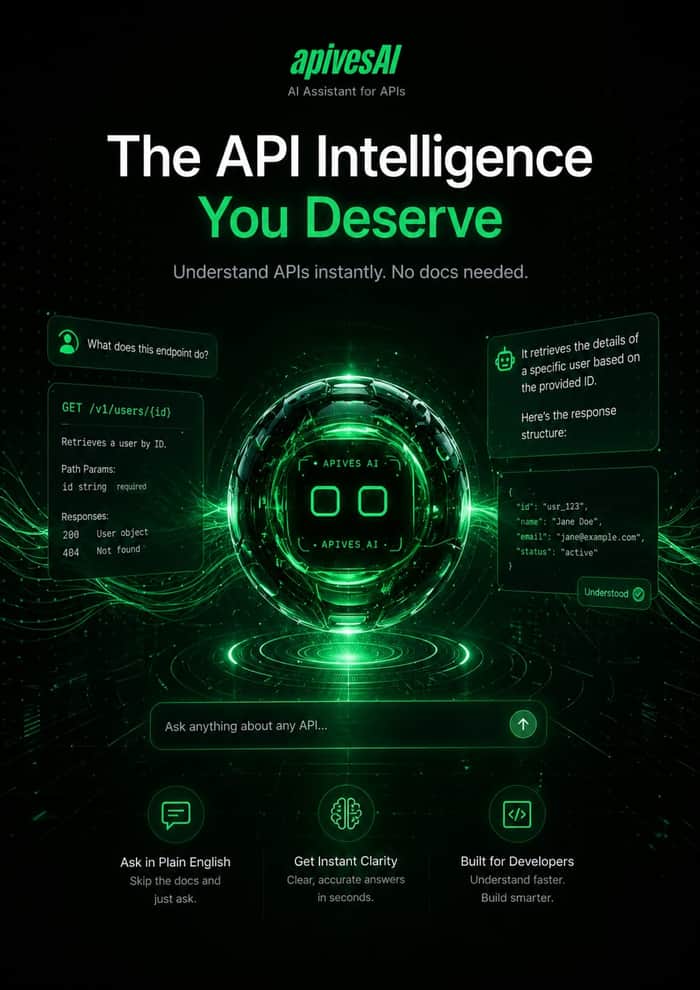
Introducing Apives AI: Your Personal API Translator
Apives is no longer just a list. It's an intelligent workspace.
The workflow is no longer "find and leave." It's "find and understand."
The Old Way:
Find an API.
Open 5 new browser tabs: the docs, a Postman window, Stack Overflow, the API's status page...
Spend an hour piecing together how to make a single POST request.
The New Way with Apives:
Find an API.
Stay on the same page and ask the AI: "How do I create a new user and what fields are required?"
Get an instant, clear answer with a ready-to-use JSON snippet.
Go back to building your actual product.
This is the solution to the other 90%. This is the tool I wish I had when I was burning out.
What I Learned (The Hard Way)
Solve the Whole Workflow: Don't just fix one step in a broken process. Look at the user's entire journey, from start to finish, and solve for that.
Listen to What's Not Being Said: Users said they "liked" the site, but their actions showed they were leaving to do the "real work" elsewhere. The real feedback was in their behavior.
The Harder Problem is Usually the Right One: Building the curated list was easy. Building the AI was brutal. But the brutal path led to a 10x better solution.
I Need Your Help
This has been a long and lonely journey, and now I need a reality check from the smartest community I know. I need you to be my harshest critics.
I'm not asking you to "check out my project." I'm asking you to help me test a new way of working with APIs.
👉 Try the "post-documentation" workflow here: Apives.com
Please, try to break it. Ask it stupid questions. Ask it hard questions. Tell me where the AI fails, where it's slow, and where it's just plain wrong.
Does this actually solve the "other 90%" of the problem for you?
Your honest, brutal feedback would be the most valuable thing in the world to me right now.
Thank you for reading my story.

The 10 percent / 90 percent framing is the sharpest thing in this post, and the meta-lesson goes even further: when users tell you what they 'like' about your product, that's usually the least useful signal. The actual gold is in what they do right after leaving you, because that's where the workflow you didn't solve still lives. The bigger strategic question I'd pressure-test next is defensibility. Anyone with API docs and an LLM can build the basic version of what you described. The moat over time becomes whatever proprietary training data and edge-case handling you accumulate from real users hitting real APIs. The faster you can structure 'when the AI was wrong' into a labeled feedback loop, the harder it becomes to copy you. That's where I'd point the next 90 days, not at features.
This is a much stronger shift than “API directory with AI.” The real positioning is that Apives is moving from discovery into API comprehension, which is where the developer pain actually starts. Finding an API is useful, but understanding the docs, edge cases, required fields, auth flow, and real request structure is the expensive part.
I’d make that “post-documentation workflow” idea much more central. That phrase has teeth because it suggests the product is not just helping users search docs faster, but replacing the painful part after discovery where developers normally open five tabs and lose momentum.
One thing I’d watch is the Apives name. It made sense when the product was an API list, but now the product feels broader: an intelligent workspace for understanding and using APIs. If this becomes serious devtool infrastructure, Exirra.com would carry that expanded direction better than a name still tied closely to “API” discovery.