I Was Spending More on Fertilizers Than Seeds—Until I Started Turning Waste Into Profit
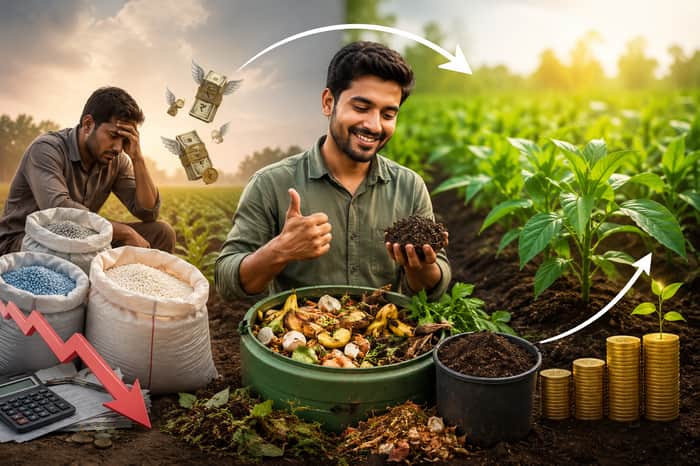
There was a time when my farming costs didn’t make sense.
Every season, I was spending heavily on fertilizers. Prices kept rising, and somehow, the soil still didn’t feel right. Crops grew, but not with the strength or consistency I expected.
It felt like I was constantly feeding the land—but never actually improving it.
That’s when I started looking at something I had been ignoring completely:
Farm waste.
Not as something to throw away—but as something valuable.
That shift led me to organic composting. And over time, it didn’t just reduce my costs—it changed how I think about farming entirely.
1. The Problem I Didn’t Notice for Years
Like many farmers, I believed:
Good farming = adding more inputs
So every season looked like this:
- Buy fertilizers
- Apply them
- Hope for better yield
But the hidden problem was:
- Soil was becoming dependent
- Natural fertility was decreasing
- Costs were increasing without long-term gain
It’s a cycle that feels productive but slowly weakens the system.
I didn’t realize that I was solving short-term problems while creating long-term ones.
2. Waste Is Only Waste If You Don’t Use It
One day, I looked around the farm differently.
Crop residues, animal waste, organic scraps—things I usually ignored or discarded—were everywhere.
That’s when the idea clicked:
What if the farm already has what it needs?
Organic composting is simply:
- Collecting organic waste
- Letting it decompose naturally
- Turning it into nutrient-rich compost
It sounds basic. And it is.
But the impact is not small.
Instead of buying fertility, you start creating it within your own system.
3. Composting Doesn’t Just Feed Plants—It Builds Soil
This was the biggest difference I observed.
Fertilizers feed crops.
Compost feeds the soil.
And when the soil improves:
- Crops grow stronger
- Water retention increases
- Roots develop better
- Overall resilience improves
I started noticing that the soil became softer, darker, and more alive.
It stopped behaving like a surface I had to manage—and started acting like a system that supports growth on its own.
4. The Cost Shift That Changed Everything
Initially, I didn’t start composting to save money.
But that’s exactly what happened.
Gradually:
- Fertilizer purchases reduced
- Input dependency decreased
- Waste management became useful, not a burden
Over time, the numbers became clear:
I was spending less, but getting better results.
And more importantly, those results were becoming consistent—not dependent on external inputs every season.
5. It’s Simple, But It Requires Patience
Let’s be honest—composting is not “instant”.
You don’t see results in a week.
You need:
- Time for decomposition
- Consistency in adding materials
- Basic understanding of balance (dry + wet waste, airflow, moisture)
Many people quit early because they expect quick results.
That’s the mistake.
Composting is not a quick fix. It’s a system you build over time.
Once it starts working, it keeps giving.
What Changed for Me
After consistently practicing organic composting:
- Soil quality improved naturally
- Farming costs became more controlled
- Waste stopped being a problem
- Crop health became more stable
But more than anything, I stopped depending entirely on external inputs.
That shift gives you control—and confidence.
In farming, we often look outside for solutions:
better products, better chemicals, better techniques.
But sometimes, the answer is already within the farm.
Organic composting is one of those answers.
It’s not complicated.
It’s not expensive.
But it requires a change in mindset.
From:
“What should I buy?”
To:
“What can I build from what I already have?”
And that question changes everything.
If you want a more detailed, practical guide on how to start organic composting, what materials to use, and how to do it step-by-step, I’ve broken it down here:
Organic Composting: Turning Waste into Nutrient-Rich Soil
This will help you move from idea to actual implementation.
