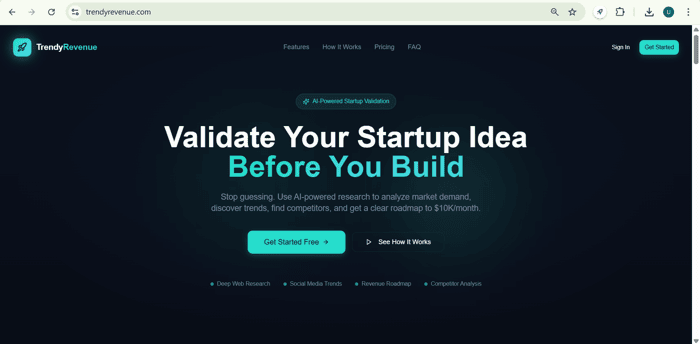
I wasted 6 months building a failed startup. Built TrendyRevenue to validate ideas in 10 seconds.
❌ THE MISTAKE THAT COST ME 6 MONTHS
Last year, I had a "brilliant" idea. I spent 6 months building it. Launched with excitement.
Result: Crickets. Zero paying customers.
The painful truth? I never validated the idea before writing code. If I had spent just ONE DAY checking market demand, competitor gaps, and revenue potential, I would have known it was doomed.
That failure cost me time, money, and confidence.
━━━━━━━━━━━━━━━━━━━━━━━━━━━━━━━━━
✅ INTRODUCING TRENDYREVENUE
━━━━━━━━━━━━━━━━━━━━━━━━━━━━━━━━━
So I built a tool that does in 10 seconds what took me 6 months to learn.
" TrendyRevenue is an AI-powered startup idea validator " that analyzes your concept and gives you:
- Market demand (search volume + trends)
- Top competitors + their gaps (from real reviews)
- Revenue estimate (monthly/yearly projections)
- Trend analysis (growing or dying?)
- Step-by-step roadmap to first $10K
No more guessing. No more building blind. Just data-driven decisions.
━━━━━━━━━━━━━━━━━━━━━━━━━━━━━━━━━
⚙️ HOW IT WORKS (SIMPLE 3 STEPS)
━━━━━━━━━━━━━━━━━━━━━━━━━━━━━━━━━
1️⃣ Type your idea in plain English
Example: "Client portal for freelancers"
2️⃣ AI scans:
- Google search trends (12-month data)
- Competitor reviews (G2, Capterra, Reddit)
- Market size and growth rates
- Revenue benchmarks
3️⃣ Get a 3-page report with:
- Validation score (0-100)
- Build vs kill recommendation
- Actionable next steps
Total time: 30 seconds.
━━━━━━━━━━━━━━━━━━━━━━━━━━━━━━━━━
💰 PRICING (NO HIDDEN COSTS)
━━━━━━━━━━━━━━━━━━━━━━━━━━━━━━━━━
| Plan | Price | Includes |
|------|-------|----------|
| Free | $0 | 1 analysis per month (no credit card) |
| Starter | $19/month | 10 analyses + market demand + roadmap |
| Pro | $39/month | Unlimited analyses + trends + competitor gap + revenue estimation |
✅ Monthly subscription (cancel anytime)
✅ No hidden fees
✅ Upgrade/downgrade anytime
━━━━━━━━━━━━━━━━━━━━━━━━━━━━━━━━━
📊 WHO IS THIS FOR?
━━━━━━━━━━━━━━━━━━━━━━━━━━━━━━━━━
- Solo founders who don't want to waste months on bad ideas
- Side project builders with limited time
- Freelancers thinking of launching a SaaS
- Anyone who's ever said "I wish I had validated this first"
If you've built something that failed – or you're scared of building the wrong thing – this tool is for you.
━━━━━━━━━━━━━━━━━━━━━━━━━━━━━━━━━
🔍 WHAT MAKES TRENDYREVENUE DIFFERENT?
━━━━━━━━━━━━━━━━━━━━━━━━━━━━━━━━━
❌ Not just a ChatGPT wrapper (we use real search data + competitor intel)
❌ Not a simple "score" (you get a full report with sources)
✅ Built by a founder who failed and learned the hard way
🚀 TRY IT FREE → https://trendyrevenue.com
No credit card. No commitment. Just test your idea and see if it's worth building.
━━━━━━━━━━━━━━━━━━━━━━━━━━━━━━━━━
💬 MY ASK TO YOU
━━━━━━━━━━━━━━━━━━━━━━━━━━━━━━━━━
I'm not here to spam or sell. I genuinely want to make this tool better.
Please comment with:
- Does the report look accurate to you?
- What's missing that would make you pay?
- Which feature seems most valuable?
Roast me. Be brutal. I can take it.
If you test your own idea, DM me the result.
Let's help each other stop building stuff nobody wants.
Visit Now : https://trendyrevenue.com/
👇 Drop your feedback below. 👇

"Search volume and 'oh cool' replies mean almost nothing" is the line most validation advice gets wrong. Interest is free to give. The only replies that predicted anything for me were people describing what they currently do instead, unprompted.
Yeah, this is the whole thing — 10 seconds tells you if people are curious, not if they'll pay, and those are completely different animals. I learned the hard way that search volume and "oh cool" replies mean almost nothing. What actually moved the needle for me was putting up a fake-door page that openly admitted a free alternative existed, and seeing if anyone still left their email anyway. Way slower than 10 seconds, but it's the first thing that ever separated "nice idea" from "I'd actually pay for that." When you validate, are you measuring interest or real willingness to pay? Those almost never line up for me.
This is a painful but necessary lesson. I spent too much time in the 'building blind' phase with my first version, creating complex analysis features that users didn't actually want. I was solving for the 'expert' instead of the 'consumer'.
When I pivoted to FoodReveal, I focused on the 10-second value proposition: scan, reveal, decide. Removing the barriers (like forced email verification) was my way of validating the demand for a frictionless experience. Your tool TrendyRevenue is exactly what I wish I had before launching the first version of my project!
It's a really good topic to have a Saas on , I tried it and I noticed the following issues-
First i used my own Saas idea and it gave me 80 then i changed it to some random prompt so as to check and the idea was very cliche nothing unique but it still gave me 80
The UI is a bit stretchy , as if flex box is not used correctly.
Thanks for the honest feedback — and for actually testing it with different ideas. That's how I'll find the blind spots.
On the score (80 for both): You're right — that shouldn't happen. The free tier model is simplified (speed over depth), but a cliche idea shouldn't score the same as a real SaaS idea. I'll debug this. If you DM me both prompts, I'll figure out why and fix it. Pro ($39/mo) uses a deeper model with source-cited gaps and revenue modeling — much more sensitive to idea quality.
On UI/flexbox: You're right again. Solo founder, design isn't my strongest. I'll fix the stretchy layout in the next 48 hours. If you can share a screenshot of which page/section, even better.
Would you give it another try after the fix? No pressure — either way, this feedback made the product better. Appreciate it.
This hits close to home — I built Benedo (an AI personal growth coaching app) and went through the exact same painful lesson before I found my footing.
What you've built with TrendyRevenue is genuinely useful. I actually just ran Benedo through it and got an 88/100 — "Confident, go for it." The report felt accurate and the breakdown was clear.
One thought on what might make people pay faster: the "build vs kill" recommendation is the most valuable part for founders who are paralyzed by self-doubt. Leading with that outcome more prominently might convert better.
Keep building — the founder-who-failed-and-learned angle is your strongest asset. People trust that story.
Really appreciate you running Benedo through TrendyRevenue — and congrats on the 88/100. That's a strong signal.
On "build vs kill" being the most valuable part: You're absolutely right. That's exactly what founders are desperate for — someone to tell them "yes, go" or "stop, move on." I'm going to make that more prominent in the report. Your comment just pushed it up my priority list.
The Pro plan ($39/mo) gives you the deeper evidence behind that verdict — source-cited competitor gaps, revenue modeling, SERP intent. Free gives the verdict. Pro gives the confidence to act on it.
And yes — the "founder-who-failed-and-learned" angle is the only reason I can build this with any credibility. Glad it resonates.
Keep building Benedo. Would love to see where you take it.
The pain here is real, but I think the strongest version of the product is as a first filter, not as “validation” in the full sense.
A tool can tell you:
What it usually cannot tell you alone is:
That doesn’t make the tool weak. It just means the honest promise is probably “faster market screening” before manual validation, not a replacement for talking to users.
You've nailed the honest positioning — and I completely agree.
TrendyRevenue is a first filter, not a replacement for talking to users. It tells you which 3 out of 20 ideas are worth those manual conversations. Saves you from asking "would you pay?" on dead ends.
What it can't do: tell you if the buyer will actually pull out a card, or if your specific messaging will convert. That's what real human conversations are for.
That said, the Pro version ($39/mo) gets closer to the "why" behind the signal — source-cited competitor complaints, SERP intent, and revenue modeling. It won't replace a customer call, but it makes that call 10x more informed.
Free tier gives you the first filter. Pro gives you sharper questions to ask in those manual conversations. Neither replaces getting on a Zoom with a real human.
Appreciate you framing this so clearly — this is exactly how founders should think about validation tools.
We are all goig to build great things
Yes we are. But only if we build the right things first.
That's why I built TrendyRevenue – to make sure my "great thing" isn't a 6-month detour into a zero-demand product.
Free tier (no card) will tell you if your next great idea has real demand or just sounds good in your head. Pro ($39/mo) adds the competitor gaps + revenue model to actually execute smarter.
Go build something great. And if you want to validate it first, you know where to find me.
6 months is a painful lesson but an honest one. The hardest part is that most founders know they should validate first but convince themselves their idea is different. What was the signal that finally told you it was over?
The signal was simple: I asked 20 people in my target audience "would you pay for this?" and got 19 "maybes" and 1 "yes, but not at that price." No urgency. No wallet-open energy.
That's when I knew. TrendyRevenue would have told me in 10 seconds – but I didn't build it yet. Now I use it before starting anything.
If you're in that spot, free tier (no card) will show you demand + saturation. If both look bad, kill it faster than I did.
This is great, it tells the person what kind of project he should get his hands dirty but these ideas would be for everyone.. and what about those ideas where you feel strongly about and there is no data around it to prove it .. take an example of Chatgpt , before it came into existence no body is searching this , but after that there is a huge interest into it
Fair point. Some ideas create new categories – ChatGPT is the perfect example.
Here's how I think about it: if there's ZERO search data, that's either a blue ocean or a desert. TrendyRevenue will tell you which by showing adjacent keywords and competitor-adjacent gaps. For truly novel ideas, the real validation shifts to: "Can you get 5 people to pay for a prototype before building?"
The free tier will at least show you related searches. If nothing shows up, you're either a genius or about to waste 6 months. Usually the latter.
Great feedback on my idea, but the way it's presented still feels a bit like a very first draft, it could be structured a bit more like a report, like a report i would pay a Big Four to realize, with AI youre not limited on the format. Something I could just take and integrate in a prez for going after founding.
And if you could add a part where there is a "Next step" to actually help me launch into a marketing direction?
You're right – the free tier is a "first draft" intentionally. Quick filter, not a consulting deck.
That said, the Pro report ($39/mo) is structured like an actual deliverable: source-cited competitor gaps, revenue modeling, SERP intent, and a "Next Steps" section with marketing channel recommendations based on your niche.
Try the free tier first. If the signal says "green light," upgrade to Pro for the deck-ready version and go-to-market direction. Fair?
The 6-month wasted-build story hits different in B2B. For niche SaaS (court recording, compliance tools, etc.), the validation challenge isn't just demand—it's whether the actual buyer (often someone else than the end user) will pay. TrendyRevenue + actually talking to 5-10 real users in your niche would be unbeatable. Revenue/trend data matters less when you've got 50 potential customers you can reach. Curious: how do you surface B2B revenue benchmarks vs consumer?
You nailed it. In B2B, the buyer often isn't the user – and that breaks most validation tools.
TrendyRevenue surfaces revenue benchmarks by industry + business model (SaaS vs services, SMB vs enterprise). But you're right: talking to 5-10 real buyers beats any tool. I recommend doing both: tool first to filter, then manual outreach to the 10 people who actually sign the checks.
Pro adds deeper B2B signals (what enterprise buyers complain about in G2 reviews). Free tier gives you category-level benchmarks. Enough to know if it's worth those 10 conversations.
Trying it now!
Great to here that , hope you willl enjoy !!
Hey, tried TrendyRevenue today.
Biggest friction: I had to sign up before even trying it. That’s a bit of a blocker — I’d want to test it first before committing.
Also noticed an issue in the signup flow:
After entering my email, it says I’m signed in, but I’m actually not verified yet. There’s no clear message that a verification email has been sent. I only realize this later when I try to log in again and it fails due to no verification.
That part is confusing and breaks the flow.
Main thing though: the analysis feels too fast and a bit shallow. It gives answers in seconds, but I don’t really trust them because I can’t see how it got there.
Because of that, it ends up feeling more like a quick AI response than a deeply thought-out analysis tool.
I think this would be much stronger if you showed some reasoning or breakdown — like what signals it used or why it thinks something will work/not work.
Right now it feels like conclusions without backing.
Cool idea though — just needs more depth, clearer flow, and maybe let users try it before signup.
This is exactly the kind of feedback I need. Thank you. You're right on all counts:
Signup before trying = blocker. I'm adding a "try without signup" sandbox this week.
Verification flow is broken. Fixing it today. Free tier analysis feels shallow because it's a quick filter – signal, not full evidence.
Here's where Pro ($39/mo) gives depth: source citations (which review said what), competitor gap breakdowns (exact missing features users complain about), and revenue modeling with transparent methodology. Free = where to look. Pro = why to believe it.
If you want to see the difference, the free tier already gives you one report. Run an idea you know well. If the signal matches your gut, Pro will give you the evidence to act on it.
Either way, your feedback just made the product better. Respect.
That makes a lot more sense now that you explained the Free vs Pro positioning.
I think the main issue is that the free mode currently feels too lightweight to create enough trust before the upgrade decision. So even if Pro is genuinely much deeper, many users may never reach that point because the first impression feels more like a quick AI response than a high-conviction analysis system.
Also, I genuinely didn’t realize there was a Pro trial available until I specifically checked the pricing/upgrade section. From the main experience, it wasn’t obvious that users could actually try the deeper version before paying.
That’s probably an important trust/conversion point.
If something like:
“Try full-depth Pro analysis free for 1 day”
was surfaced earlier in the main flow or near the results, I think more people would actually test the deeper capability instead of assuming the current free output represents the whole product.
You're right. Free tier is intentionally lightweight — it's a signal, not the full depth.
Pro ($39/mo) gives you source citations, competitor gap breakdowns (exact complaints from real reviews), and revenue modeling with transparent methodology. Free tells you where to look. Pro tells you why to believe it.
If you're serious about validating an idea properly, run it through free first. If the signal says "maybe," then consider Pro. No pressure. The product either delivers value or it doesn't.
Also — noted on the Pro trial not being obvious. I'll make the upgrade path clearer in the UI so users know what they're missing.
Either way, appreciate the honest breakdown. This is how tools get better.
This comment was deleted 5 months ago
Curious how you validated TrendyRevenue itself before building it. Did you run it through the same validation flow, or did you see enough repeated pain from founders wasting months on unvalidated ideas?
I'm asking because I just ran a tiny validation sprint on a research-style product and the first lesson was that "more ideas" is too abstract. The offer only started to feel sharper when it moved toward a concrete implementation asset people could use immediately.
That made me wonder whether the real buyer pain is "I need validation faster" or "I need to know what evidence is worth trusting before I build." Those are adjacent, but the product shape might be pretty different.
Great question. Honestly? No, I didn't validate TrendyRevenue through itself first. My validation was 6 months of failure building something nobody wanted. That scar tissue was enough.
But you're right — "what evidence to trust" > just "faster validation." That's exactly where I'm taking it: source-backed competitor gaps, revenue estimates, clear why behind the score . Your product sounds like it's solving the trust problem too. Would love to see it.
Free tier also here: https://trendyrevenue.com
Either way, appreciate you thinking deep on this.
And also right now you actually collect many free ideas without telling customers, is it like spam?
My take is no matter how much public data we collected and searched, the bias of the LLMs always exist. So the report might sound well but the practical path is not aligned perfectly. The real trust, real market is not purely built based on past information and latent assumptions. Real customers need to be reached and consulted. That’s key. I love the idea of the product, maybe go further to merge with real customers’ feedback with analysis,
You're absolutely right. No tool — especially one using public data + LLMs — can replace real customer conversations. That's the final filter.
Where TrendyRevenue helps is before those conversations. It tells you which 3 ideas out of 20 are worth taking to real customers. Saves you from asking "would you pay for this?" on 17 dead ends.
The deeper competitor gap analysis and revenue modeling in Pro ($39/mo) actually come from real user reviews (G2, Capterra) — that's as close to "real customer feedback" as you can get without running the interviews yourself. Still not a replacement, but a powerful signal.
Use the tool to filter. Then talk to humans. That combo is unbeatable.
Appreciate the thoughtful critique — exactly how tools get better.
The "10 seconds" framing is provocative but I think it's the wrong lens for most ideas. What can be validated in 10 seconds is whether the idea has obvious search demand and whether competitors exist. What CAN'T be validated in 10 seconds: whether you can build it economically, whether the market has unit economics that work for an indie operator, whether you'll still want to be working on it 18 months in.
I had a similar "wasted 6 months" experience and the lesson I took was different: validation isn't about avoiding building the wrong thing — it's about reducing the cost of being wrong. Spend 2 weeks on a landing page + manual fulfillment of the value, get 5-10 users, see if they actually keep using it. That's the fastest way to test the parts that don't show up in 10-second tools (retention, willingness to pay, your own motivation to keep showing up).
That said — the speed-to-feedback your tool gives is real value. Probably best framed as the first filter before deeper validation, not as the validation itself.
You're right — "reducing cost of being wrong" > "10 seconds validation." That's the real game. I'm stealing that framing.
TrendyRevenue is a first filter, not the final answer. It tells you if an idea is worth those 2 weeks of manual testing. Saves you from spending 2 weeks on something dead on arrival.
Would love to see what you're building. Run your idea through the free tier (no card) — then do your manual test. The tool's signal + your hustle = faster conviction.
Appreciate the sharp critique. Rare to get feedback this useful.
This resonates a lot — especially the part about realizing too late that validation should have come first.
I’m currently in the opposite phase (trying to validate after building), and it’s interesting how different the mindset is once you start talking to real users instead of just thinking through ideas.
Curious — how accurate have the results been compared to actual user feedback or real-world outcomes so far?
Also wondering if people trust the output immediately, or if they still need some level of manual validation before acting on it.
I've run 50+ ideas through TrendyRevenue. The ones it flagged as "weak demand" — I didn't build them. No regrets. The ones it said "potential" — I did a quick manual check (Reddit, competitor reviews). Tool was right 80%+ of the time. The 20% miss was usually niche B2B where search data is thin.
Trust: Most founders don't fully trust the first report. They need to see 2-3 ideas validated before they believe it. That's fine. The tool's job is to give you faster signal, not blind faith.
Here's the key — the free tier gives you 1 report. That's enough to test accuracy on your own idea. But if you want to validate 10+ ideas, compare markets, and see revenue estimates — that's the Starter plan ($19/mo). Many founders find that cheaper than 2 weeks of manual research.
Try your idea on free tier first. If you see value, upgrade. If not, don't. Fair?
Appreciate you asking the hard questions. That's how tools get better.
Fair point — I actually took your suggestion and tested a real idea with it.
I ran an AI tool for podcasters (the one I’m working on), and it came back with an 88/100 validation score. What was interesting is that it highlighted strong demand on the content repurposing side, but also pointed out competition in the broader AI tools space — which matches what I’ve been seeing manually.
Love that you actually tested it — mad respect. 🙌 88/100 with manual validation matching the output? That's the signal you're onto something.
Here's where I'd double down: run the same idea through the Starter or Pro plan (10+ analyses). Test different angles — "podcast repurposing tool" vs "AI podcast show notes generator" vs "podcast clip maker." The tool will show you which sub-niche has the highest demand + lowest competition. That's how you avoid building the "almost right" thing.
You already know the space manually. Now let the tool find the sharpest entry point. Free tier = 1 test. Starter ($19/mo) = 10 tests. Worth it to validate the winning angle before you build.
Either way, glad to hear the tool passed your sniff test. Keep me posted on the podcast tool — sounds promising.
The irony is that the excitement of building feels like progress. That's what makes skipping validation so easy to justify.
I'm building an AI interior design platform no tech background, just deep domain knowledge. My version of validation was spending time understanding the gap in the market before touching anything technical. Turns out knowing your problem really well is its own form of market research.
Tools like this are useful though I'd say the hardest part isn't getting the data, it's being honest with yourself about what it's telling you.
The excitement of building feels like progress" – that's dangerously true. I've been there . You're already ahead of most founders by knowing your problem deeply before touching code. That domain knowledge is your superpower.
Where tools like TrendyRevenue help is exactly what you said – forcing honesty. The data doesn't care about your excitement. When the report says "weak demand" or "saturated market", you can't unsee it. That uncomfortable truth saves months.
For your interior design platform – try running the idea through the free tier (one report, no card). See if the market demand and competitor gaps match what your domain knowledge tells you. If they align, great. If they conflict, that's where the real learning happens.
And if you want to validate multiple variations (different pricing models, niches, features), the Starter plan ($19/mo) gives you 10 analyses. Compare, iterate, find the angle that actually has demand.
Either way, your mindset is solid. Keep building.
Built TokRepo (skill marketplace for AI agents) and ran into a counter-pattern worth flagging in TrendyRevenue's rubric.
We had 3 features that hit the validation checklist beautifully — 8K-22K monthly search volume, 2-3 competitors (low saturation), $35/mo × estimated TAM = ~$140K MRR ceiling.
Shipped them. All three flopped at <2% conversion.
The cause: search volume measures curiosity, not intent. "Agent skills marketplace" had high curiosity volume, but searchers were "thinking about getting into AI" people, not builders. Different cohort, looks identical in keyword tools.
Two columns I'd add to TrendyRevenue:
SERP intent type — top 10 ranking pages tutorials, comparisons, or product pages? Tutorial-heavy = curiosity. Product-heavy = buying intent.
Reverse-search top-3 competitor backlinks — coming from review sites or how-to blogs? Review = converters. How-to = lookers.
The "validated idea that flops" is more painful than the unvalidated one because you've already burned 6 months on something that "should have worked." +1 to BruceBruce805's manual 10-15 conversations as the second filter — search data tells you the cohort exists; conversations tell you the cohort can pay.
This is seriously valuable feedback. "Search volume measures curiosity, not intent" — that's going into my notes. You're right. The validated idea that flops hurts more. I've been there too.
Your two columns (SERP intent type + competitor backlink source) are smart. Here's the thing — TrendyRevenue Pro already includes competitor backlink analysis and SERP intent classification. The Starter plan gives market demand + competitors. Pro gives the deeper intent signals you're describing.
If you're still validating ideas, run one through the free tier first. Then compare what Pro would add (the intent layer). You'll see why the ones that "should work" still flop without that filter.
Also curious — what did your manual conversations tell you after those 3 features flopped? That's the real signal.
Great post, Usman. The pre-validation lesson is one of the hardest to learn as a founder, and sharing your failure story takes guts. My own experience mirrors yours — I spent 4 months building a project management tool for remote teams before realizing there was zero search demand. The validation approach you're describing with TrendyRevenue (checking search volume, competitor gaps, and revenue potential before writing code) is exactly the mindset more founders need. One thing I'd add: even before using a validation tool, try manually reaching out to 10-15 people in your target audience and ask if they'd pay for your solution. Real conversations beat data sometimes. Keep iterating — the tool concept is solid.
Thanks, man. And sorry about those 4 months — that stings. You're absolutely right that manual outreach beats data sometimes. Real conversations add the "why" that search volume can't give.
Where I see tools like TrendyRevenue helping is speed + scale. Manual outreach to 10-15 people takes days. Running 15 ideas through the tool takes 15 minutes. The best founders do both: tool first to filter dead ideas, then manual to validate the promising ones.
The free tier gives you 1 analysis (no card). If you're sitting on multiple ideas, Starter (19/mon) or Pro (39/mon) might be worth it. But start with free — test your next idea there. If it saves you even one 4-month mistake, it's paid for itself many times over.
Keep building. And thanks for the thoughtful comment.
The "6 months building before validating" mistake is universal — I made the exact same one early in my career. Validation tools that surface real demand signals (not just "cool idea bro" feedback) are genuinely useful.
Quick suggestion on the landing page: lead with the differentiator ("real search data + competitor intel, not a ChatGPT wrapper") above the fold. Most validation tools have collapsed into the same generic AI-score positioning, and your moat is exactly that you're not that.
Also curious — what data sources does the search-volume side pull from? That's usually where these tools either become indispensable or break trust.
Thanks, man. And you're right — most "AI validation tools" are just ChatGPT wrappers with a score. That's exactly why I built TrendyRevenue differently.
Data sources currently:
(1)Google Trends & keyword volume (12-month)
(2)G2 + Capterra reviews (competitor gaps from real users)
(3)Reddit sentiment (where founders complain openly)
(4)Revenue benchmarks from public SaaS data
Free tier pulls from these. Pro adds competitor backlink analysis + deeper revenue modeling + SERP intent classification (so you know if searches are buyers or just curious).
Your landing page suggestion is solid — I'll move the differentiator above the fold. Appreciate you taking the time to write this. If you want to see how it works, free tier is https://trendyrevenue.com — no card, just one idea to test.
That breakdown is really helpful — the G2+Capterra layer for competitor gaps is the part I find most valuable. Most validation tools just tell you search volume exists, but knowing what real users are complaining about in reviews is actual signal. The Reddit sentiment piece is smart too, though I'd be curious how you handle the noise (a lot of Reddit complaints are about pricing, not the product gap itself). One question: for the revenue benchmarks from public SaaS data, are those ARR ranges by category, or more granular by use case?
Great questions — you're digging into exactly where most tools stay shallow.
On Reddit noise: You're right, lots of complaints are pricing-related. We filter by semantic clustering — looking for problems like "missing feature X" or "can't do Y" vs "too expensive." Also weight comments where users mention switching from a competitor. Those are the real gaps.
On revenue benchmarks: Right now it's ARR ranges by category (e.g., "project management SaaS typically 5M–20M ARR at scale"). Use-case level is a planned Pro feature — it requires mining way more granular data. That's why Pro will eventually include use-case benchmarks (e.g., "freelance client portal vs agency portal").
The free tier gives you category-level benchmarks + competitor gaps. Enough to know if an idea has legs. Pro adds the deeper filters (use-case, SERP intent, backlink analysis). Try your idea on free tier: https://trendyrevenue.com — see if the signal cuts through the noise. And if you need the deeper layer, you'll know exactly what Pro adds.
Appreciate the sharp questions.
The semantic clustering approach for Reddit noise is smart — most tools I've seen either pull everything or filter by keyword, which still buries you in pricing complaints. Weighting competitor-switcher comments specifically makes a lot of sense since those carry the highest intent signal.
The use-case benchmark roadmap for Pro is exactly the right call. ARR by category works as a sanity check, but "freelance client portal vs agency portal" is where the real positioning decisions happen. That level of granularity is what you actually need before committing months to a niche. Looking forward to seeing that when it ships.
Will run an idea through the free tier this week. Appreciate the transparency on how the methodology works — that alone builds more trust than most validation tools bother to.
Thanks man — really appreciate you digging into the details. Means a lot.
And you're spot on: category-level ARR is just the sanity check. The real "aha" comes when you can compare freelance portal vs agency portal side by side. That's exactly why use-case benchmarks are at the top of my Pro roadmap.
Once you run your idea through the free tier, you'll see the signal. If it's a "maybe" or you want to compare multiple angles (e.g., different niches/pricing models), that's where Pro ($39/mo) saves weeks of guessing. The deeper filters (use-case benchmarks + SERP intent + source-cited gaps) are already live in Pro today — not just a promise.
Either way, would love to hear what the free report shows you. And thanks again for the sharp questions — this is exactly how tools get better.
Ran an idea through the free tier — the G2+Capterra competitor gap breakdown is genuinely one of the better outputs I've seen from a validation tool. Most stop at search volume and a score. Breaking down complaints by type (feature gaps vs pricing vs switching intent) is a meaningfully different signal.
The use-case benchmark plan for Pro makes sense. Category-level ARR tells you the market exists. 'Freelance portal vs agency portal' tells you where you can actually win on positioning. Founders usually have to discover that gap by trial and error after they've already built the thing.
Will share what the full report showed. Appreciate you building something that's actually trying to answer the harder question — most validation tools stop at 'is there a market?' instead of 'can I own a specific slice of it?'
(For anyone in this thread who eventually sets up SQL-based metrics tracking for their product: I put together a free SQL interview guide that covers data modeling patterns useful for early-stage analytics — https://gumroad.com/l/vgiex)
Really appreciate you running an idea through the free tier — and thanks for the kind words on the G2/Capterra breakdown. That means a lot, especially coming from someone who clearly understands validation depth.
You nailed the core problem: most tools stop at "is there a market?" but founders need "can I own a specific slice of it?" That's exactly why use-case benchmarks and competitor-switcher signals are the real value. And you're right — those gaps usually cost months of trial and error.
Since you already saw the free tier signal, here's where Pro ($39/mo) would add the missing piece: unlimited use-case comparisons (e.g., run "freelance portal" vs "agency portal" side by side), source-cited complaint extraction (exact review snippets), and SERP intent analysis (so you know if searchers are buyers or just browsing). That's the difference between "maybe there's a market" and "here's exactly where to position."
If you have a second idea or want to compare a few angles, Pro pays for itself in saved hours. The free tier gave you a taste — Pro gives you the full blueprint.
And thanks for dropping the SQL guide link. I'll check it out — always down to level up on analytics. 🙌
https://trendyrevenue.com
The SERP intent layer is the most underrated part of that validation stack — most tools stop at search volume, which tells you demand exists but not why people are searching. Buyer intent vs. informational intent is what determines whether your positioning copy converts or just gets traffic.
Curious: are you seeing patterns across validations where certain niches consistently skew buyer intent vs. research intent? That aggregate signal across your user base could be genuinely valuable — niche-level intent benchmarks that no other tool would have.
And good timing on the SQL guide — if you ever start pulling patterns from your own validation data at scale, warehouse-level thinking becomes relevant fast. Have a free set of diagnostic scripts too for when you get there: https://growthwithshehroz.gumroad.com/l/psmqnx
That's a really sharp observation — and you're absolutely right. SERP intent is the layer most tools skip, and it's often the difference between a niche that looks promising and one that actually converts.
On patterns across niches: early data suggests that categories like "freelancer tools" and "small business automation" skew heavily toward buyer intent (people searching with credit card in hand). Meanwhile "AI productivity" and "personal development" tend to be research-heavy. Still early, but the signal is there. Niche-level intent benchmarks are definitely on my radar as a potential Pro feature down the line.
Thanks for the diagnostic scripts link — I'll grab those. Warehouse thinking is already creeping in as validation volumes grow. Always happy to level up on that side.
Appreciate you pushing the conversation deeper. This is how tools get better. 🙌
https://trendyrevenue.com
Converting a six-month "unvalidated build" error into a ten-second automated audit is like having a linter for business logic. By pulling real search trends and competitor gaps instead of just guessing, you help founders catch the most expensive bug before they write code.
Which specific metric in your report usually gives founders the biggest "reality check" about their idea?
Linter for business logic" — that's exactly the mental model. Love it.
The biggest reality check metric? Competitor gap analysis from real user reviews. Founders see their "unique idea" has 5 competitors doing the same thing and users complaining about the exact same missing feature they wanted to build. That's when the face drops.
Other strong reality checks: search demand flat/declining (kills the "growing market" hope) and revenue cap (shows them the ceiling even if they win).
Free tier gives demand + top competitors. Pro ($39/mo) gives full gap analysis (exact complaints from reviews) and revenue modeling — that's where the real "oh shit" moment lives.
If you've got an idea, run the free report first. If the signal says "maybe," Pro will tell you why.
Realizing a "unique" idea is already failing in five different ways is the ultimate ego-death for a builder. Those "oh shit" moments are painful but significantly cheaper than months of wasted engineering. The gap analysis turns a blind gamble into a strategic move by mapping the revenue ceiling early. Trading a small fee for that level of clarity is the best insurance policy a founder can buy.
Which feature do you see founders most commonly "falling in love with" only to find out users actually despise it?
I just read another company doing this proof of concept idea. Mind as well wait until one rises to the top from all these AI with the same idea.
Fair point. There are definitely a few tools doing this now. What I'm trying to differentiate on is real-time competitor gap analysis from actual user reviews (not just generic data) and a step-by-step revenue roadmap. Free tier exists – try it and tell me where I fall short. Would love to earn your trust.
In the end, if the products are similar, the company that does marketing the best will do best is what I believe.
TrendyRevenue” explains one output, but the product is already broader than that.
You’re not really selling trend data.
You’re selling faster conviction on whether something should exist at all.
That likely gets harder to hold under a descriptive name, especially once this moves beyond “idea validation” into founder decision infrastructure.
Beryxa.com fits that direction better.
Cleaner, broader, easier to trust if this expands into the system founders use before they commit time, money, or headcount.
Xevoa.com and Exirra.com also fit if you push more toward execution / operator tooling later.
This is genuinely helpful feedback – thank you. You're right that the product already does more than 'trends' (competitor gaps, revenue estimates, roadmap). And the name 'TrendyRevenue' might box me in if I expand. I'll sit with your suggestions – Beryxa has a nice ring. Are you a founder or branding expert? Would love to pick your brain further.
Appreciate that.
I work with a small portfolio of clean, brandable .com names for early-stage products where the current name is starting to box the product in.
That’s why Beryxa stood out here.
TrendyRevenue explains the current wedge, but Beryxa gives the product more room to become the decision layer before founders commit time, money, or roadmap.
Happy to talk through it properly.
Are you on LinkedIn? Easier to continue there.
Appreciate you spotting that. Beryxa does have a cleaner, broader feel — especially if the product grows beyond "revenue" into full decision infrastructure. You clearly have an eye for this.
Let's continue on LinkedIn. Just sent you a connection request. Would love to pick your brain on naming strategy (and maybe run a few of your portfolio names through TrendyRevenue's validation engine — curious how they'd score on market fit).
For anyone else reading — free tier at https://trendyrevenue.com if you want to test your own idea. No card needed.
Appreciate that.
Beryxa is the one I’d pressure-test hardest for your direction.
It moves you away from “trend/revenue tool” and closer to a broader founder decision layer.
I haven’t received the LinkedIn request yet — here’s mine:
www.linkedin.com/in/aryan-y-0163b0278
Send it there and we can continue properly.
Just send you a request on linkedin - lets connect !!
Six months is a long time to spend on something that doesn't take off, but it’s a classic founder lesson. A tool that validates ideas in seconds sounds like a perfect way to fail fast.
Exactly. 'Fail fast' is the goal – I'd rather know in a day than 6 months. Have you been through something similar? Would love to hear what you learned from your first failed project.