I went from 40 support tickets/month to 8 — by stopping the question before it was asked
I run a small ecommerce store using Printful (print-on-demand).
Every day the same emails: "Where is my order?" "Has it shipped?" "When will it arrive?"
I was spending 3+ hours/month copy-pasting tracking links and answering the same question.
So I built a different system.
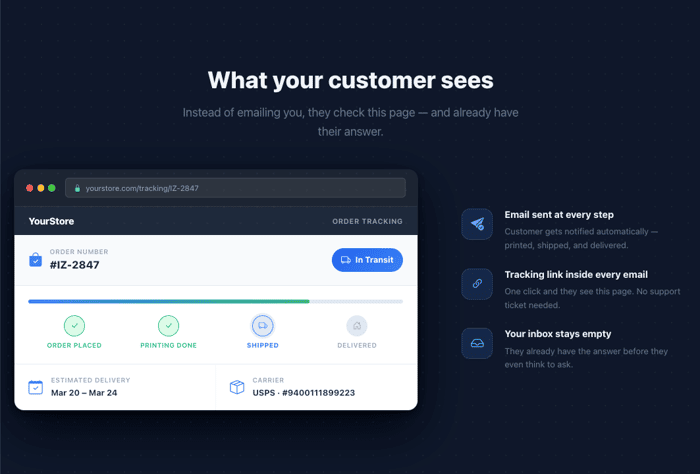
Instead of responding after customers ask, I connected my backend to Printful's webhooks. Every fulfillment event (printing started, shipped, delivered) automatically triggers a proactive email with the order status and a tracking page — no login required, token-based access, similar to how DHL works.
The result:
→ Support tickets: 40/month → 8 (-80%)
→ "Where is my order?" emails: 32 → 0 (-100%)
→ Time handling support: 3h/month → 35min
Customers never ask because they already know.
I'm now validating whether other ecommerce founders have the same pain before building this as a proper SaaS tool.
Two questions for this community:
- Does this problem sound familiar to you?
- Would a plug-and-play version of this system be useful for your store?
Landing if you're curious:
👉 https://app.lujandev.com/inbox-zero-prevention?utm_source=indiehackers&utm_campaign=launch_feb2026&utm_medium=forum

UPDATE: MVP is live and validated in production.
If you commented here with the WISMO pain — DM me.
I'll set you up for free this week.
Proactive support is underrated — you essentially eliminated the friction before it became pain. Same principle applies to failed payments: most founders react after a user churns, but the window to recover is Day 1-3. RecoverKit auto-sends a recovery sequence the moment Stripe flags an invoice failure. If you're running subscriptions, would you want to be the first tester? tryrecoverkit.com/connect — beta is free.
Thanks Heze! Totally agree, proactive is king and your RecoverKit parallel is spot on with the webhook trigger to instant recovery email.
Love it.Right now I'm still in pure validation mode for Inbox Zero Prevention, no paying customers yet and no subscriptions running, just the landing and manual betas. So no Stripe churn to recover for me... but once I get first paid users, RecoverKit will be the first thing I test!
Quick update for anyone who commented on this thread.
been iterating this week based on the feedback here. added a proper setup form so people can request access directly, and a live chat on the landing so anyone can reach me in real time. still doing everything manually for the first users.
if you run a printful or woocommerce store and deal with wismo tickets i will set it up for free in exchange for honest feedback.
https://app.lujandev.com/inbox-zero-prevention?utm_source=indiehackers&utm_campaign=launch_feb2026&utm_medium=forum
Honest answer: still in free beta, so no paying customers yet — just early beta users connecting their Stripe accounts. What I can share from the validation-to-first-user path:
The key was being very specific about who I was talking to. Not 'SaaS founders' generally, but 'solo founders with Stripe subscriptions who have seen payment failures and not done much about it.' IH was actually the best channel for this — finding posts where someone mentioned Stripe, churn, or payment failures, and adding a comment that showed I understood the problem. That got inbound interest where cold outreach probably wouldn't.
For the first paid conversion, my current theory (untested at scale): the person most likely to pay first is someone who has recently experienced the pain. Not just 'yeah I know payments fail' but 'we lost 00 last month and I was annoyed about it for a week.' Finding that person is the challenge.
What's your product? The 'stop the question before it was asked' frame sounds like proactive support — curious if that's the pattern you're building around.
really helpful, and honest — appreciate that. same boat here, still in free setup phase validating manually.
the specificity point hits hard. i've been targeting "woocommerce store owners" broadly but the ones who actually engage are always the ones who mention a specific number — "i get 40 of these a month" or "i lost 3 hours last week copying tracking links." that's the signal.
your theory on first paid conversion matches what i'm seeing too. the person closest to the pain is the one closest to paying.
my product is exactly the "stop the question before it's asked" pattern — proactive order status updates for printful/woocommerce stores via webhooks. customer gets an automatic email at every fulfillment step, no login required to track. inbox zero before they even think to ask.
landing if you're curious: https://app.lujandev.com/inbox-zero-prevention?utm_source=indiehackers&utm_campaign=launch_feb2026&utm_medium=forum
would be good to stay in touch — feels like we're building adjacent things with the same mechanic
This exact pattern — webhook event → proactive email → customer already knows before they ask — is one of the most underused patterns in SaaS.
You eliminated 80% of support tickets not by improving your support response, but by making support unnecessary. That's the right level of the problem to solve.
I applied the same logic to Stripe payment failures with RecoverKit. When invoice.payment_failed fires, most founders wait for customers to notice their subscription is gone and email in. We flip it: the webhook triggers an immediate Day 1 email to the customer explaining what happened and giving them a direct link to update their card. No support ticket needed because the customer already knows — and they have a path to fix it.
Same architecture: fulfillment webhook → proactive email → customer knows → question never asked. Different domain, identical mechanic.
To answer your question: yes, this pain is extremely common. Any Shopify/WooCommerce store with more than 50 orders/month is almost certainly drowning in 'where is my order?' emails. The ecommerce ops space has been waiting for a well-built plug-and-play version of this.
really sharp parallel with recoverkit, same mechanic different trigger. the payment failed use case is something i hadnt even considered but makes total sense. how did you find your first paying customers for recoverkit? trying to figure out how to go from validation to first paid setup
this is such an underrated mindset tbh. most ppl build reactive systems and then wonder why theyre drowning in tickets lol
we did somethign similar with one of our apps - its an artcile to audio converter and early on we kept getting "how do i use this" msgs. so instead of answering each one we just built the onboarding to answer the qeustion before they asked it. support droped like 70%
proactive > reactive every single time. the best support ticket is the one that never gets created
also curious - did u notice any change in customer retenton after implementing this? feels like ppl who feel informed probably stick aroudn longer
The retention question is the one I didn't expect to validate — but yes. Customers who feel informed don't just stop asking, they trust the brand more. That trust shows up in repeat purchases.
Your onboarding fix is the same principle. The best support ticket is the one that never gets created — that's going in my notes.
Article to audio converter sounds interesting — what's the product?
Proactive status updates instead of reactive support is such a smart shift. improving customer support is a real win
Exactly — and the shift is simpler than most founders think. You don't need AI or a chatbot. Just tell them before they ask.
The proactive approach is brilliant. I've seen this same pattern with user confusion in my apps too. When people don't know what's happening, they reach out for help, even when everything is actually working fine.
Building PadelTracker (watch app for tracking padel matches), I noticed players would often restart the app mid-match thinking it froze, when it was actually just waiting for them to tap the next point. Added a subtle pulsing animation and a 'tap to score' hint. Support questions about 'app not working' dropped to almost zero.
The token-based access without login is the real insight here. Friction creates support tickets. Remove the friction, remove the ticket. Your 'stopping the question before it's asked' framework applies way beyond e-commerce.
The PadelTracker parallel is perfect — same root cause, different domain. Uncertainty creates friction, friction creates the question.
"Friction creates support tickets. Remove the friction, remove the ticket." — that's the clearest one-liner for what this is. Saving that.
The numbers are impressive. If you turn this into a SaaS, do you see it more as a Shopify/Printful-style integration product, or something more generic for any ecommerce stack?
Great question — and honestly the most important one for the roadmap.
Starting with Printful because that's where I have production data. But the architecture is webhook-based, so it works with any fulfillment provider that sends events.
Short term: Printful + Shopify integration.
Long term: generic for any ecommerce stack.
What stack are you running?
I’m not running an e-commerce stack — TORDOX isn’t a store.
It’s an organizational control system focused on work intake, decisions, ownership, and execution review inside teams. Think governance layer rather than fulfillment or sales ops.
That said, we’re solving a somewhat similar problem from a different angle: reducing operational chaos and making “what’s happening” visible and controllable.
Your product tackles this on the customer/support side with order status and proactive updates.
TORDOX focuses on the internal side — controlling what work enters the system, who owns decisions, and how execution is reviewed :)
That’s a sharp distinction — customer-facing vs internal-facing, but same root problem.
Your framing of “making what’s happening visible and controllable” is exactly the principle. Different layer, same pattern.
Appreciate the clarity. Good luck with TORDOX.
This is basically the same pattern I've seen kill support load on every project I've worked on. The "where is my order" email is the canary in the coal mine — it tells you your system isn't communicating state changes fast enough.
I ran into something similar building internal tools. We had a dashboard that showed deployment status, but devs would still ping Slack asking "is it deployed yet?" Turns out they weren't checking the dashboard because it required a context switch. The fix was dead simple — push notifications to the channel they were already in. Ticket volume dropped to almost nothing overnight.
The token-based access bit is the real insight here though. I've seen so many order tracking implementations that require login, and customers just... don't. They email support instead because it's less friction than remembering a password. Removing that barrier is half the battle.
To answer your validation question — yeah, this pain is everywhere in ecommerce. A friend runs a Shopify store doing ~200 orders/month and easily 30% of his support is WISMO (where is my order). He'd pay for this in a heartbeat. The tricky part will be making the integration plug-and-play enough that non-technical store owners can set it up without touching webhooks directly.
The token-based detail is the whole insight.
Most tracking systems technically exist — Printful sends a number, customer goes to USPS and searches. That’s 4 steps and a context switch. So they email instead.
One click → tracking page → answer. No account, no password. The information finds them.
And here’s what surprised me: most of those 40 tickets weren’t real problems. The order was fine. Customers just didn’t know — so they asked. Remove the uncertainty and the ticket never exists.
Would your Shopify friend be open to a quick chat? 200 orders/month with 30% WISMO is exactly who I’m building this for.
Love this approach. Proactive > reactive is such an underrated principle.
We're seeing the exact same pattern but in internal operations — team members constantly asking "what's the process for this?" or "where do I find the SOP?" Instead of building better documentation, we realized the answer needs to show up where the work is actually happening, not in a separate wiki nobody checks.
Your webhook-based approach is a great example of solving the information gap at the right moment. The "anticipatory design" framing in the comments nails it. How long did it take you to set up the initial webhook integration with Printful?
The internal ops parallel is spot on — information asymmetry creates overhead everywhere, not just in ecommerce.
To answer your question: the initial Printful webhook setup took me about 3-4 hours as a developer. That’s the exact problem I need to solve for the SaaS version — making it a 5-minute setup for non-technical founders.
How are you currently handling the “where’s the SOP?” problem in your team?
Honestly, we went through the classic cycle:
Phase 1: SOPs in Google Docs → nobody could find the right version
Phase 2: Moved to Notion → better organized, but the docs drifted from
reality within weeks because updating them felt like "extra work"
Phase 3: Tried embedding SOPs directly into Jira ticket templates →
closer, but inflexible and painful to update when the process changed
The root issue we kept hitting: the SOP (how we define a process) and
the execution (tickets/checklists people actually work on) lived in
separate systems. So they inevitably went out of sync.
That's actually what pushed us to start building something where the
process template itself generates the work items. Change the template,
future work follows the new version. No separate "update the docs" step.
Still early, but the "where's the SOP?" question has basically
disappeared for the processes we've moved over — because the SOP IS
the thing people interact with daily, not a doc they have to go find.
Your webhook setup time problem feels analogous — the gap between
"knowing what to do" and "actually doing it" is where all the friction
hides.
What you're describing is essentially the same insight applied to a different layer — when the process IS the work item, the documentation problem disappears by default. That's elegant.
The analogy to my webhook setup friction is exactly right. The gap between "knowing what needs to happen" and "it actually happening" is where users drop off, give up, or just don't bother.
Out of curiosity — the founders you're building for with your tool, are any of them running ecommerce operations? I'm trying to map how widespread the "reactive support" pain is across different founder profiles before I commit to a full build.
Thanks — "the process IS the work item" is exactly the mental model we're going for. Glad it resonated.
To your question: we’re not specifically targeting ecommerce yet, but the "reactive support" pain definitely shows up there. Our current focus is more on teams running internal operations — IT, CS, onboarding — where undocumented or outdated processes create constant friction. That said, ecommerce ops (returns, fulfillment, supplier coordination) have the exact same structure: repeatable processes that break down when they live in someone's head instead of in the workflow itself.
Would be curious to hear more about the specific pain points on your side — sounds like we might be solving adjacent problems from different angles.
This is one of the sharpest examples of anticipatory design I've seen.
The 80% drop isn't just about automation — it's about eliminating the friction that creates the question in the first place. Most founders treat support as reactive cleanup. You identified it as a design gap.
The part that makes this especially effective is the behavioral layer underneath: when customers don't know what's happening, they default to asking. That creates cognitive load on both sides. By flipping it proactive, you removed the uncertainty that triggers the support request.
The "no login required, token-based access" detail is critical. A lot of tracking systems technically exist but require customers to create accounts or dig through dashboards. That friction gap is where most implementations fail. You removed it.
One thing I'd add — this pattern applies beyond ecommerce. Anywhere there's a status-dependent workflow (onboarding, approvals, processing), the same dynamic exists. People ask because they don't know. If you tell them before they ask, the question never surfaces.
The validation question is smart. This problem is universal across fulfillment-based businesses. The specific pain varies (shipping notifications, processing updates, approval status), but the root cause is identical: information asymmetry creates support overhead.
Your framing of "stopping the question before it's asked" is spot on. That's not just support optimization — it's friction elimination at the source.
“Information asymmetry creating support overhead” — that’s the sharpest way I’ve heard the root cause described. Stealing that.
Started with ecommerce because that’s where I had the pain and the data. But you’re right — the pattern is identical anywhere there’s a status-dependent workflow. Someone always defaults to asking when they don’t know.
The anticipatory design framing changes how I think about the positioning entirely. Thank you for that.