If your SaaS isn’t converting, here’s the uncomfortable truth:users don’t see enough value to care.
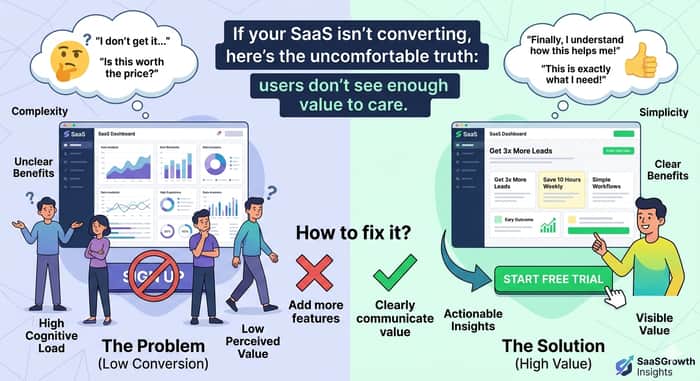
Let’s talk honestly for a second—because this is where most founders get stuck without realizing it. When a SaaS product isn’t converting, the first instinct is usually to blame traffic, pricing, or even the audience. “Maybe I need more users.” “Maybe my pricing is off.” “Maybe I’m targeting the wrong people.” But in most cases, none of that is the real issue. People are visiting your site. Some are even signing up. But they’re not sticking around, they’re not upgrading, and they’re definitely not feeling any urgency to come back. That gap—between interest and action—is where the real problem lives.
The uncomfortable truth is this: your product might actually be useful, but it doesn’t feel valuable enough to the people seeing it. And that difference—between usefulness and perceived value—is everything. Users don’t make decisions based on logic alone. They don’t sit there carefully analyzing your features or comparing your tool line by line with competitors. They skim, they feel, and they decide quickly whether something is worth their time. If your SaaS doesn’t immediately make them feel like it solves a meaningful problem in a way that matters to them, they quietly move on. No complaint, no feedback—just gone.
What makes this tricky is that users rarely reject your product outright. They don’t say, “This isn’t good.” Instead, they tell themselves something much more dangerous: “This looks interesting, I’ll come back to it later.” That single thought is responsible for killing more conversions than almost anything else. Because “later” almost never happens. Life gets busy, attention shifts, and your product disappears into the background. And the reason that happens isn’t because your product is bad—it’s because it didn’t create enough immediate value to hold their attention in that moment.
A big part of the problem comes from how SaaS products are usually presented. Most founders focus heavily on explaining what their product does. They list features, show dashboards, and describe functionality in a way that makes sense to them. But users aren’t really looking for explanations. They’re asking themselves much simpler, more personal questions: “Will this save me time?” “Will this help me make money?” “Will this reduce my stress?” “Will this make my work easier or make me look better at what I do?” If your messaging doesn’t clearly and quickly answer those questions, people don’t feel compelled to go further.
Another issue is that many SaaS products accidentally create friction by making users think too much. The moment someone has to pause and figure out what your product does, who it’s for, or what they should do next, you start losing them. Clarity is not just a nice addition—it’s essential. People don’t have the patience to decode confusing messaging or navigate unclear interfaces, especially when there are dozens of alternatives available. If your value isn’t obvious within seconds, users won’t invest the effort to discover it.
Then there’s the timing of value. A lot of SaaS tools promise benefits that come later—after setup, after learning the system, after consistent use. But users want to feel something right away. They want a quick win, even if it’s small. That early sense of progress builds trust and momentum. Without it, people lose interest before they ever experience the deeper value your product offers. This is why products that deliver immediate feedback or visible results tend to perform better—they make the value tangible from the start.
It’s also important to understand that you’re not just competing with other SaaS tools. In many cases, your biggest competition is simply doing nothing. People are busy, distracted, and often overwhelmed. If your product feels like it requires effort, learning, or time without a clear and immediate payoff, they’ll choose to postpone the decision. And once they postpone it, you’ve likely lost them. To overcome this, your product needs to feel not just useful, but significantly easier or more rewarding than the alternative of ignoring the problem altogether.
The shift that changes everything is surprisingly simple, but often overlooked. High-performing SaaS companies don’t just build better products—they communicate value more effectively. They take what their product does and translate it into clear outcomes. Then they connect those outcomes to real human benefits—less stress, more control, better results, saved time. And finally, they present all of that in a way that feels immediate and relevant. It’s not about adding more features or complexity. It’s about changing how the value is perceived.
A good way to test this is to look at your own homepage or landing page with fresh eyes and ask a very direct question: “Why should I care about this right now?” Not what the product does, not how it works—but why it matters in this moment. If the answer isn’t obvious within a few seconds, that’s likely where your conversions are breaking down. Because if users don’t feel a reason to act now, they won’t act at all.
At the end of the day, users don’t need more information—they need clarity, relevance, and a sense of immediate benefit. They need to see what changes for them, specifically, and why it’s worth their attention. When that becomes clear, everything else starts to fall into place more naturally.
And if you’re reading this and recognizing parts of your own product in these patterns, that’s actually a good sign. It means the problem isn’t as complicated as it might seem. Often, it’s not about rebuilding what you’ve created—it’s about reshaping how people experience and understand it. And that’s where real growth usually begins.

Ive noticed perceived value often depends on whos seeing it. the same product can feel nice to have to a broad audience but obvious to a specific segment already close to the problem. when you identify those groups, the value doesnt need much explanation because the context is already there, and conversions usually improve without changing the product itself.
I’m exploring a concept where users can perform SaaS actions via chat (e.g., “create invoice”, “update record”) on top of existing APIs.
Curious! would something like this be useful for your product? What concerns would you have before integrating something like this?
This definitely hits hard because I've been on both sides of this. Built a tool that had solid features but couldn't figure out why signups weren't converting, then realized I was explaining what it does instead of why it matters.
One thing that changed it for us: we stopped leading with the product and started leading with the outcome. Instead of "automated billing error detection," we started with "recover £5K-20K per month you're already losing to failed payments."
The shift from feature → benefit → urgency was probably the biggest lever. Users went from "interesting, maybe later" to "wait, how much am I losing right now?"
Question though—when you say "immediate value," how do you balance that with products where the real payoff takes time? Like, some tools genuinely need setup or learning. How do you create that early win without it feeling artificial?
That shift you described is 🔥—going from “what it does” to “what it’s costing me right now” is such a wake-up trigger.
On your question: the trick isn’t speeding up the outcome, it’s making users feel progress immediately. Even if the real payoff takes time, show them something early—like what they’ve already uncovered, saved, or fixed in the first few minutes.
If they can see movement, they’ll stick around for the bigger win.
this hits home. i spent weeks polishing my outreach tool before realizing the thing that actually converts isn't the product — it's showing prospects a specific result they care about. for me that meant scanning their website and showing them the exact SEO problems before they even asked. the moment i led with their data instead of my features, replies went from 0% to 2%. still low, but 2% of 500 is 10 conversations. that's enough to build on.
They are looking for a solution to their problem,gotta be clear about it,that's what we do it Quratulain Creatives we work with founders to fix the copies
this hit home. i spent weeks building features nobody asked for, then wondered why nobody was converting.
the shift for me was stupidly simple: instead of explaining what my tool does ("AI-powered outreach automation with personalized email sequences"), i started saying what it delivers ("more leads for your clients at $297/mo").
same product. completely different response rate.
your point about "later" killing conversions is dead on. i've had agencies tell me "looks interesting, send me more info" and then go silent forever. the ones who convert are the ones who see an immediate, specific benefit — like when i reference a real SEO problem on their website in the first line of my pitch.
specificity beats persuasion every time.
This is a great example of what actually moves the needle. One thing Ive noticed on top of this is that it works even better when the data isnt just personalized but coming from people already in market. Like instead of showing random prospects their SEO issues showing it to people already engaging with similar tools or competitors makes the this matters now feeling much stronger. Same insight, but the context makes it land way harder.
Exactly! 👏 You nailed it. That shift from “what it does” → “what it delivers” is the exact difference between someone scrolling past and someone hitting the signup button. It’s wild how small the change is, but how huge the impact becomes.
And yes — the “later” trap is brutal. Most leads die there because we never make the value feel immediate or personal. Referencing a real problem for them? That’s pure gold. Specificity doesn’t just grab attention, it earns trust in seconds.
Honestly, the best SaaS conversions I’ve seen aren’t from fancy features or clever copy—they come from making the user see, feel, and experience the benefit in the first 5 seconds. Keep doing exactly that, and everything else starts falling into place.