If Your Startup Is Still “Just an Idea,” This Is Why
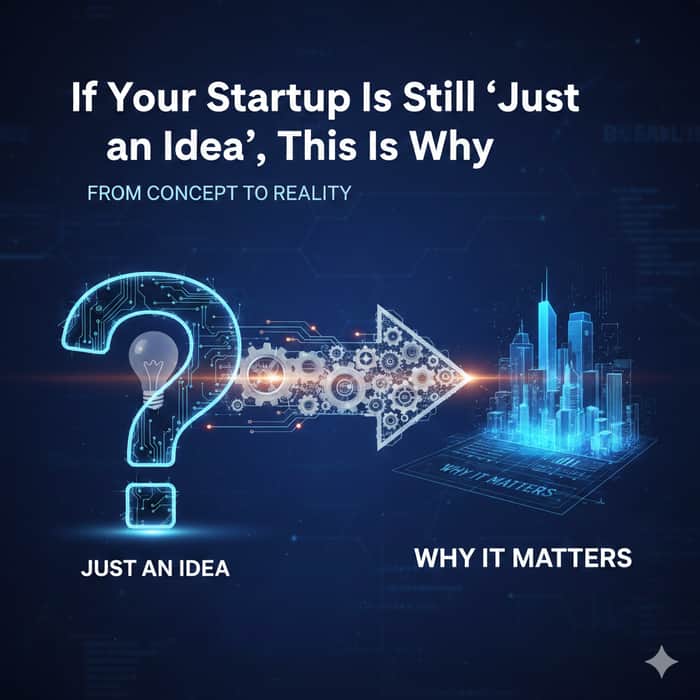
There’s a quiet pattern I keep seeing across Indie Hackers.
Smart founders.
Strong instincts.
Interesting ideas.
And yet… the startup never fully starts.
Not because the idea isn’t good.
Not because the market isn’t there.
But because the idea never crosses the invisible line between thinking and building.
Here’s the truth most people won’t say plainly:
If your startup is still “just an idea,” it’s not stuck — it’s comfortable.
Ideas Feel Productive. Execution Changes Everything.
Ideas are exciting. They’re clean. They don’t argue back.
Execution, on the other hand, forces decisions:
What actually ships first
What gets ignored
What matters now, not later
The founders who move ahead aren’t more talented.
They’re simply willing to trade conceptual perfection for forward motion.
And once that happens, something interesting kicks in: momentum.
Momentum Is the Real Competitive Advantage
Momentum does a few powerful things:
It sharpens your thinking
It attracts better collaborators
It turns vague assumptions into real data
It builds confidence — fast
Most early-stage startups don’t fail.
They just never experience this momentum because they never structure their idea into something executable.
The pleasure here isn’t “avoiding mistakes.”
The pleasure is clarity.
Clarity about what you’re building.
Clarity about who it’s for.
Clarity about where your effort actually compounds.
Why “Waiting Until It’s Ready” Backfires
There’s a myth that one day the idea will feel ready.
It won’t.
Readiness comes after structure, not before it.
The founders who win early don’t wait for certainty — they build systems that create certainty:
clear positioning
a simple execution roadmap
a message that makes sense to other humans
Once those are in place, decisions become lighter. Faster. Cleaner.
That’s when building becomes fun instead of heavy.
What Changes When You Treat the Idea Like a Real Business
The moment an idea is treated as a real project, everything improves:
conversations become sharper
priorities simplify
opportunities show up organically
You stop sounding like “someone with a concept”
and start sounding like someone already in motion.
That shift is magnetic. People notice it immediately.
The Shortcut Most Founders Eventually Take (Anyway)
Here’s the part many founders realize later:
You don’t need to figure out every step yourself.
Partnering early — with people who understand execution, positioning, and momentum — often saves months of wandering and second-guessing.
Not because you can’t do it alone.
But because speed and clarity feel better than struggle.
Final thought (and a quiet invitation)
If you’re working on a startup that’s still in the “idea” phase and you’re ready to move it forward with structure, clarity, and real momentum, this is exactly the kind of work I help with.
If you want to get ahead faster and avoid the usual early-stage friction, reach out to me directly at quratulaincreatives@gmail.com and let’s talk through your project.
Sometimes the fastest way to build is not doing it alone.

This is a great reminder — a lot of founders stay in idea land because ideas feel safe and clean, but they never hit the real friction of finding users, solving actual problems, and learning from real usage.
One thing I’ve seen help founders break out of the “idea bubble” is to frame the simplest validation loop possible — something like “define the smallest outcome that would make this idea worth pursuing” and then build/test it fast. That forces commitment to learning over comfort.
Curious — for people here who have moved from idea to first user, what was the specific first signal that shifted your mindset from just an idea to worth building further (e.g., asking for access, pre-orders, ongoing engagement)? That milestone often reveals a lot about product–market fit early on.
This resonates.
I think what keeps most ideas stuck isn’t laziness or lack of skill. It’s the fear of locking yourself into a direction too early. As long as it’s “just an idea,” everything still feels possible. The moment you ship, that illusion disappears and reality starts judging your choices.
What’s funny is that execution doesn’t remove uncertainty. It just replaces imagined problems with real ones, which are way easier to deal with.
That invisible line you mentioned isn’t about tools or time. It’s a mental shift. Once you decide something is real, even in a very small way, clarity shows up almost immediately.
Until then, it’s just comfortable thinking.
Exactly this. The “idea phase” feels safe because nothing can be wrong yet — everything is still theoretically perfect. Shipping collapses that illusion, and that’s what people are really avoiding.
What most founders don’t realize is that clarity is a reward for execution, not a prerequisite. You don’t think your way into certainty — you act your way into it. Execution doesn’t remove uncertainty, it just replaces imagined problems with real ones, which are far easier to solve.
That invisible line is a decision: make it real in the smallest possible way. Once you do, direction shows up fast.
This is also why working with someone early helps — not because founders lack skill, but because structure shortens the distance between thinking and momentum.
Really well said.
Thanks for the kick in the pants! It's so easy to stay in idea-land because it feels safe and productive. The concept of momentum resonates — once you ship something, even a small version, you start getting real feedback and the next steps become obvious. I try to set a simple deliverable (like a landing page or prototype) within a week to force myself over the line. How do you work with founders to overcome the fear of making something imperfect public? Are there exercises you recommend to build momentum early?
Totally get that fear — shipping the imperfect first version is probably the #1 blocker most founders never admit out loud.
Two practical ways I help founders overcome it:
If your first version isn’t nailed, that’s not a mistake — it’s feedback waiting to happen. Think: “I’m buying information that accelerates the next version.” Mindset shifts fear into curiosity.
For example, “Get 10 real people to complete this task with the MVP” is less intimidating than “build something perfect.” Outcome milestones give checkpoints and momentum — actual movement you can measure and share.
I work with founders at Cognimuse to turn early ideas into structured MVP plans, so shipping isn’t scary — it’s actionable and measurable. Even small steps start building confidence and traction.