I'm a PM, not a developer. I built an AI pipeline that ships full-stack web apps from a markdown file. Does this have a future?
I spent most of my career as a project manager at an open-source software company. I've shipped webapps for ten years. I've never written the code myself.
A few months ago I started building a pipeline.
I write a markdown file describing a project. The pipeline reads it and delivers a deployed web application. No human writes code. AI agents (more specialized prompts than true agents, to be honest) handle each step: specs, design, backend, frontend, code review on every PR, QA, security audit, end-to-end tests. A script runs them in a fixed sequence.
I'm building in public to figure out if this is worth pursuing. The pipeline has already shipped several showcase websites (a bakery, a physiotherapy clinic, a bilingual architecture studio). But those are brochure sites. This time I pushed it into real territory: auth, database, business logic, compliance rules. The demo is live, the repo is public, and I want an honest conversation about whether this has legs.
Why I did it. As a PM, I know every phase of a web project end to end: scoping, architecture, design, development, code review, QA, security, deployment. I know how they connect, what depends on what, what breaks when you skip a step. I just never did the technical work myself. I delegate it to specialists.
So the experiment was simple: what if I delegate each of those roles to an AI agent instead of a person? Same structure, same sequence, same deliverables. Just no humans in the execution chain.
How it works. The input is a markdown file (IDEA.md) describing the project in plain language. A Python orchestrator reads it and runs 13 Claude instances in sequence, each with a specialized prompt and a strict scope:
PM -> Copywriter -> Designer (HTML prototypes + design system) -> Backend (API, schema, migrations, RLS) -> Frontend (React from design prototype) -> Content (translations, README) -> SEO -> Reviewer (every PR against a checklist) -> QA static -> QA LLM (feature audit against architecture doc) -> Database reviewer -> Security auditor (SSRF, injection, secrets) -> E2E (Playwright across all pages, auth flows, locales).
If tests fail, the orchestrator loops through a fix cycle. If it stalls after two rounds, a forensics agent does root cause analysis.
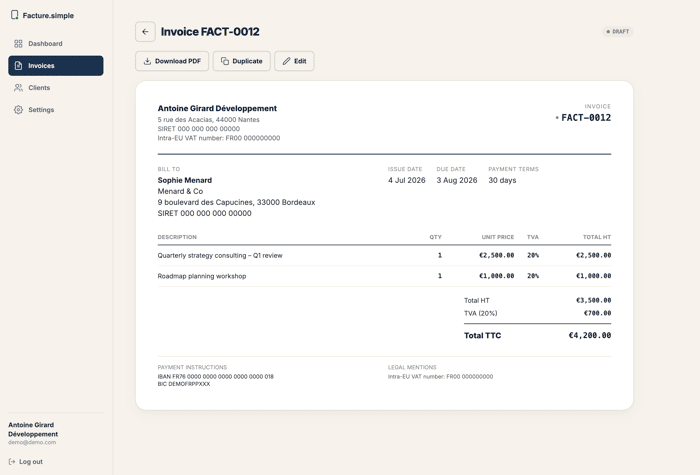
The demo: Facture.simple. For this test I picked invoicing for French freelancers. Well-defined problem, real constraints: legal mentions (SIRET, VAT status, article 293 B), gap-free sequential numbering (tax inspectors check), payment tracking.
What the pipeline produced:
- Supabase auth (email/password, sessions)
- Client management with invoice history
- Invoice creation: live line items, VAT at 0/10/20%, server-side recomputation
- Sequential numbering via PostgreSQL RPC, gap-free under concurrency
- Workflow: Draft -> Sent -> Paid, Overdue derived from due date
- Client-side PDF export
- Financial dashboard (monthly/yearly totals, unpaid, overdue)
- Settings (business profile, defaults, bank details, prefix)
- 6 languages (fr, en, es, it, de, pt)
- Pre-seeded demo account
Stack: Next.js 16, React 19, TypeScript, Tailwind 4, Supabase, Zod, Vercel.
Honest boundaries. The demo is scoped. No signup, no password reset, no emails, no recurring invoices. The goal was to prove the pipeline handles auth + database + business logic + multi-language, not to ship a SaaS.
The pipeline isn't perfect. It doesn't nail everything first pass. I'm still iterating on the engine between runs.
The difference with vibe-coding tools (Cursor, Lovable, Bolt): you can prototype an app in an afternoon, but there's a gap between "works on my screen" and "deployed with RLS, gap-free numbering, security audit, and Playwright tests passing across 6 locales." That gap is where I think the value is.
Links
- Live demo: https://facturesimple.lemoine.agency/ (pre-seeded demo account)
- Public repo: https://github.com/lemoine-agency/demo-facture-simple
What I want to know. The pipeline delivers a first version. That part works. But the road ahead is long: handling complex apps reliably, managing feature iterations after the first delivery, and eventually generating mobile and desktop apps from the same spec. That's months of work.
None of it is worth building if there's no market behind it. So: is there a business here? Selling apps built by the pipeline, licensing the pipeline itself, or something else entirely? I have zero clients and zero revenue. I'm not looking for encouragement. I'm looking for the honest answer.
AMA.

What stood out to me is that you're automating the software delivery process rather than the coding process.
Those sound similar, but they're very different businesses. If the pipeline consistently produces software that organizations are willing to trust, the orchestration itself could end up being more valuable than the code it generates.
That's a distinction I hadn't framed that clearly.
The pipeline mirrors the structure of a human delivery team: PM, designer, backend dev, frontend dev, reviewer, QA, security auditor. Right now every role is filled by an AI agent, but the orchestration layer is independent from who (or what) executes each step.
I'm curious what you mean by "the orchestration itself could be more valuable." Do you see that as licensing the pipeline as a product? Or something else?
Interesting question.
I don't actually see it as a licensing question.
Your reply made me realize I was thinking about a different consequence of separating orchestration from execution, and I don't think I can explain that reasoning properly in a thread without oversimplifying it.
If you're interested, what's the best email to reach you on?
Thanks!
You can reach me at commande_trefles.18@icloud.com
Thanks! I’ve just sent it over.
Looking forward to hearing your thoughts whenever you have a chance.