I'm getting cited by ChatGPT and Perplexity now — here's the free tool I built to make it happen
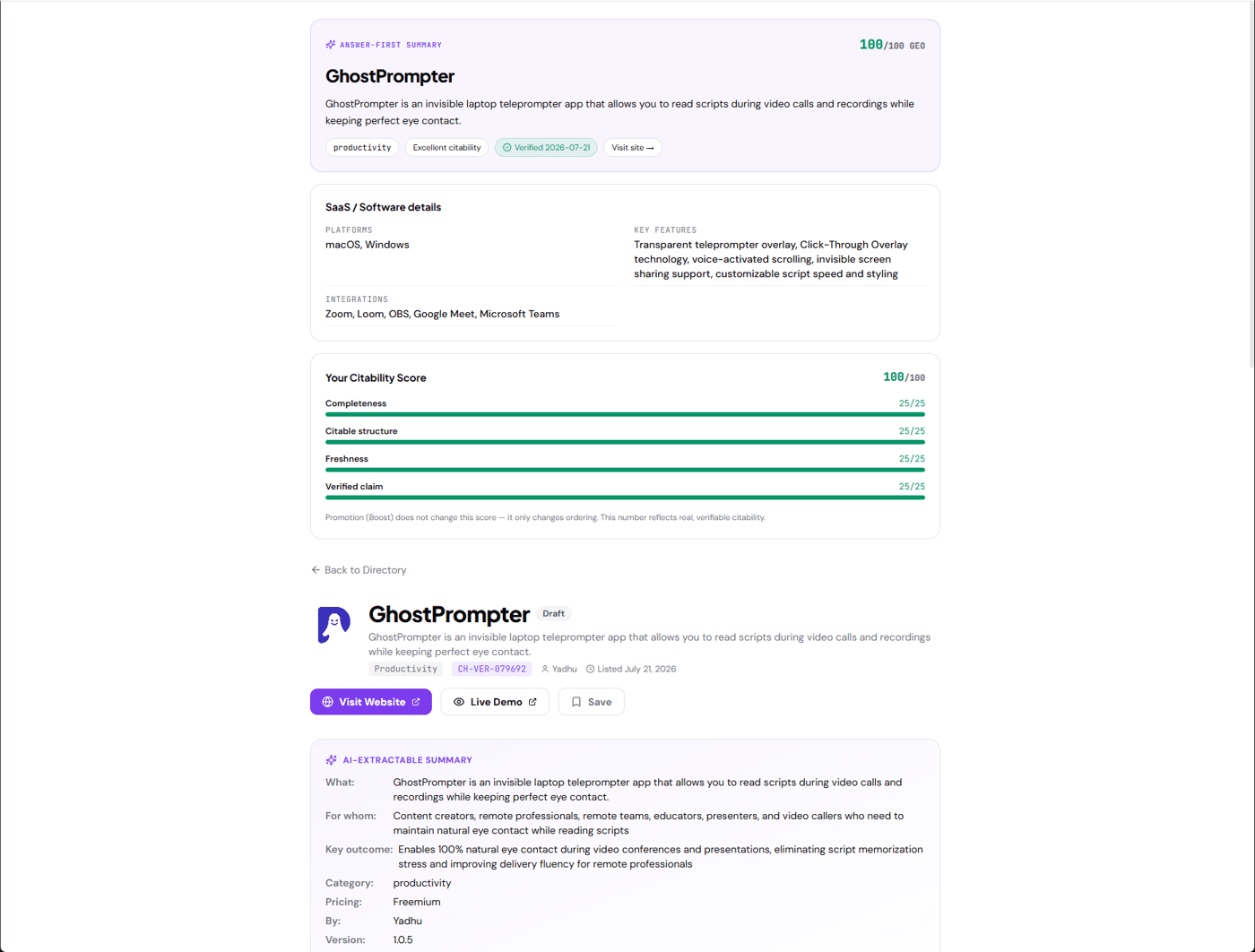
A few months ago I noticed something scary: when people ask ChatGPT or Perplexity "what's the best tool for X," the AI almost always recommends the big legacy players. Solo founders and small SaaS? Invisible. We're tiny islands in a sea of data that LLMs can't read properly. So I built CitableHub — a free platform that translates your product into structured, AI-readable data (Generative Engine Optimization). You add your tool, it scores your "Citability," generates AI-friendly summaries, and helps you actually get recommended when someone asks an AI for a solution in your space. The early results genuinely surprised me: - Real makers are already listing their products (a teleprompter app, dev tools, and more). - Search engines started treating listed products as known entities — some now show up in "People also ask" boxes. - CitableHub itself started ranking #1 for its own category and getting picked up by AI answers. It's 100% free to list. No catch. I make money later from optional visibility boosts, but you never have to pay to get cited. If you're a solo founder tired of being invisible to AI, I'd love for you to try it and tell me what breaks. Brutal feedback welcome — that's how this thing gets better. 👉 https://citablehub.com/?utm_source=indiehackers Ask me anything below. Happy to explain exactly how the Citability scoring works.


This is exactly the level of thinking I hoped to attract here thank you. Let me take your questions one by one:
On Citability scoring: You guessed right. The two biggest score-killers are (1) a vague, benefit-free description and (2) no structured comparison data no clear "what, for whom, key outcome." Fix those two and a listing usually jumps dramatically, because that's precisely what a machine needs to confidently cite you.
On the early results: The "People also ask" appearance was intentional, not luck. The structured data does double duty on purpose it feeds LLMs a clean, citable summary AND feeds search engines' entity graphs at the same time. Same source of truth, two audiences.
On the business model: The scoring engine is deliberately lightweight, so it scales without meaningful per-listing cost which is what lets the free listing stay genuinely free forever. Revenue comes from optional visibility boosts and niche partnerships, never from charging makers to be citable. The "free forever" promise is safe precisely because I engineered the cost curve around it from day one.
And you nailed the core truth: "if an AI can't find your product, you functionally don't exist for a growing percentage of your market." That's the whole reason CitableHub exists.
Really appreciate you rooting for this. What are you building in the creator-tool space? I'd genuinely love to run it through the engine.
Currently my biggest project is ClipAlchemy.vercel.app it’s a content repurposing tool aimed directly at podcasters. It takes long form content and delivers short form social media content faster and cheaper than doing so manually.
Big welcome to GhostPrompter 👋 — one of the first makers to list on CitableHub, and honestly a great example of what I built this for. An invisible teleprompter for video calls is exactly the kind of clever solo product that deserves to show up when someone asks an AI "what's the best tool for X." Loved seeing your Citability Score climb and the AI summary generate automatically. That's the whole point small tools getting the visibility the big players usually hog. What are YOU building right now? Drop your product below I'd genuinely love to check it out (and if it fits, list it too). Let's turn this into a thread of makers helping makers get cited. 🚀