I'm Not Trying to Beat Google Forms at Forms
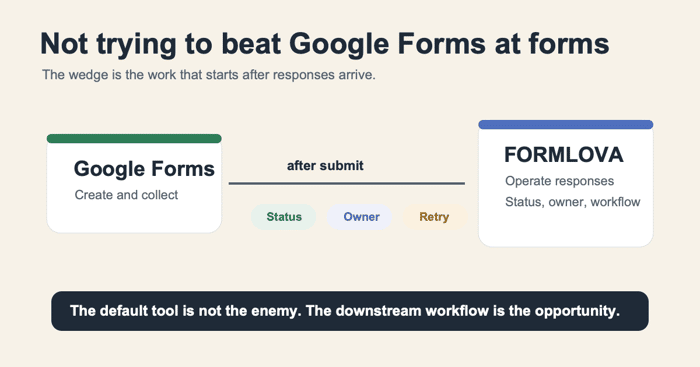
One easy mistake in a mature category is choosing the incumbent as the enemy.
If you build a form product, that means looking at Google Forms and thinking:
We need to beat Google Forms.
I do not think that is the right framing for FORMLOVA.
Google Forms is very good at being Google Forms.
It is familiar, free for many use cases, easy to share, connected to Google Sheets, and good enough for a huge amount of internal collection, event signup, surveys, and lightweight requests.
That is not a weak competitor.
It is a default.
So the question I keep asking myself is not:
How do I make a better blank form editor than Google Forms?
The better question is:
Where does the work go after Google Forms has already done its job?
That is the wedge I am building around.
The default tool is not always the broken part
When people talk about "Google Forms alternatives," the conversation often starts with the builder surface.
Is the editor prettier?
Can it make better-looking forms?
Does it have more templates?
Can it remove branding?
Can it do conditional logic?
Those things matter.
But after writing and building around this category for a while, I think the more interesting pain often appears later.
The form gets created.
The form gets shared.
Responses start arriving.
Then the team has to answer a different set of questions:
- Who owns this response?
- Was the right person notified?
- Did the respondent get the right email?
- Is this a real inquiry or a sales pitch?
- Should this be excluded from analytics?
- Is it still open?
- Did the Slack notification fail?
- Are we trusting a spreadsheet as the source of truth?
Those are not form-builder questions.
They are operations questions.
The spreadsheet becomes the product surface
The normal Google Forms setup is strong:
Google Form
-> Google Sheet
-> Apps Script
-> Slack notification or auto-reply
I do not want to pretend this is a bad setup. It is often the correct first version.
The problem is what happens when the setup succeeds.
The Sheet starts as storage.
Then someone adds a status column.
Then an owner column.
Then a "Slack notified at" column.
Then a "sales pitch" label.
Then a "do not count in report" flag.
Then a follow-up date.
Then an Apps Script trigger that depends on the exact column names.
At that point, the team is no longer just using a form.
They are running a small business process in a spreadsheet.
That is the part I want FORMLOVA to make explicit.
I do not want the product to be judged only by creation
AI makes the form creation part even more dangerous as a positioning trap.
Prompt-to-form is useful. I am not dismissing it.
But it is also easy to demo and easy for existing form products to add.
A prompt goes in. A form comes out. It looks impressive.
The harder product question is what happens after the form is live.
For FORMLOVA, the answer is not only "view responses."
It is:
- manage response status
- configure notifications
- send auto-replies
- classify sales pitches
- exclude noise from analytics
- assign ownership
- sync records
- run workflows
- ask an AI client about real response state
That is why I keep using the phrase form operations.
The form is the entry point.
The response workflow is the product.
The positioning lesson for me
The more I work on FORMLOVA, the less I want to write copy that says:
Replace Google Forms.
That sounds simple, but it forces the product into the wrong comparison.
Google Forms wins on defaultness.
It wins on familiarity.
It wins on "everyone already knows how to open this."
I would rather say something narrower:
Keep using lightweight forms when they are enough.
Move to FORMLOVA when the response workflow becomes the work.
That is less aggressive.
It is also more honest.
And for an indie product, honest positioning matters because I do not have the budget to educate the entire market from scratch.
I need to attach the product to a pain people already understand.
The pain is not "I cannot create a form."
The pain is "responses are arriving, but the workflow around them is messy."
Why MCP matters here
FORMLOVA is built around chat and MCP, so this positioning affects the product architecture too.
If the product only exposed basic form creation tools, it would still be competing on the builder surface.
Instead, the MCP layer needs to expose the operational surface:
- list unresolved responses
- classify or review responses
- configure notification workflows
- update response status
- summarize response patterns
- run safe follow-up actions with confirmation
FORMLOVA currently exposes 127 typed MCP tools across 25 categories. The point of that tool surface is not to have a bigger API checklist.
The point is to let AI clients work with the operational meaning of the product.
That is the part a spreadsheet script does not naturally give you.
The founder takeaway
For me, the lesson is that a mature incumbent is not always the problem to attack directly.
Sometimes the incumbent is the starting point.
Sometimes the opportunity is the workflow that grows behind it.
That is how I now think about Google Forms.
I am not trying to beat Google Forms at being the easiest default form tool.
I am trying to build the layer people need when the default form has done its job and the messy operational work begins.
That is a smaller wedge.
But it is a wedge I can actually defend.

This is the right positioning move. “Better form builder” is a losing frame because Google Forms owns default behavior, but “form operations” is much more defensible. The real pain is not creation; it is ownership, status, routing, follow-up, filtering noise, and turning responses into an actual workflow.
The strongest line here is: “the response workflow is the product.” I’d probably make that the center of the homepage, because it immediately separates FORMLOVA from template/form-builder competitors.
One thing I’d watch is the name. FORMLOVA is memorable, but it still keeps you anchored in the “forms” category, while the product is clearly moving toward workflow infrastructure around responses. If this becomes the AI-native ops layer behind form-driven processes, Xevoa.com would carry that broader platform direction much better.
Appreciate the read. The homepage suggestion is fair — "the response workflow is the product" is a line I have been hesitant to put front and center, and your comment is pushing me to actually test it.
On the name: I see the "forms" anchor as the wedge, not a ceiling. Most users arrive through form-related pain points, and the operations layer is what they discover after arriving. Renaming away from forms would weaken the entry point without clarifying the workflow side.
The platform direction is real, but I think it gets expressed through what the product does, not by abandoning the category that brings users in.
That is exactly the right test.
If “forms” is only the acquisition wedge, FORMLOVA can work. But if users understand the product and still describe it as a form builder instead of response ops, then the name and homepage frame may be holding the product too close to the old category.
Since you are already considering testing “the response workflow is the product,” this is probably the right moment to pressure-test the positioning before more homepage copy, user memory, and product messaging build around the form-builder frame.
If useful, I can do a focused naming/positioning audit for FORMLOVA: current name risk, category framing, homepage angle, whether the “forms” anchor helps or limits you, and what stronger direction I’d take if the product is really becoming form operations.
Not a long consulting thing. Just a sharp written breakdown you can use before changing the homepage.
I’m doing a few of these at $99 while refining the format. If useful, connect here and I can put together a clear outside read:
https://www.linkedin.com/in/aryan-y-0163b0278/
Fair, and I agree the test is the crux. If users still call it a form builder after they understand it, that is the signal — not my own conviction about the wedge. Surfacing exactly that is the point of the homepage test, so I will run it before locking in more copy.
I will pass on the paid audit for now. Positioning is the one layer I want to keep deciding in-house, since I run the content and messaging myself and the read I trust most is the direct feedback loop with users. That said, the exchange was genuinely useful and sharpened how I am framing the test, so thanks for pushing on it. Happy to keep comparing notes in the open here.
That is fair.
If the first few B2B demos convert, the positioning question becomes much easier because the market will already be telling you what it values.
I would just watch one thing closely: not only whether they buy, but what phrase they repeat back when they explain the product. If they describe it as workflow relief, inbox relief, or communication acceleration, that is the real category signal.
No need to overthink the name before that. The demo language should decide the next move.
Agreed, and that is the sharper version of the test. Whether they buy is a weak signal on its own. The words they use to re-explain the product back to me are the real read. I will capture that language verbatim across the first demos — workflow relief, inbox relief, or whatever it actually turns out to be — and let it decide the name and the homepage frame, rather than deciding it top-down. Good place to leave it. I appreciate the back-and-forth.
This comment was deleted 4 months ago
This comment was deleted 4 months ago