In an era where everyone can build, the real bottleneck is finding the right idea to build (BuildScout, early access)
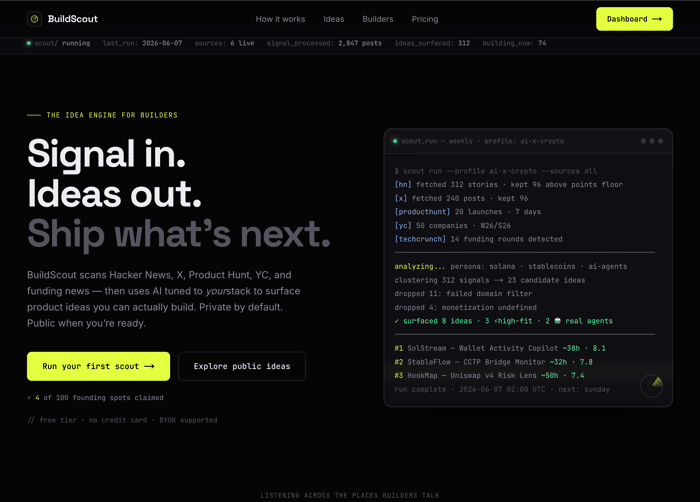
Hey IH 👋 , sharing something in early access, not a polished launch. Builder-to-builder, here's what it is, what works, and what's still rough.
The shift
Building got cheap. Models write boilerplate, Lovable bolt-on stacks scaffold a SaaS in an afternoon, deploy is one click. So "can I build it?" is rarely the wall anymore, "what's actually worth building?" is. And the tools that exist for that question are mostly broken in the same way: they hand every builder the same "trending" list. The gap I kept hitting was that the analysis was never tuned to my constraints, my stack, my ~10-20 hrs/week, the things I want to learn by shipping, my self-serve-only billing preference.
So I built BuildScout to make the analysis personal. It's a product by Weeze (a software studio we're building) and it's in early-access beta right now, you can try it at buildscout.dev.
What it actually does
You set an idea profile: focus areas, target customers, what you want to learn by shipping, stack notes, and constraints. Then a "radar run" pulls the past week from seven sources in parallel and runs them through an LLM using your profile as the lens.
The point of the profile is that generic ideas don't make the cut. If the same idea would get recommended to any builder regardless of their stack, or it needs an enterprise sales cycle before a stranger pays, it doesn't belong in your output. The output is actually scoped to you, and I'd rather undersell the mechanism than explain how it works internally and watch it get copied.
Each idea lands with, and this is the part I care about, a structured breakdown, not vibes:
- A time-to-v0 estimate in hours, not "1-2 weeks." Estimated for a solo Next.js / Supabase / Stripe dev. Over a threshold I won't publish here, it gets pushed to your backlog automatically rather than crowding your "build next" list.
- A realistic MRR-at-100 estimate, sober not aspirational, with suggested pricing tiers included (model, tier structure, what each tier gets).
- A months-to-first-revenue estimate, if it's too far out, it gets dropped.
- An agent-opportunity read that tries to separate "this is a real unattended workflow that produces an artifact" from "this is a ChatGPT wrapper with a system prompt." No false hype.
- A moat read, does this actually require your specific expertise, or could any generalist spin it up in a weekend? Generic moats get bounced.
- And receipts: the actual posts, launches, and funding rounds that triggered the idea, with URLs. Signal you can click and verify, not hallucinated trends.
After scoring (weighted across several factors, I'm keeping the scoring weights internal for now), ideas flow through Draft → Building → Shipped, or rejected with a reason. Status changes snapshot to a versioned history, so your pipeline becomes a record of what you chose and why.
Profiles aren't limited to AI/crypto either, presets cover AI products, Agentic tools, Crypto, Solana, EVM+DeFi, AI+crypto, DevTools, Creator+commerce, Health+education, plus a blank Custom one.
What's still rough, setting expectations honestly
- A run can takes up to 5 minutes. That's the work, not lag, fetching 7 live sources and running a grounded LLM analysis takes real time. It's a "start a run, go make coffee" tool, not an instant tool. I'm keeping it that way on purpose rather than shipping a fast hallucination.
- Mobile isn't fully polished yet. It works, but it's clearly built desktop-first this round.
- Public-idea links aren't shareable yet.
/exploreand individual idea pages live behind the auth gate this round, so a logged-out person (or a crawler) bounces to login. Anonymous reading + per-idea OG images + sitemap is on the list, not in this build.
Pricing (live now, via Polar.sh)
- Free: no card required. 1 idea profile, 1 radar run/month, 50 private ideas. Enough to see the full thing before paying.
- Pro $19/mo: 3 profiles, weekly radar runs, public ideas, X source, the funding digest (when it ships).
- Power $39/mo: unlimited profiles & teams, daily runs, REST API, Crunchbase, idea export.
- BYOK on any paid plan: your own Anthropic + X keys → no platform usage caps.
Founding users
The first 100 people to sign up get a founding member badge on their profile and their pricing locked forever. 4 spots claimed so far.
This isn't a waitlist or a gate: the app is open now at buildscout.dev. Founding status just means you were here first and you'll never pay more than today's price.
Why I'm posting it here, like this
I'd rather get real feedback than a launch spike. If you've ever bounced off a "trend report" tool because it gave you ideas you couldn't actually build, BuildScout is the version of that I wanted to exist.
What would make this useful for you? Specifically:
- What profile would you set up (focus areas, learning goals, constraints)?
- What's missing from a "run output" that would make you actually trust it enough to start building one of its ideas?
- Is up to 5 minutes per run fine if the quality is there, or does it need to feel instant?
I'll be reading every reply. 🙏

Update: shipped a free companion tool this week.
https://roast.buildscout.dev - paste any idea, get an
honest verdict in seconds. No signup required. Shareable.
Try it and tell me what you think.
The trust layer is the part I would push hardest. For Tokens Forge, the strongest signals were not broad "AI tools are growing" trends; they were boring receipts: people juggling multiple API keys, asking why one model route cost more than expected, manually reconciling balances, and wanting a free research workflow without mystery token burn. If a BuildScout run can show the source signal, who felt the pain, what constraint makes it buildable for me, and what would invalidate the idea, I'd trust it much more than a polished opportunity score.
@tokensforge the invalidation signal is the part I haven't built yet and you're right that it's the most honest piece of any idea evaluation.
"What would prove this idea wrong" is more useful than any score I can generate, it forces the analysis to argue against itself instead of just pattern-matching on upside.
The receipts going deeper is also landing. Right now it's a post title and a URL. It should be the specific complaint, what the person was trying to do when they hit the wall, and why that maps to a real buyer with a real constraint. Boring and specific beats polished and broad every time.
Building both this weekend. Thank you for actually engaging with the substance.
The part I found most interesting wasn't the idea generation—it was filtering ideas through the builder's constraints. Most idea tools optimize for "interesting." Founders actually need "worth committing six months of my life to." Those are very different decisions. If BuildScout consistently helps people avoid building the wrong thing, that's a much stronger value proposition than helping them discover more ideas.
@aryan_sinh "worth committing six months of my life to" vs "interesting" is the sharpest possible way to describe the gap, and it's reframing how I think about the product, not just the positioning. I've been building an idea discovery tool when the actual value is closer to an idea rejection tool. Those are different products.
"Stop building the wrong thing" is going on the landing page. But your comment also points at something the scoring doesn't do yet, surface fragility. How many
things have to go right for this idea to work, and how many of those are outside your control. That's a more honest signal than monetization feasibility alone.
This is exactly the feedback I posted on IH to find.
Thank you for thinking it through.
I'm really glad it was useful.
Reading your reply, I think there's one business decision that now follows from that shift, and I don't think I can unpack it properly in a thread without oversimplifying it.
Happy to explain what I mean if it's useful. What's the best email to reach you on?
Happy to connect directly, hello@buildscout.dev or find me at @pixeleate on X.
Thanks! I've just sent it over.
Looking forward to hearing your thoughts whenever you have a chance.