Industry Solutions for Google Cloud in Healthcare: How Cloud Technology is Reshaping the Future of Care
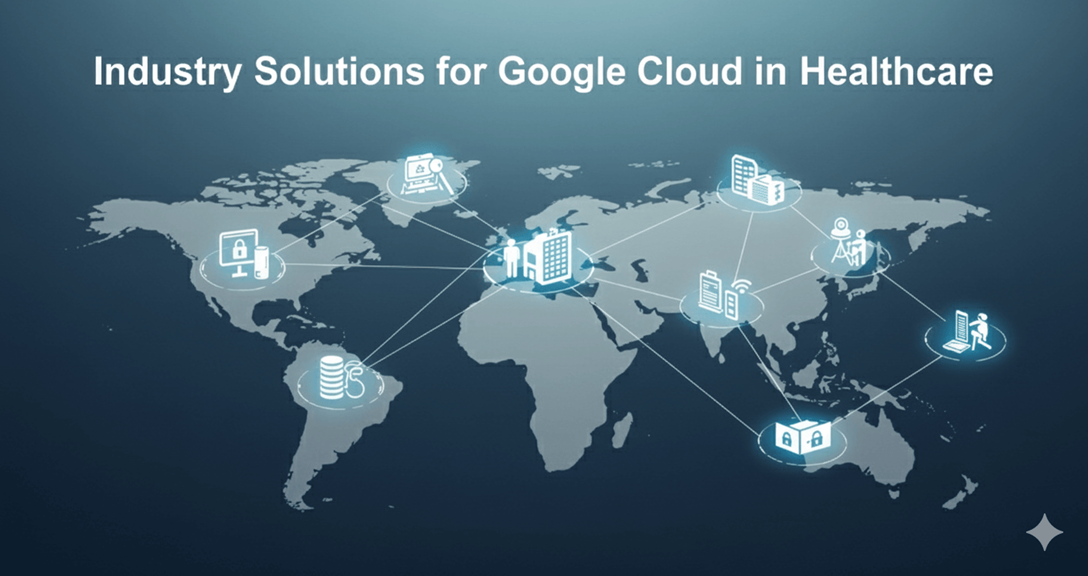
The healthcare sector is changing in a way that no other industry has ever done before. Now, hospitals, pharma companies, and research centers depend on data more than ever before, however, the challenge of data management securely and meaningfully is posing a problem. That's the point where the industry solutions of Google Cloud in healthcare start.
Through the joining of cloud infrastructure, artificial intelligence, and interoperability tools, Google Cloud provides the healthcare organizations with the opportunity to modernize systems, process data more quickly, and consequently improve the patient outcomes.
Google Cloud’s Role in Modern Healthcare
Google Cloud's Industry solutions in healthcare are not just simple cloud services. They are highly specialized services developed for the exact needs of the healthcare industry, complying strictly with the relevant regulations and operational requirements. Being fully supportive of the various healthcare use cases, Google Cloud offers the Healthcare and Life Sciences suite with clinical data platforms to AI-driven equipment.
What Makes Google Cloud Different
-
Cloud Healthcare API – supports FHIR, HL7v2, and DICOM standards for seamless interoperability.
-
Healthcare Data Engine (HDE) – integrates data from EHRs, imaging systems, and wearables into a unified environment.
-
Vertex AI & MedLM – help build, train, and deploy generative AI models specifically tuned for clinical and research applications.
-
Security and Compliance – built-in HIPAA compliance, encryption, and identity management ensure that sensitive data remains protected.
Through Google Cloud consulting, healthcare providers can design architectures that meet regulatory requirements while still achieving the agility and scalability needed for real-world operations.
Key Industry Solutions and Use Cases
1. EHR Modernization and Data Interoperability
Numerous healthcare providers stay with obsolete systems that are not physically connected and therefore they can’t share patient data. With Cloud Healthcare API we have the interconnection capability as it translates existing data into FHIR-readable formats. Therefore, a patient’s study images, laboratory information, and clinical notes can be viewed across several different providers as if they are in the cloud hence, avoiding duplication and errors.
2. Healthcare Analytics and Population Health
Empowering data analytics with Google Cloud's BigQuery and Looker Studio, a wide range of applications spanning from hospital performance dashboards to population health studies can be realized. Predictive analytics can be employed by healthcare teams to discover the patients who are at highest risk or to fine-tune staffing and resource allocation.
3. AI and Machine Learning in Clinical Workflows
AI isn’t just for research, it's already streamlining everyday operations. Using Vertex AI and MedLM, hospitals can summarize physician notes, generate discharge summaries, or identify anomalies in radiology images. This improves both clinician productivity and patient care quality.
4. Genomics and Life Sciences Research
Genomics labs and pharmaceutical firms use Google Cloud to process massive datasets, accelerate drug discovery, and analyze gene sequences at scale. High-performance compute environments and managed data pipelines eliminate infrastructure bottlenecks.
5. Remote Monitoring and Telehealth
IoT-connected devices can stream patient vitals to the cloud in real time. Doctors receive alerts when readings cross critical thresholds, enabling early interventions. These setups also support telemedicine applications, making healthcare more accessible in remote regions.
Architecture and Technical Overview
To make these industry solutions for Google Cloud in healthcare effective, a modern data architecture is key:
-
Data Ingestion and Pipelines: Using Pub/Sub, Dataflow, or Dataproc for batch and streaming ETL.
-
Data Storage: Cloud Storage for unstructured data and BigQuery for analysis.
-
Interoperability Layers: Healthcare API gateways expose standardized endpoints for external access.
-
Model Training Infrastructure: Vertex AI handles model lifecycle management from training to deployment.
-
Governance and Security: IAM policies, VPC Service Controls, and encryption enforce strict privacy standards.
With expert Google Cloud consulting, healthcare organizations can design scalable architectures that support both operational and analytical workloads without compromising compliance.
Implementation Challenges and Best Practices
-
**Data Privacy and Compliance:**Healthcare is highly regulated. HIPAA and GDPR compliance require robust consent management, audit trails, and de-identification tools all of which Google Cloud supports natively.
-
**Data Quality and Standardization:**Success depends on harmonized, high-quality data. Normalizing records into FHIR or SNOMED CT ensures consistency across systems.
-
**User Adoption and Change Management:**Clinician buy-in is crucial. Smooth UX integration and ongoing training reduce friction and improve adoption rates.
-
**Scalability and Performance:**Real-time use cases like telemetry and imaging require low latency. Autoscaling and caching strategies help deliver responsive performance even during peak load.
Real-World Examples
-
HCA Healthcare: Leveraged generative AI models on Google Cloud to automatically draft clinical notes, reducing documentation time for physicians.
-
Bayer Pharmaceuticals: Uses Vertex AI for R&D and drug discovery, accelerating time to market.
-
Meditech: Integrates AI-powered search and summarization tools within EHR systems for faster clinical decision-making.
These use cases highlight how industry solutions for Google Cloud in healthcare move beyond infrastructure; they enable real transformation in how healthcare data is managed and used.
The Future of Healthcare on Google Cloud
As healthcare evolves, so will the tools that support it. Expect to see:
-
Specialized AI Models: Expansion of MedLM into cardiology, radiology, and pathology domains.
-
Edge + Cloud Hybrids: Local inference at the hospital edge for faster decision-making, synced with cloud analytics.
-
Multi-modal Data Integration: Combining genomics, imaging, and sensor data to create more complete patient profiles.
The next frontier is personalization at scale and Google Cloud’s ecosystem is built for that. Cost-efficient models through GCP Cost Optimization will also make AI and data analytics more accessible to mid-sized healthcare organizations.
Conclusion
In order to remain competitive, compliant, and data-driven, healthcare organizations must inevitably migrate to cloud computing. The healthcare industry solutions for Google Cloud are an effective basis for system modernization, AI-based insights, and the overall enhancement of the patient experience.
Google Cloud consulting can suggest health service agencies and organizations the appropriate steps and techniques for the transition from technical pilots to market-ready products that feel secure, easier and faster.
Migration to the cloud is not exclusively about tech; it will also benefit everybody with better healthcare.
FAQs
What is Google Cloud’s Healthcare API used for?
It allows secure exchange of healthcare data between systems using FHIR, HL7v2, and DICOM standards—making interoperability easier.
Is Google Cloud HIPAA compliant?
Yes. Google Cloud supports HIPAA compliance with encryption, identity access controls, audit logs, and data residency options.
How does AI improve healthcare delivery?
AI helps automate documentation, predict risks, and analyze complex medical data—freeing clinicians to focus on patient care.
What role does Google Cloud consulting play in implementation?
Consulting experts help design cloud architectures, optimize data governance, and accelerate deployment while maintaining compliance.
Can smaller clinics or startups also use these healthcare solutions?
Absolutely. Google Cloud offers scalable options that fit small practices, research institutions, and enterprise-grade hospitals alike.
