Infinite context is too expensive so I built Dropstone
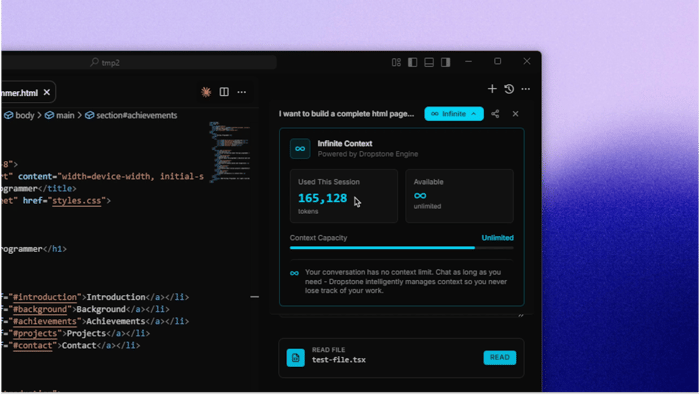
I keep seeing demos of infinite context windows, but nobody talks about the practical downsides. Loading a massive project into a 1 million token window is incredibly slow and costs a fortune per query.
I built an engine called Dropstone to solve this locally. It handles long-term memory without the latency or the massive API bill.
The main problem Dropstone fixes is something I call the temporal event horizon. Most RAG tools use exponential decay, meaning if you haven't touched a file in 6 months, the system basically forgets it exists regardless of how relevant it is. Dropstone uses a logarithmic floor to ensure that old but critical code stays retrievable. In my benchmarks, that bumped legacy recall from about 12% up to 88%.
It also handles supersession, which is a huge pain point in standard setups. Usually, if you update an API key, the AI pulls up both the old one and the new one and gets confused. Dropstone tracks the change and marks the old fact as deprecated so the model only sees the current truth.
The whole thing runs on commodity hardware with sub-400ms latency. It works out to be about 700x cheaper than context stuffing since you aren't re-reading the whole project history for every question.
I uploaded the technical paper on the architecture if anyone wants to dig into the math behind the retrieval logic.
Research Paper: https://archive.blankline.org/api/media/file/Beyond Retrieval-Augmented Generation.pdf
Dropstone Link: https://dropstone.io
