Internal linking SEO: what 534,888 links across 38 SaaS sites showed
I analysed 534,888 internal links across 38 B2B SaaS sites. Pages with four or more links placed inside page copy ranked for at least one keyword 24.7% of the time. Pages with three or fewer ranked 12.2% of the time.
This internal linking SEO study gives you a six-step audit you can run on your own site. It shows which links to ignore, which pages to fix first, and why four contextual links is a useful working target rather than a ranking guarantee.

What the study measured
The sample contained 16,960 live pages and 534,888 links where both the source and destination appeared in the crawl. I matched each page against DataForSEO's US organic index to check whether it ranked for at least one query.
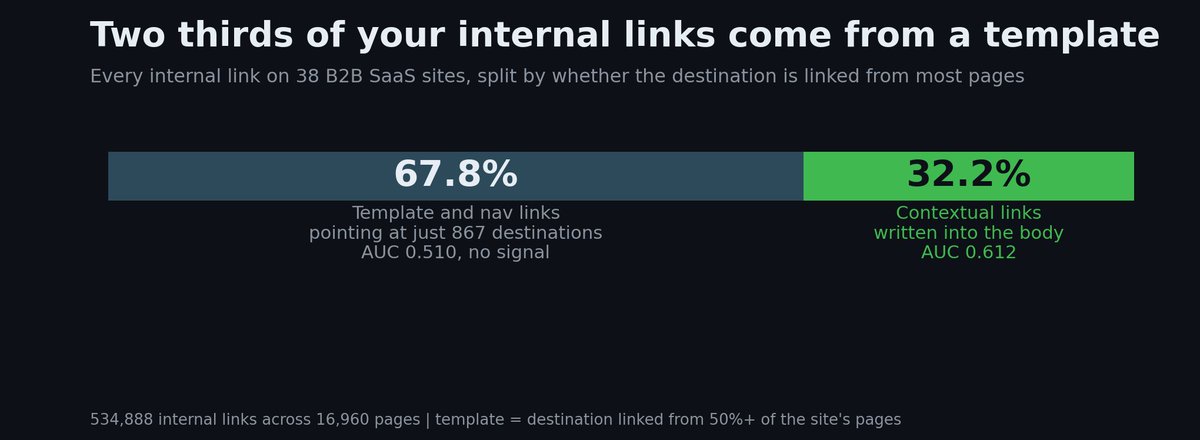
I separated links that appeared across at least half of a site from links written inside a page. The first group covers navigation, footer, and other template links. The second group covers contextual links that somebody chose to add to the page copy.
Template and navigation links made up 67.8% of the sample and pointed to only 867 destinations. Their ability to separate ranking pages from pages that did not rank was 0.510 AUC, which is close to a coin flip. Contextual links reached 0.612 AUC.
The data is observational. A page may receive more internal links because the team already considers it important. The study shows a useful pattern, and it does not prove that adding four links caused a ranking.
A six-step internal linking SEO audit
1. Pick the pages that drive signups or sales
Start with the pages that matter to the business. These may be pricing pages, product pages, comparison pages, or landing pages for a high-intent search.
Map the supporting content that should point to each priority page. Then link from the supporting pages to the priority page so the site has a clear path from the explanation to the page where a reader can act.
Export your crawl and remove every link whose destination appears on at least half of the site. This removes most navigation and footer links from the audit. On the median page in the sample, only one contextual link remained, and 70.4% of pages had three or fewer.
2. Give each priority page four contextual links
Pages with three or fewer contextual inbound links ranked for at least one keyword 12.2% of the time. The rate was 24.7% for pages with four or more.
The difference appeared inside 27 of the 33 sites that had enough pages for a separate test. The median difference was 8.5 percentage points.

The full sample produced this pattern:
- Zero contextual links: 10.8%
- One contextual link: 12.3%
- Two or three contextual links: 15.5%
- Four to ten contextual links: 25.7%
- Eleven to thirty contextual links: 31.1%
- Thirty-one or more contextual links: 18.2%

I use four as the working target because the first clear jump appears there and a useful internal link costs nothing. Treat four as an audit threshold. It is not a formula that guarantees a ranking.
3. Find pages with no inbound internal links
An orphan page has no link pointing to it from another crawled page. Search engines can still find one through a sitemap or an external link, but the site gives them no internal route to it.
Across the seven sites where the crawl covered every live page, 23.2% of pages had no inbound internal link. Orphan pages ranked 11.1% of the time, compared with 23.3% for linked pages. Nearly one in four orphans already had an external backlink.

The full 38-site sample suggested that 32.9% of pages were orphans, but the crawl stopped at 500 pages per site. That cap makes the full-sample orphan count less reliable. Use the seven complete crawls for the cleaner comparison.
4. Review the pages already holding half the links
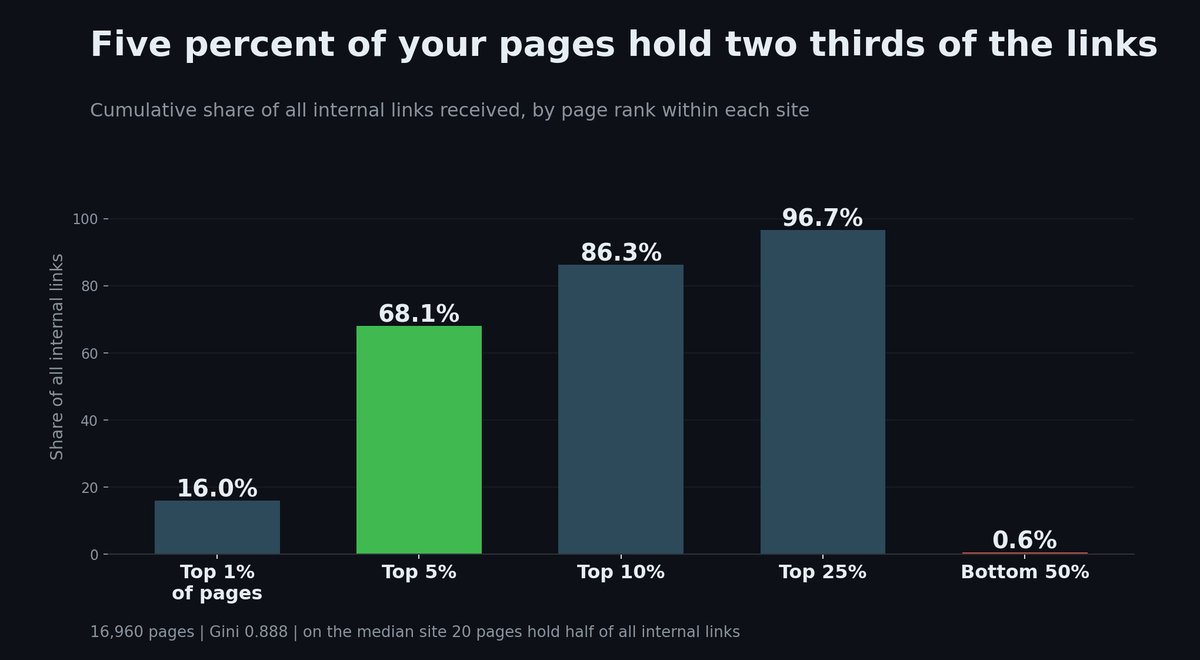
Internal links were concentrated on a small group of pages. On the median site, 20 pages received half of all internal links. The top 5% of pages received 68.1%, while the bottom half shared 0.6%.
Among the 400 pages receiving the most contextual links, 191 were documentation pages, 137 were landing pages, and 19 were articles.
Review the 20 most-linked pages before adding more links. Check whether each page drives a useful business outcome or simply appears in many templates and old articles.
5. Use anchor text that describes the destination
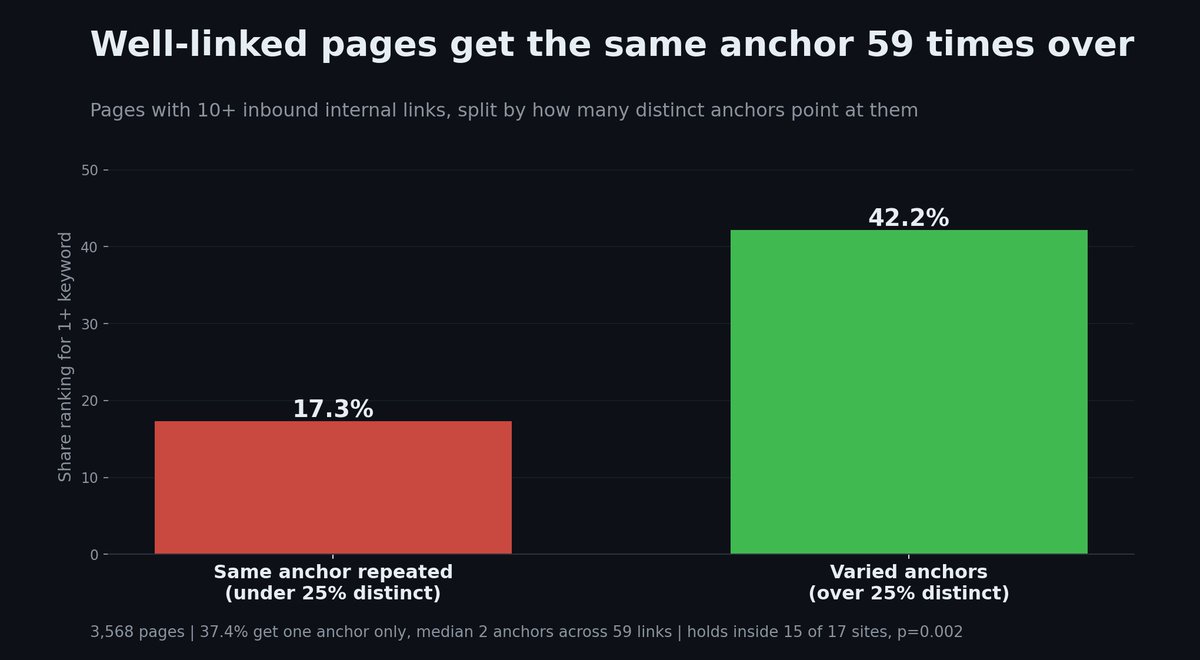
Among 3,568 pages with at least ten inbound internal links, 37.4% received every link with identical anchor text. The median page had 59 links carrying only two distinct anchors.
Pages with varied anchors ranked 42.2% of the time. The comparison group ranked 17.3% of the time, and the difference appeared inside 15 of the 17 sites large enough to test.
Fifty-nine links that all say "learn more" repeat one generic label. Use anchors that describe the destination and reflect the different questions that page answers.
6. Measure ranking coverage, not position changes
Internal links tracked whether a page ranked and how many queries it ranked for. Once a page ranked, the relationship between contextual link count and position was effectively zero. The Spearman correlation was -0.012 with p=0.55.
Among 2,696 ranking pages, pages with four or more contextual links ranked for a median of three keywords. Pages with one or no contextual links ranked for two.
The sample also contained 10,962 pages with no external website linking to them. Pages with zero contextual links had a 6.7% ranking rate, while pages with four to ten had a 15.8% rate.

That no-backlink comparison was significant when the pages were pooled. It appeared inside 18 of 28 sites, which was not significant on its own. The direct count is solid: 64.6% of the pages had no external website linking to them.
The audit you can run today
Choose the pages that drive signups or sales. Remove template links from the crawl, then find priority pages with fewer than four contextual links and pages with no inbound link at all.
Review the small set of pages receiving most of the site's links. Rewrite vague or repeated anchors when a clearer description would help the reader understand the destination.
Record whether each page ranks for any query and how many queries it ranks for. The study found almost no relationship with position once a page ranked, so a position-only report would miss the useful pattern.
Frequently asked questions
How many internal links should a page have for SEO?
Four contextual inbound links is a useful working target for a priority page. In this sample, pages with four or more ranked 24.7% of the time, compared with 12.2% for pages with three or fewer. The study is observational, so four links is an audit threshold rather than a guaranteed ranking formula.
What is a contextual internal link?
A contextual internal link is a link placed inside the copy of one page that points to another page on the same site. This study removed links whose destination appeared on at least half of a site, which filtered out most navigation, footer, and template links. The remaining links were the ones a team could change page by page.
How do I find orphan pages on my website?
Crawl the site and find pages with no inbound link from another crawled page. Check that the crawl covered the full site before trusting the count, because a page can look orphaned when the crawler stopped early. In the seven complete crawls, 23.2% of pages had no inbound internal link.
Should I use the same anchor text for every internal link?
Use anchor text that accurately describes the destination, and vary it when the page answers different questions. Pages with varied anchors ranked 42.2% of the time in the tested group, compared with 17.3% for the comparison group. Repeating "learn more" 59 times gives readers and search engines very little detail.
Can internal links help a page that has no backlinks?
Internal links were associated with a higher ranking rate among pages with no external backlinks. In the pooled sample, pages with zero contextual links ranked 6.7% of the time, while pages with four to ten ranked 15.8% of the time. The within-site result was not significant on its own, so treat this as a useful signal rather than proof of cause.
Which pages should get internal links first?
Start with pages that drive signups or sales and orphan pages that support those decisions. The median site had 20 pages holding half of all internal links, so review that concentrated group before adding more. Move links away from low-value destinations only when the new path is more useful to the reader.
Which page on your site should receive four useful contextual links this week?

The distinction between a useful audit threshold and a ranking formula is important here. The anchor-text finding is interesting too — especially that the relationship held across most of the sites tested.
Curious whether you found any meaningful differences by page type (docs vs. landing pages vs. articles)?