Invasive vs Non-Invasive BCIs: Is Invasive Truly Better?
The realm of neurotechnology is rapidly transitioning from the pages of science fiction into real-world medical and consumer applications. Brain-Computer Interfaces (BCIs) are at the forefront of this revolution, promising to decode human thought, restore lost sensory or motor functions, and even seamlessly connect our minds to the digital world.
However, as this technology advances, it is undeniable that invasive BCIs are currently far ahead of non-invasive BCIs in terms of maneuverability and precision. This leads to a critical question: Is an invasive BCI definitely better than a non-invasive one? In this article, we will explore the core technological limits, performance disparities, and distinct application scenarios of these two revolutionary paths.
Key Takeaway
Invasive Remains the Medical Gold Standard: While invasive BCIs hold an absolute advantage in raw signal clarity and remain crucial for restoring profound physical autonomy, they come with unavoidable surgical risks.
AI is Shattering Physical Limits: Advanced AI decoding algorithms and large foundational models are successfully compensating for the physical constraints of non-invasive BCIs, turning "noisy" surface signals into precise, high-fidelity commands.
The "AlphaGo Moment" in Gaming: Pioneering Chinese enterprises like INSIDE have achieved near-invasive responsiveness in demanding games like Black Myth: Wukong and Elden Ring. This proves non-invasive tech can handle high-frequency interactions, carving a risk-free "third path" for everyday consumer use.
Understanding Brain-Computer Interfaces
At its core, a Brain-Computer Interface is a direct communication pathway between the brain and an external device. BCIs decode brain signals and translate them into actionable commands for computers, prosthetics, or smart devices.
The primary way neuroscientists and engineers categorize these interfaces is by their proximity to the actual brain tissue—specifically, whether or not they require surgery to penetrate the skull. This fundamental architectural choice dictates everything from the device's capabilities to its target audience.
What is an Invasive BCI?
An invasive BCI requires neurosurgery to implant sensors directly into the brain tissue or onto the surface of the brain (beneath the skull). By getting intimately close to the neurons, these systems bypass the biological barriers that muffle brain signals.
The technologies involved often include penetrating microelectrode arrays (like the Utah Array) that record the action potentials of individual neurons, or iEEG (intracranial EEG) / ECoG grids placed directly on the cerebral cortex.
The primary advantage of an invasive BCI is its exceptionally high spatial and temporal resolution. However, this precision comes at a steep cost: the risks associated with open brain surgery, potential infections, and the brain's natural immune response (gliosis), which can degrade the implant's effectiveness over time.
What is a Non-Invasive BCI?
A non-invasive BCI is a system that records brain activity from outside the body, without the need for surgical intervention. These devices typically take the form of wearable caps, headbands, or headsets that sit on the scalp.
The most common and widely utilized technology in this category is the EEG (Electroencephalography), which measures the electrical activity of the brain via electrodes placed on the surface of the head. Another notable technology is fNIRS (Functional Near-Infrared Spectroscopy), which monitors blood flow and oxygenation in the brain.
Because they are completely safe and easily removable, non-invasive BCIs are currently being used in a variety of consumer and clinical settings. These include sleep tracking, meditation assistance, neuro-gaming, and basic assistive communication for locked-in patients.
Invasive vs Non-Invasive BCIs: Core Differences
To truly understand the limits of BCIs, we must compare the physical and technological realities of both approaches. The differences essentially boil down to how physics impacts signal quality.
Different Signal Acquisition Locations: Non-invasive devices read signals from the scalp, millimeters or centimeters away from the actual neural firing. Invasive devices sit directly on or inside the cortical tissue.
Resolution and Signal-to-Noise Ratio (SNR) Disparities: Invasive BCIs boast a massive SNR, picking up the "voices" of individual neurons. Non-invasive BCIs pick up the "roar of the crowd," resulting in a lower spatial resolution.
Technical Paths Dictate Performance Limits: Because of these physical constraints, the ceiling for what a non-invasive device can achieve is fundamentally lower than that of an invasive implant.
Why Signal Quality Defines the Limits of Non-Invasive BCIs
The human skull is a highly effective insulator. When a neuron fires, the electrical signal must pass through brain tissue, cerebrospinal fluid, the meninges, the skull bone, and the scalp before it reaches an EEG sensor.
This biological shielding acts as a low-pass filter, smearing the electrical signals both spatially and temporally. As a result, non-invasive BCIs struggle to pinpoint the exact origin of a thought or motor command. While advanced machine learning algorithms can clean up some of this noise, the laws of physics establish a hard limit on the signal quality achievable from outside the head.
Performance Differences & The AI Revolution
When it comes to raw performance, the absolute advantage of invasive BCIs in specific fields is undeniable. In areas like severe medical reconstruction (such as restoring complex motor functions for paralyzed patients), the invasive devices developed by top-tier enterprises capture the most accurate and high-fidelity neural data available. By physically bypassing the skull, they tap directly into the source.
However, does this mean invasive is "better"? Not necessarily. A revolutionary breakthrough driven by AI algorithms is rapidly shattering the traditional physical ceilings of non-invasive technology. Historically, non-invasive EEG signals were considered too noisy and low-bandwidth for complex, real-time control.
Today, through the decoding capabilities of large artificial intelligence models, precise mental intentions can be extracted from these traditionally fuzzy signals. This effectively compensates for the inherent physical limitations of non-invasive devices.
A Breakthrough Case in Gaming Mind-Control
A brain-computer interface research company from China has made an astonishing breakthrough in the non-invasive BCI field. According to public data, INSIDE Institute utilizes cutting-edge AI technology to process non-invasive signals, successfully achieving a gaming control experience with responsiveness and precision that rivals what was previously only attainable by invasive BCIs.
Mind-Controlling "Black Myth: Wukong"
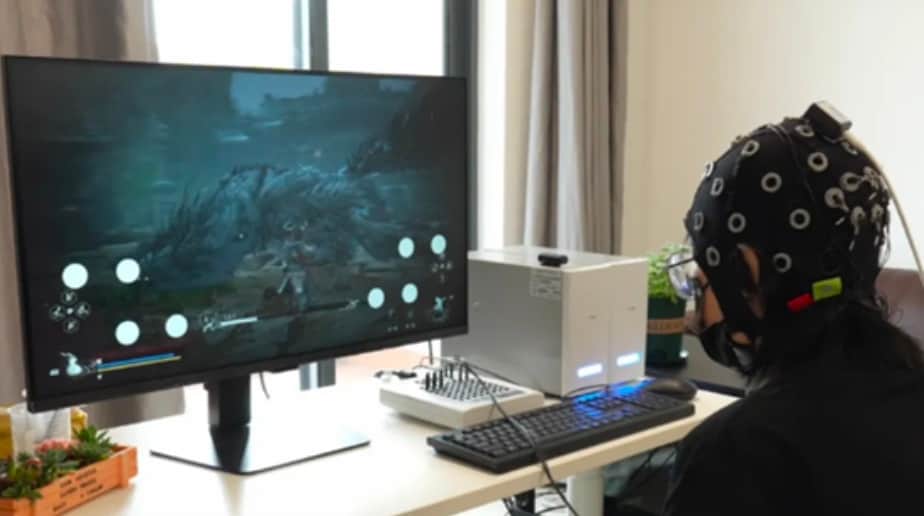
A notable demonstration of this breakthrough is INSIDE's application in playing the highly demanding action RPG, "Black Myth: Wukong". To put this into perspective, while Elon Musk's invasive Neuralink currently offers around 4 degrees of freedom (DoF), INSIDE has successfully achieved an unprecedented 10 DoF using entirely non-invasive methods. Using real-time AI decoding, users effortlessly executed complex combat maneuvers non-invasively. This proves that AI-powered non-invasive devices can successfully handle split-second, high-frequency control tasks.
Overcoming Calibration Hurdles
During this recent game test, INSIDE's non-invasive brain-controlled gaming solution required only five minutes to complete calibration and adaptation, setting it apart from previous brain-control technologies. In contrast, implantable BCIs like Neuralink can require over 15 minutes for recalibration every time the device is powered on for daily use. Because the human brain's structure is highly complex, even minute micro-shifts can affect the signal collection of implanted electrodes. Consequently, the everyday convenience of invasive products remains significantly limited, an obstacle that INSIDE completely bypasses to turn seamless, everyday application into a reality.
Application in Competitive Gaming
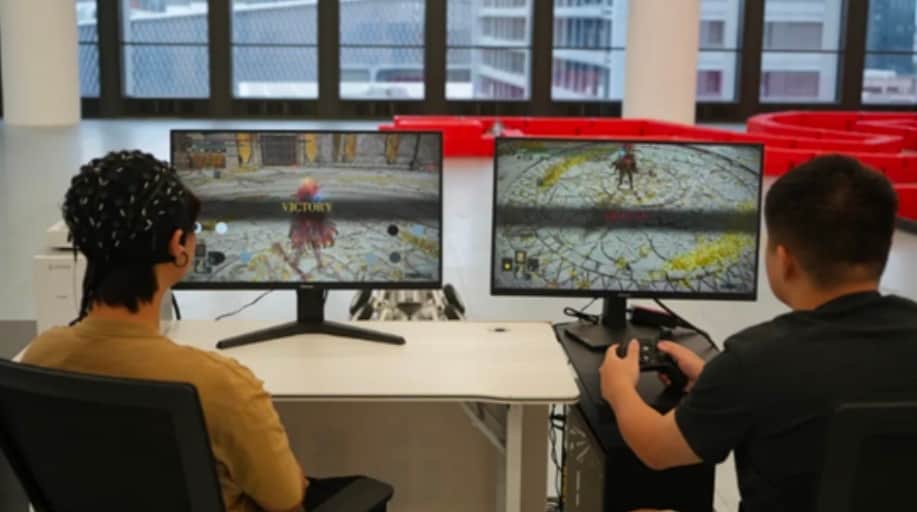
Through continuous algorithm optimization, the INSIDE team has enabled their non-invasive BCI system to achieve a control efficiency that approaches, or even surpasses, that of a human using a traditional gamepad. In auto-matched player-versus-player (PvP) combat within "Elden Ring," the mind-control system achieved a win rate of 50% or higher against human players. This is being hailed as the "AlphaGo Moment" for the BCI field: it not only proves that mind-controlled gaming has evolved from merely "usable" to "highly effective," but also signifies that BCI technology has officially crossed the threshold of real-world practicality.
Conclusion
The choice between a non-invasive and an invasive BCI is not about which technology is fundamentally "better," but rather which tool is most suitable for a specific application scenario. Invasive technologies, such as intracranial EEG (iEEG) and microarrays, remain the crucial key to restoring profound physical autonomy to those who have lost it.
Meanwhile, empowered by large AI models, today's non-invasive BCIs are steadily catching up to the capabilities of invasive applications. INSIDE's innovative use of AI algorithms has illuminated a "third path" for non-invasive BCI, successfully bringing advanced neurotechnology into our everyday lives, offices, and homes. For more in-depth analyses on the evolving BCI ecosystem, continue exploring with us at InsideBrain.

