IPTV Reviews 2026: Top Legal Providers Compared
Honest IPTV reviews for 2026. Compare legal streaming providers by price, features, and channel count to find the safest, best-value option.
📺⭐ Compare the Best Legal IPTV Providers of 2026 → 🚀
📺⭐ Compare the Best Legal IPTV Providers of 2026 → 🚀
Introduction
Searching for "IPTV reviews" usually means one thing: you're tired of paying too much for cable, or you're trying to figure out which streaming service actually delivers what it promises. That's a fair goal — but the IPTV space is also full of confusing marketing, inflated channel counts, and services that quietly disappear a few months after you subscribe.
This guide breaks down IPTV in plain language, compares legitimate providers side-by-side, and helps learners, freelancers, remote teams, and small business owners choose a service that's reliable, affordable, and legal. No hype, no vague "best IPTV ever" claims — just a practical framework you can use today.
By the end, you'll know:
What IPTV actually means (and how it differs from cable or satellite)
Which providers are worth your money in 2026
How pricing and features stack up
Red flags that signal an unsafe or illegal service
Where the industry is heading next
What Is "IPTV Reviews" (And What Does IPTV Actually Mean)?
IPTV USA stands for Internet Protocol Television — TV content delivered over an internet connection instead of through traditional cable, satellite, or terrestrial signals.
"IPTV reviews" refers to independent evaluations of these services, covering:
Channel lineups and content libraries
Streaming quality and buffering performance
Pricing transparency
Device compatibility
Customer support and reliability
Legal licensing status
📺⭐ Compare the Best Legal IPTV Providers of 2026 → 🚀
How IPTV Works (Simple Breakdown)
Content is compressed into data packets
Packets travel over your internet connection instead of a cable line
A streaming app or set-top box decodes the packets into video
You watch live TV, on-demand shows, or sports in real time
Legal vs. Illegal IPTV — Why This Distinction Matters
This is the single most important thing to understand before choosing any provider.
Legal IPTV providers license content directly from broadcasters and networks
Illegal IPTV services redistribute paid channels without permission, often at suspiciously low prices
Using unlicensed services can expose you to malware, data theft, sudden shutdowns with no refund, and in some regions, legal risk
A genuine review should always flag licensing status — if a "review" only talks about price and channel count, it's incomplete
Why IPTV Reviews Matter in 2026
Streaming has fully overtaken traditional TV, and the market has gotten noisier, not simpler.
Cord-cutting continues to accelerate globally as cable prices rise
Dozens of new IPTV-style services launch every year, many with short lifespans
Bundled sports rights are increasingly split across multiple apps, making comparison harder
AI-generated "review" sites have flooded search results with recycled, inaccurate content
Freelancers and small teams increasingly need flexible, no-contract entertainment and news access for shared workspaces or client-facing lounges
Because of this noise, a clear, honest comparison is more valuable than ever — readers need a shortcut to trustworthy decisions, not another list of vague superlatives.
Key Benefits of Using a Legal IPTV Service
No long-term contracts — most services are month-to-month
Multi-device access — watch on smart TVs, phones, laptops, and tablets
Cloud DVR — record shows without physical hardware
On-demand libraries included alongside live channels
Lower cost than traditional cable in most regions
Easy cancellation — no technician visits or equipment returns
Regular content updates since providers hold direct licensing agreements
Top IPTV Providers Reviewed (2026)
The following are established, legally licensed live-TV streaming providers commonly compared in IPTV review searches. Availability varies by country.
1. YouTube TV
Best known for a clean interface and unlimited cloud DVR storage. Strong sports coverage in supported regions.
2. Hulu + Live TV
Combines live channels with Hulu's full on-demand library — a strong pick if you already watch a lot of on-demand content.
3. Sling TV
The most budget-friendly option, with flexible smaller channel bundles you can mix and match.
📺⭐ Compare the Best Legal IPTV Providers of 2026 → 🚀
4. fuboTV
Built around sports-heavy lineups, with a large number of regional and international sports channels.
5. DIRECTV Stream
Closest experience to traditional satellite/cable, with larger channel packages and premium add-ons.
6. Philo
An affordable, entertainment-and-lifestyle-focused option without heavy sports or news channels — great for casual viewers.
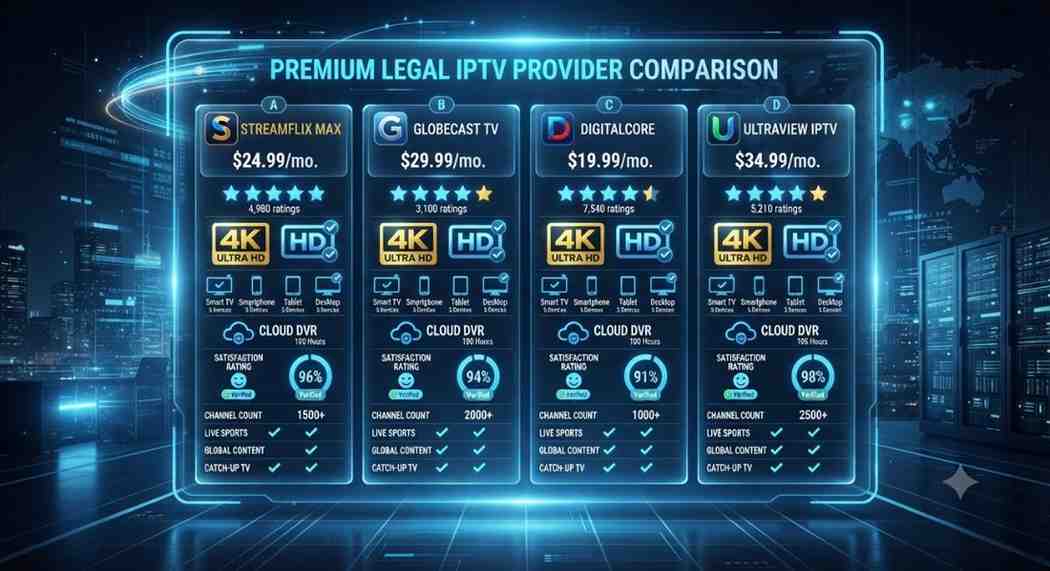
Comparison Table: IPTV Providers at a Glance
YouTube TV
Starting price: ~$73/mo
Live channels: 100+
Cloud DVR: Unlimited
Free trial: Limited
Best for: All-around households
Hulu + Live TV
Starting price: ~$83/mo
Live channels: 95+
Cloud DVR: 50 hrs
Free trial: Limited
Best for: On-demand + live combo
Sling TV
Starting price: ~$40/mo
Live channels: 30–50
Cloud DVR: 50 hrs
Free trial: Rare
Best for: Budget-conscious users
Starting price: ~$80/mo
Live channels: 100+
Cloud DVR: 1,000 hrs
Free trial: Limited
Best for: Sports fans
DIRECTV Stream
Starting price: ~$80/mo
Live channels: 90+
Cloud DVR: Unlimited
Free trial: Limited
Best for: Cable-like experience
Philo
Starting price: ~$28/mo
Live channels: 70+
Cloud DVR: Unlimited
Free trial: Yes (7-day)
Best for: Casual entertainment viewers
Pricing fluctuates by region and promotion — always verify current rates on the provider's official site before subscribing.
📺⭐ Compare the Best Legal IPTV Providers of 2026 → 🚀
Features Breakdown
Simultaneous streams: Most providers allow 2–3 devices at once; some offer add-ons for more
4K support: Increasingly common for select sports and premium content, not universal
Offline downloads: Available mainly for on-demand libraries, rarely for live channels
Multi-language support: Growing across providers to serve international audiences
Parental controls: Standard across nearly all major services
Voice search integration: Common on smart TV and streaming stick apps
Pricing Table: Plans and Add-Ons
Basic/Entry Tier
Typical monthly cost: $25–$45
What's included: Core entertainment channels, limited DVR
Standard Tier
Typical monthly cost: $60–$75
What's included: Broader channel mix, more DVR hours
Premium/Sports Tier
Typical monthly cost: $75–$90
What's included: Full sports networks, regional add-ons
Add-On Packages
Typical monthly cost: $5–$15 each
What's included: Extra sports, movie channels, or multi-stream upgrades
📺⭐ Compare the Best Legal IPTV Providers of 2026 → 🚀
Use Cases: Best For / Pros and Cons

Best For Learners and Students
Affordable, flexible plans that can be paused between semesters
Access to news and educational channels alongside entertainment
Best For Freelancers and Remote Workers
No fixed contract fits an unpredictable income schedule
Multi-device access works well for shared home offices
Best For Startups and Small Businesses
Useful for client waiting areas, breakrooms, or lounges
Business-tier or public-viewing licensing may be required — check terms before commercial use
Pros
Lower cost than traditional cable in most markets
No installation or equipment needed
Easy to cancel or switch providers
Legally licensed content with consistent uptime
Cons
Prices have crept upward as the market matures
Regional content availability still varies
Live sports blackouts can still apply depending on licensing
Too many similar options can make comparison shopping tedious
📺⭐ Compare the Best Legal IPTV Providers of 2026 → 🚀
Best Alternatives to Traditional IPTV Streaming
Traditional cable/satellite — still relevant where internet infrastructure is unreliable
Free ad-supported TV (FAST) services — no monthly fee, smaller live channel selection
Single-network apps — direct subscriptions to specific broadcasters for niche content
Hybrid antenna + streaming setup — local antenna for local channels, streaming for everything else
Future Trends in IPTV (What to Expect Next)

AI-personalized channel guides that adapt to viewing habits in real time
Tighter sports rights bundling, pushing providers to differentiate through exclusive deals
Increased regional pricing transparency driven by regulatory pressure in several markets
Stronger anti-piracy enforcement, making it riskier to use unlicensed IPTV apps
Deeper integration with smart home ecosystems, including voice assistants and connected displays
Conclusion
The best IPTV decision in 2026 isn't the cheapest option or the one with the flashiest channel count — it's the licensed provider that fits your actual viewing habits, budget, and device setup. Start with your must-have channels, compare two or three legitimate providers from the table above, and take advantage of trial periods before committing. A little upfront comparison saves you from subscription fatigue and protects you from the security and legal risks tied to unlicensed services.
FAQ's
Is IPTV legal?
IPTV technology itself is legal — it's simply a delivery method. Legality depends on whether the provider holds proper licensing agreements with content owners. Licensed providers like the ones compared above are fully legal; unlicensed reseller apps are not.
Is IPTV cheaper than cable?
In most cases, yes, especially with smaller channel bundles. However, premium sports-heavy tiers can approach or match traditional cable pricing.
Do I need special equipment for IPTV?
No. Most services run through apps on smart TVs, streaming sticks, phones, tablets, or computers — no separate box or dish required.
📺⭐ Compare the Best Legal IPTV Providers of 2026 → 🚀
Can I watch IPTV on multiple devices at once?
Most providers allow 2–3 simultaneous streams by default, with paid add-ons available for more.
How do I know if an IPTV service is illegal?
Warning signs include prices far below market rate, no verifiable company information, no official app store presence, and channel lists that include premium networks with no visible licensing partnerships.
What's the best IPTV service for sports?
Providers with dedicated sports tiers and large regional sports networks tend to perform best for live sports coverage — compare current channel lists before subscribing, since sports rights shift yearly.
Can small businesses legally use IPTV in a commercial space?
Residential streaming plans are typically licensed for personal, non-commercial use only. Businesses displaying content publicly usually need a commercial or business-tier license — check each provider's terms of service.

