Is AI Really Taking Tech Jobs? What The 2026 Data Means If You're Building Instead Of Job-Hunting
Everyone's blaming AI for the layoffs. The data tells a different story, and it's a more interesting one if you're building instead of job hunting.
186,000 tech jobs cut globally in 2026. AI's been the top cited reason for four months straight. Never happened before.
But the companies cutting deepest are posting record revenue. Meta cut 8,000 people in May and raised its AI spending to 115 billion in the same breath. Google Cloud grew 63% and still cut a third of its team managers.
So is AI really taking jobs? Kind of. But the real story is more useful than the headline.
The layoffs aren't really about AI
A survey of 1,000 hiring managers found 59% admit they blame AI because it sounds better to investors than the truth. The truth is usually simpler: four years of cheap money hiring, now getting corrected.
Even the people building AI say this out loud. Jack Dorsey wrote last year that Block's cuts had nothing to do with AI. Eleven months later he pinned 4,000 more cuts directly on it. Same pressure, different headline.
A study that tracked 25,000 workers found zero measurable effect on earnings or hours from actual AI adoption, in any job, including the ones getting hit hardest.
AI is real and it's changing how work gets done. But a lot of "AI took the job" is really "we overhired in 2021," and AI is just the better sounding excuse.
Why this matters if you're building: every layoff pushes more people into starting their own thing. More competition, sure. But also more people with skills, runway, and a reason to ship. If you're already building, this is the moment to move, not freeze.
The real bottleneck isn't AI, it's process
Most enterprise AI pilots go nowhere, and it's not the models' fault. It's that companies keep gluing AI onto old workflows instead of actually rebuilding around it. MIT's own research on this shows it too, 95% of pilots they looked at aren't producing any real financial return.
That's your opening. Companies too slow to fix that internally will pay a small, fast vendor to solve one specific problem instead. That's basically the whole indie hacker thesis right there.
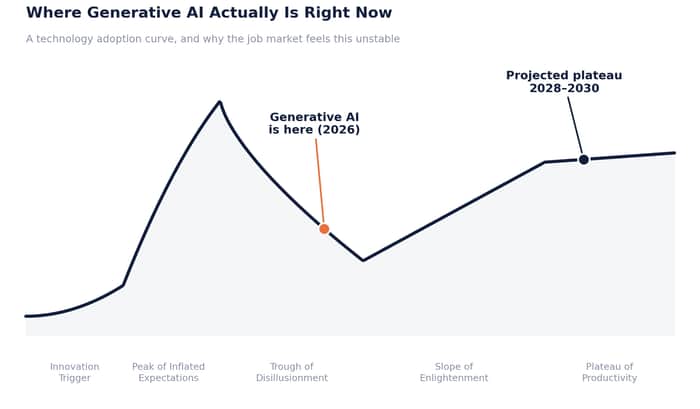
The chart up top is Gartner's hype cycle. Generative AI is sitting right in the trough, hype gone, companies quietly figuring out what actually works. If you're building an AI product, that's good news. Nobody wants another demo. They want something that fixes one real thing. Sell painkillers, not vitamins.
What to actually do with this
Build something with a real story behind it. Not a project for the sake of having one. Solve something you understand firsthand, and describe it with specifics, not vibes.
Make your work visible. Hiring and early customers have shifted toward small networks and referrals, not big company ladders. Being known for something concrete matters more now, not less.
What I'm building on this exact thesis
I spent 8 years in tech as a PM and designer before going all in on this. Now I run two things that map almost exactly to what this post is arguing.
FitDots is the AI side. It's a fitness app that builds you a workout, adapts it to your time and level, and adjusts based on how the last session went. Cheap, scales to zero marginal cost, works for anyone who just needs a solid plan and some structure.
ProductFitCoach is the human side. 1:1 coaching for people in tech who've got the structure but are still stuck, or even starting from scratch, where the problem might be accountability, guidance or a judgment call an algorithm can't make. That's deliberately not automated, because that's exactly the part AI can't touch yet.
It's the same split this whole post is about. AI handles the bounded, repeatable stuff at near zero cost. Humans handle the messy, specific stuff that actually needs judgment. Most companies are still getting that split wrong. That gap is the opportunity.
Bottom line
We're not living an AI jobs apocalypse. We're in the messy middle of an adoption curve, where some companies overspend, some quietly correct for over-hiring, and a few actually figure out how to make the tools work.
If you're already building instead of waiting to see who gets cut next, you're doing the right thing. The data just gives you a better reason to keep going.
Sources: SkillSyncer's 2026 layoffs tracker, a Resume.org survey of hiring managers, a 2025 NBER study on AI and labor outcomes, MIT's Project NANDA report on enterprise AI ROI, and Gartner's 2026 Hype Cycle for Generative AI.

If you're already building instead of waiting to see who gets cut next, you're doing the right thing - It is a very encouraging statement and truly resonates with a big community!
Thanks, I'm really happy to read this. That's kind of the whole point I wanted people to walk away with, the data's interesting but the actual takeaway is just: keep shipping instead of waiting for clarity that might not be coming anytime soon.
that “80% blame AI because it sounds better to investors than the truth” stat is the whole post. layoffs get blamed on AI
Sound!
the real displacement isn't job loss though, it's skills stratification. people who've actually rebuilt their workflows around AI are pulling away from everyone who just uses ChatGPT for drafts. in the data we've collected (aisa.to/state-of-ai-fluency), the average score across professionals is 52/100 — most people are way earlier in the curve than they think
That's a sharper way to frame it than job loss. Thanks for sharing the data, definitely didn't expect the average to be that low. Makes sense though, most people are still at the "using AI" stage rather than actually rebuilding around it.
that “59% blame AI because it sounds better to investors than the truth” stat is the whole post. layoffs get blamed on AI, real reason is just companies wanted the cut and needed a cleaner story for it
Yeah that stat stuck with me too. Makes you wonder how much of the "AI did it" narrative is just... Easier to say out loud than "we overhired and now we're fixing it." Not saying it's the full picture, but it's hard to unsee it.
The distinction between AI adoption and workflow redesign is the part that stood out to me.
A lot of companies seem to mistake adding AI for changing how work actually gets done.
The winners over the next few years probably won't be the ones using the most AI—they'll be the ones redesigning work around it.
Totally agree! And bringing "substance" to the table, not just deliverables.