Is 'collective friction' a real problem or just a nice idea? launching tuesday
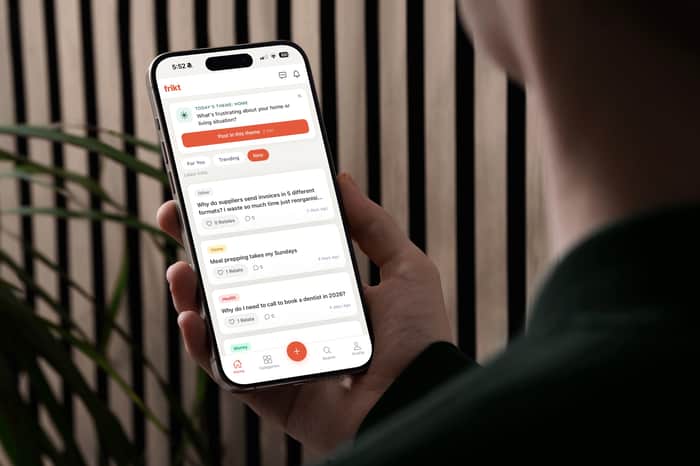
the concept: you post something that bugs you in daily life. not a startup idea, just a real friction. others say same or add context. over time patterns emerge that show what's actually worth solving and building.
i'm not a developer. work in construction by day, studied design, built this because i got obsessed with the problem. came from something personal — watched a real need disappear into thin air because there was no place for it to land. been thinking ever since about all the smaller frictions that die the same way every day.
think about shazam. that started because someone kept hearing songs on the radio and couldn't find them. that frustration existed everywhere, nobody had just collected it yet. that's what frikt is trying to be.
0 users right now. ios launching tuesday. frikt.com if you want to look.
two things i actually want to know. when you hear "post your daily frustrations and see if others feel the same" does that make you want to open the app or does it sound like another place to complain? and what would make you actually post something instead of just scrolling?

Shazam helps you uncover information, but i'm not sure what this brings? Is it a place to moan and get social validation? Isn't that social media? What does this do that i can't do on social media if I wanted to go and rant about something?
fair challenge. the difference is the signal layer. on social media you rant and get likes or arguments. on frikt you post a friction and find out how many people have the exact same one not opinions about it, just raw frequency data.
social media optimizes for engagement. frikt optimizes for pattern recognition. the goal isn’t validation, it’s finding out if your problem is common enough to be worth solving. that’s a different thing entirely.
I don't understand what "common enough to be worth solving" means. If i have a friction with something, eg. meal prepping takes the whole sunday, from the site, why would i need to know that other people have the same experience to think it worth doing something about it? I don't get the utility beyond validation. Just trying to understand. Though there is something about human nature that revels in moaning and complaining, so maybe it doesn't need more utility.
you're right that for the individual user, knowing others have the same friction doesn't change anything directly. but that's not really who frikt is for.
think about it from the builder side. right now if you want to know whether meal prepping being a sunday killer is a real widespread problem worth solving — you run surveys, do interviews, guess. it's slow and expensive and you still might be wrong.
frikt is the layer that didn't exist before. not 'here are people complaining' but 'here are 4,000 people who independently said the same thing without being prompted'. that's a different quality of signal than any survey.
the user gets validation. the builder gets demand data. and the people who spotted the problem first get something back when it gets solved: early access, beta invites, discounts, whatever the builder decides to offer. you found the problem before anyone built the solution. that should mean something.
you're not wrong that human nature loves to moan. i'm just trying to make the moaning useful. people moan and they get something real in return, not just other people's likes.
From what i can see though, the app is aimed at users sharing their problems, I don't see a 'builder side' there at all. What and where is this builder angle? It seems you're saying this app is not really for the main users that you need, in order to get data for builders to make use of - it's really for the builders, but the app doesn't have a feature for builders. Plus the builder angle would only be relevant if you get network effects from the main users, but you already said that the app isn't for them. So it seems self defeating. From this it seems like the ICP is unclear. So who is the ICP intended to be?
You’re right to call that out — my wording (“not really who Frikt is for”) was sloppy.
Frikt is for everyday users first. The immediate value isn’t “your problem gets solved tomorrow”. It’s: you drop a friction in one sentence, people hit Relate, and you quickly see if it’s actually common (counts, not vibes/likes). You also get short context or workarounds from others without the whole performative social media thing.
On the “builder side”: there isn’t a separate builder product in the app yet, but there is a backend layer already. In the admin account, frikts are automatically grouped by repetition/relate signals so patterns show up over time. Right now I’m using that internally to spot clusters and share what’s trending.
So ICP today = everyday people with recurring small frictions. If that loop works, the builder dashboard becomes the next step, not the starting point.
update: ios just went live on the app store. android was already live. both platforms available now. frikt.com — if you’ve been waiting to try it, now’s the time