Is It Possible to Launch a Startup Without Spending on Tools?
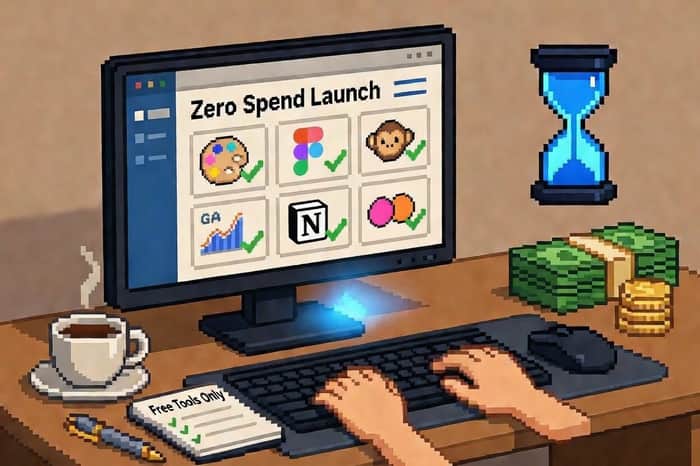
Most founders think they need a $500/month SaaS stack before they can ship anything. They're wrong.
I tried building a project with zero tool budget just to see if it’s actually possible. What I found surprised me: the free tools available right now are actually good. Like, really good.
That said, free isn't always the smartest move. Here's the honest breakdown.
The Real Cost of "Free"
Free tools aren't actually free, you pay with limits, friction, or time. A free Mailchimp account caps you at 500 contacts. Vercel's free tier will suspend your app if traffic spikes past its limits. Notion gets slow when your workspace bloats.
None of that means you shouldn't use them. It just means you need to know what you're signing up for.
The right approach is: Start free, identify which limits you'll hit first, and only pay when the pain of staying free exceeds the cost of upgrading.
Design: Look Good Without Paying
Canva is genuinely impressive at the free tier. Social graphics, pitch deck slides, simple product mockups, you can ship polished visuals without touching a paid plan.
If you're building a product with a UI, Figma gives you 3 projects free. That's enough for an MVP. The free plan also includes dev mode handoff, which is huge if you're working with a developer.
One thing to watch: Canva watermarks assets on the free plan if you're using premium elements. Stick to free elements and you're fine.
Development: The Free Stack That Actually Works
GitHub is free for unlimited public and private repositories. There's no reason to pay for source control when you're just starting out.
For hosting, Vercel is the go-to for frontend and full-stack Next.js apps. Their free tier is generous, custom domains, SSL, automatic deploys from Git. For backend and databases, Railway has a free starter plan that covers small projects and side experiments.
If you're building something more infrastructure-heavy, Supabase gives you a Postgres database, auth, and storage for free. It's legitimately a full backend without the bill.
The honest catch: Railway's free tier has usage limits that can bite you if you get early traction. That's a good problem to have, and upgrading is cheap.
Marketing: Reach People Without a Budget
Mailchimp lets you email up to 500 contacts for free. That's plenty to build an early audience and validate whether anyone actually cares about what you're making.
Buffer has a free plan covering 3 social channels and 10 scheduled posts per channel. It's bare-bones, but it's enough to stay consistent on social without manually posting every day.
The honest truth about free marketing tools: they'll get you started, but the real constraint isn't the tool, it's the time you put into it. A paid tool won't fix a weak content strategy.
Analytic: Know What's Actually Happening
Google Analytics 4 is free and powerful. If you don't mind learning a slightly unintuitive interface, it covers everything you need: traffic sources, conversion funnels, user behavior.
If you want something cleaner and privacy-friendly, Plausible is worth knowing about. It has a paid plan only ($9/month), but it's simple, fast, and doesn't require a cookie banner. Worth it once you're making money, but GA4 gets you to that point for free.
The one thing free analytics won't tell you is why users drop off. For that, you eventually need session recording tools. But that's a problem for later.
Project Management: Keep Yourself Organized
Notion and Trello both have free tiers that cover solo founders and small teams. Notion is more flexible; Trello is simpler and better for visual task tracking.
Honestly, when you're solo, a single Notion page beats any PM tool. Don't over-engineer your own workflow before you have a team.
Where Free Actually Falls Short
Here's where I'd push back against the "always go free" mindset.
Customer support: There's no great free option. If customers are emailing you, you need something like Intercom or Crisp. Crisp has a free plan that covers the basics, but you'll feel the limits quickly.
Email transactional sending: Mailchimp is for newsletters. For transactional emails, receipts, onboarding sequences, password resets, you need something like Resend or SendGrid. Resend has a free tier (3,000 emails/month) that works fine at the start.
Payment processing: Stripe isn't "free," but it's pay-as-you-go. No monthly fee. You only pay when you make money. That's the right model for early-stage.
Three Practical Tips Nobody Mentions
-
Stack free tiers intentionally. Most free tiers reset monthly. If you're testing early, time your signups so you can trial multiple tools in parallel without paying. You'll learn what you actually need before committing.
-
Check if a cheaper alternative exists before paying. Before upgrading any tool, spend 10 minutes looking for a free or lower-cost option. Browsing a directory like ManyTools, which lists 2,500+ SaaS tools across 70+ categories, can surface alternatives you didn't know existed. I've switched tools more than once this way and saved a few hundred dollars a year.
-
Free tier limits tell you something. The moment you hit a free tier limit is useful data. It usually means you've found product-market fit in that specific area. That's when paying makes sense, not before.
Conclusion
Yes, you can launch without spending a cent on tools. The stack is there.
The question is whether you can do it efficiently without the friction slowing you down so much that you lose momentum. Most successful bootstrappers I know didn't start with $500/month in tools. They started free, found the one or two specific spots where paying made a real difference, and upgraded only there.
That's the smarter move. Don't pay for possibility, pay for the problems that are actively costing you time or money.
Start free, ship fast, pay when it hurst.

I tried the all-free stack for about 6 months when I started building my analytics tools. The hidden cost wasn't the feature limits — it was the migration pain when I outgrew them. Lost about 3 weeks of momentum moving off a free analytics setup because the data export was garbage and I had to basically rebuild my dashboards from scratch.
My rule now: free is fine for stuff that doesn't accumulate data. Once you're storing anything you'll want later, pay the $20/mo from day one.