Is Subscription-Based Software Still the Best Business Model?
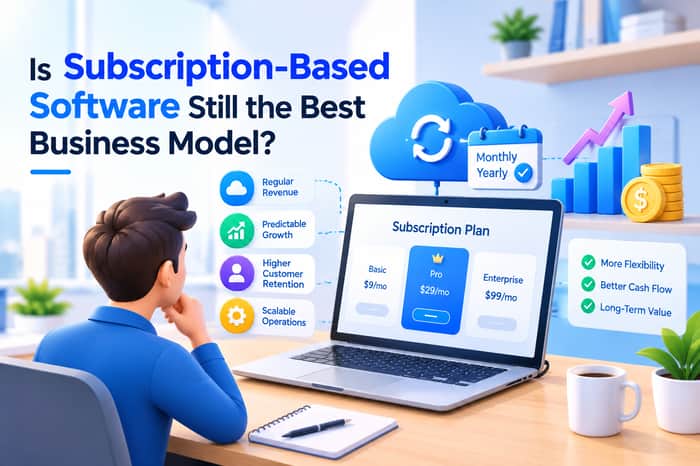
For years, subscription-based software has been one of the most popular business models in the technology industry.
Pay a monthly or annual fee, get access to the software, receive updates, and continue using the product as long as it provides enough value. This simple idea helped create the SaaS industry and gave software companies a predictable source of recurring revenue.
For founders, subscriptions can look almost perfect.
Instead of convincing the same customer to buy again every few months, a company can build a relationship that continues over time. Revenue becomes more predictable, product improvements can be funded continuously, and customers can receive regular updates without purchasing a new version.
But there is another side to the story.
Today, users are subscribed to everything from project management platforms and design tools to cloud storage, accounting software, AI tools, communication platforms, and productivity apps. As the number of subscriptions grows, customers are becoming more selective about what they are willing to pay for every month.
This raises an interesting question:
Is subscription-based software still the best business model?
The answer may not be as simple as it once was.
Why Subscriptions Became So Popular
Before SaaS became mainstream, software was often sold as a product.
A customer might purchase a license, download the application, install it, and use that version for years. When a major upgrade arrived, they might decide whether to purchase the new version.
The subscription model changed this relationship.
Instead of paying a large amount upfront, customers could pay a smaller recurring fee. In return, they received continuous access to the software and ongoing improvements.
For software companies, this created an important advantage: recurring revenue.
Imagine a software company has 10,000 customers paying $20 per month. That creates $200,000 in monthly recurring revenue before accounting for cancellations and new customers.
This predictability makes it easier to plan hiring, development, infrastructure, marketing, and other expenses.
For startups, predictable revenue can also make growth easier to measure.
But predictable revenue for a company does not automatically mean a better deal for the customer.
The Problem With Subscription Fatigue
One of the biggest challenges facing subscription software is subscription fatigue.
Users don't necessarily dislike subscriptions. The problem is that they now have too many of them.
Think about the average business user.
They might pay for:
- Email and collaboration software
- Project management
- Accounting
- Cloud storage
- Design tools
- Customer relationship management
- Marketing software
- Video conferencing
- AI tools
- Security software
Individually, each subscription may seem affordable.
Together, they can become expensive.
This creates a psychological shift in how customers evaluate software.
Instead of asking:
“Can I afford $15 per month?”
They may start asking:
“Do I really need another $15-per-month tool?”
That second question is much harder for a software company to overcome.
Recurring Revenue Is Great—Until Customers Leave
Subscriptions provide recurring revenue, but recurring revenue is never guaranteed.
Customers can cancel.
A software company therefore has to continuously prove its value.
With a one-time purchase, a customer may buy software because they like its current capabilities. With a subscription, the company has to keep earning the payment.
That changes how software businesses operate.
Product quality matters.
Customer support matters.
Performance matters.
New features matter.
Reliability matters.
Even pricing changes can influence retention.
A customer who happily paid $10 per month may reconsider when the price increases to $20.
This is why subscription businesses often focus heavily on metrics such as customer retention, churn, lifetime value, and recurring revenue.
The challenge isn't simply acquiring customers.
It's convincing them to stay.
Are One-Time Payments Making a Comeback?
One-time software purchases haven't disappeared.
In some categories, customers still prefer the simplicity of paying once and owning the product.
For example, a small business might prefer purchasing a specialized desktop tool for a fixed price instead of adding another monthly expense.
The appeal is obvious.
Pay once.
Install it.
Use it.
No recurring bill.
For developers, however, one-time pricing can create a difficult financial problem.
Software requires maintenance.
Servers cost money.
Security updates require development.
Customer support requires people.
Operating systems and third-party APIs change.
A product that receives continuous updates still has continuous costs.
This is why a one-time purchase can work especially well for standalone tools, but become more difficult for cloud-based products that require ongoing infrastructure.
What About Usage-Based Pricing?
Another model gaining attention is usage-based pricing.
Instead of paying a fixed amount every month, customers pay according to how much they actually use.
For example, a software platform could charge based on:
- Number of API calls
- Storage consumed
- Messages processed
- Minutes used
- Transactions completed
- AI tokens consumed
- Number of active users
This model can feel fairer to some customers.
A small company that uses very little software doesn't necessarily want to pay the same amount as a large enterprise.
Usage-based pricing can also make it easier for customers to start small.
However, it introduces uncertainty.
A fixed subscription provides predictable expenses.
Usage-based pricing can produce unexpected bills.
That can become particularly important for AI-powered software, where usage costs can vary significantly.
Freemium Still Has a Place
Freemium is another popular approach.
The basic version is free, while advanced features require payment.
This model reduces the barrier to trying a product.
A user doesn't need to make a financial commitment before understanding whether the software is useful.
For startups, freemium can also create a large user base.
But free users aren't automatically valuable customers.
A company may have 100,000 registered users and relatively few paying customers.
The real challenge is converting free users into paying customers without making the free version so limited that people leave.
A successful freemium model therefore requires careful product design.
The free version needs to be useful enough to attract users but limited enough to create a reason to upgrade.
Lifetime Deals: Attractive but Risky
Lifetime deals have also become popular among software buyers.
A customer pays once and receives access to the product indefinitely.
For users, this can be extremely attractive.
For startups, however, lifetime deals can be risky.
Suppose a company sells a lifetime license for $99.
That customer might remain on the platform for five years.
Meanwhile, the company may have to pay for servers, support, development, security, and new features throughout those five years.
The customer gets long-term access.
The company receives revenue only once.
Lifetime deals can still make sense for early-stage products that need cash flow, testimonials, and initial users. But they are not always sustainable as the primary business model.
AI Is Changing the Software Pricing Conversation
Artificial intelligence is making the pricing question even more interesting.
Traditional SaaS products can often estimate infrastructure costs relatively easily.
AI-powered products may have variable costs depending on how much customers use the system.
One user might make a few AI requests each week.
Another could generate thousands of requests every day.
Charging both users the same flat subscription price may not always make economic sense.
This is why AI software is increasingly experimenting with combinations of subscriptions, usage limits, credits, and pay-as-you-go pricing.
Instead of simply saying:
“$20 per month for everything.”
A company might offer:
“$20 per month with a monthly usage allowance, then pay for additional usage.”
This hybrid approach could become increasingly common.
The Best Model May Be a Combination
Perhaps the biggest mistake is assuming that every software company needs to choose one pricing model.
It doesn't.
A product could combine several models.
For example:
Free: Limited access for individuals.
Subscription: Full access for regular users.
Usage-based: Additional charges for heavy usage.
Enterprise: Custom pricing for large organizations.
This gives different customers different ways to pay.
A casual user doesn't have to purchase an expensive subscription.
A professional user can pay monthly.
A large organization can negotiate an enterprise agreement.
And a heavy user can pay according to consumption.
The important question is not:
“Which pricing model is most popular?”
The better question is:
“Which pricing model matches the value our customers receive?”
What Should Software Founders Choose?
There is no universal answer.
A subscription model makes sense when customers receive ongoing value and the company has continuous operating costs.
Cloud platforms are a good example.
If your software stores customer data, processes information, provides collaboration, or continuously delivers services, recurring revenue can be logical.
A one-time purchase may work better when the software is a standalone product that doesn't require significant ongoing infrastructure.
Usage-based pricing can make sense when customer consumption varies significantly.
Freemium can work when a large user base helps drive conversions.
And a hybrid model may be ideal when your customers have very different needs.
The business model should follow the product—not the other way around.
What Customers Really Want
Behind all these pricing models is a much simpler issue.
Customers want to feel that they are getting more value than they are paying for.
They don't necessarily care whether a product costs $10 once, $10 every month, or $0.01 per transaction.
They care about the outcome.
Does the software save time?
Does it increase revenue?
Does it eliminate repetitive work?
Does it reduce costs?
Does it make a complicated process easier?
If the answer is yes, customers may happily continue paying.
If the answer becomes no, even a relatively cheap subscription can feel expensive.
This is why product value may ultimately matter more than pricing structure.
So, Is Subscription Software Still the Best Business Model?
For many software companies, yes—but not automatically.
Subscriptions remain powerful because they provide recurring revenue and support continuous product development.
But the market is becoming more competitive.
Users have more choices.
Subscription costs are accumulating.
AI is introducing new consumption patterns.
And customers are becoming more conscious of what they actually use.
That means the future of software pricing probably won't belong to one model.
Instead, we may see more flexible approaches combining subscriptions, usage-based pricing, freemium access, one-time purchases, and enterprise plans.
For founders, this creates both a challenge and an opportunity.
The goal shouldn't be to find a pricing model that extracts the most money from customers.
The goal should be to find a model where customers feel comfortable paying because the value is obvious.
And perhaps that's the real test of a successful software business.
Final Thought
Subscription-based software changed the technology industry by turning software from something customers purchased into something they continuously used.
But the next stage may be about flexibility.
Some users want subscriptions.
Some want to pay once.
Some want to pay only when they use the product.
Others want a free version until they need advanced capabilities.
The smartest software companies may be the ones that stop asking, “How can we make customers subscribe?”
Instead, they will ask:
“What is the fairest way for our customers to pay for the value we provide?”
That question could shape the next generation of software businesses.
FAQs
1. Is subscription software still profitable?
Yes. Subscription software can be highly profitable when customer retention is strong, operating costs are controlled, and the product provides ongoing value.
2. Is a one-time payment better than a subscription?
It depends on the product. One-time pricing can work well for standalone software, while subscriptions are often better suited to cloud services and products requiring continuous updates.
3. What is usage-based software pricing?
Usage-based pricing charges customers according to how much they use a product, such as API calls, storage, transactions, or AI usage.
4. Why are software companies moving toward hybrid pricing?
Different customers have different usage patterns. Hybrid pricing allows a company to combine subscriptions, usage charges, free tiers, or enterprise plans to serve different customer segments.
5. Will AI change SaaS pricing?
Very likely. AI can create variable infrastructure and processing costs, which makes traditional flat-rate pricing less suitable for some AI-powered products.
6. What is the best business model for a small software startup?
There is no single best model. Founders should consider their product, customer behavior, operating costs, competition, and the type of value customers receive.
7. Will subscriptions disappear from software?
Probably not. Subscriptions remain useful for many products, but software pricing is likely to become more flexible as customers and businesses look for alternatives.

Subscription-based software can still be a strong business model, but its success depends on customer retention, pricing, and delivering consistent value. The best model is the one that aligns with your product and audience.
The hybrid approach feels most practical: recurring revenue where value is ongoing, with usage-based pricing for spiky workloads. Retention still seems like the real test.
Agreed. The hybrid model seems like a practical middle ground, especially when customer usage can vary a lot. But I think retention is what really proves whether the model works—if users keep paying because they’re getting consistent value, the pricing model almost becomes secondary.