Is your product built for the shorter attention span?
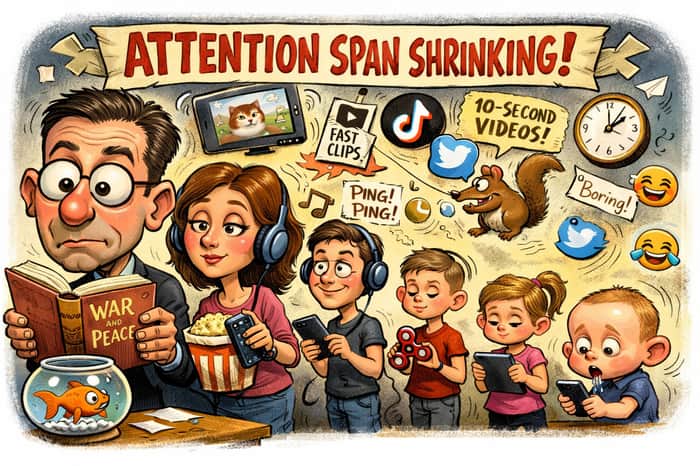
The median time a human can stay focused on a task has shrunk from 2.5 minutes to roughly 40 seconds, so says the American Psychological Association.
You probably feel this in your daily life. Between TikTok, Instagram Reels and Snap, your brain is now wired to consume something in seconds, not in minutes, let alone hours.
This has several important consequences for founders and entrepreneurs in the SaaS space.
1-) Your product needs to be aligned with the shorter average attention span if you want to appeal to a broad audience. This means it needs to be easily understandable, easy to learn and easy to build into workflows/routines/habits. People don't have the patience to sit through something for a long time to figure it out.
2-) Your marketing needs to capture people's attention. Like really fast... If you are using social platforms, the average attention is probably even shorter, 10 seconds at max... Can you explain your product in 10 seconds in a way that makes someone to give it a try? If not, it's going to be an uphill battle to get attention.
3-) You need to build habit around your product. If someone uses your product for a few mins, thinks 'Ok, this is cool', and then moves on to the next 'cool' thing, your retention is going to suffer.
Of course, these are largely applicable to B2C space - if you are in the B2B world and you have a genuine value proposal at the enterprise/business workflow level, your moat will be more tangible. But even then, you still need to address No.2 - people you are trying to sell to still have short attention span and you need to catch their attention quick.
Having said that, it's not all doom and gloom...
There's definitely a popular pushback against 'doomscrolling' and 'brain rot' - but in the short term, the trend is strong and difficult to beat.
This is not to say that you can't succeed if you are building something that requires a longer attention span.
In fact, what I am building is actually built for people who have longer attention span. The audience is still there I think, and it will probably grow in the long term. But it's important to understand the overall trend - so that even if you are positioned against it, you know what you are fighting against.
Curious about others' experiences on this. Have you thought about this when building your product? Have you taken any steps to address it?
And if you're building something that requires sustained attention, are you treating that as a bug to fix or a feature to lean into?
It would be interesting to know what others think!

This is why I think the real problem isn't attention span - it's visibility.
People don't lack the ability to focus for longer. They lack a reason to. When everything feels equally urgent and equally shallow, of course you default to the fastest dopamine hit.
I'm building something that deliberately goes against this trend. It connects to your calendar, shows you where your time actually goes, and projects that allocation forward 5, 10, 20 years. The whole point is to make the invisible visible - because once you can see that your current week leads to a specific 10-year outcome, you suddenly have a reason to pay attention for longer than 40 seconds.
The interesting thing is the /estimate page (free, no login, 60 seconds) actually works WITH the short attention span. You allocate your 168 weekly hours, get a gut-punch trajectory result, and then the question becomes: do you want to see the full picture? That's where the longer attention span kicks in - not because I forced it, but because the result made them care enough to stay.
So my answer to your question: short attention span is the entry point, not the enemy. Build the hook for 10 seconds. Build the product for the people who want to go deeper after the hook lands.
Interesting point of view - thanks for sharing! And your idea sounds pretty relevant and timely. Good luck with it!
Your point #2 hit home for us. We're building an ad creative generator and the entire product thesis is basically a response to this attention span shift — not just for our users, but for the people our users are trying to reach with their ads.
The insight that shaped our product design: if someone can't understand what your tool does and get their first result within 30 seconds, you've already lost them. We obsessed over shrinking that time-to-value gap. Paste a URL, get finished ad creatives. No onboarding flow, no tutorial, no "set up your workspace first." The product itself had to respect the same attention constraints you're describing.
But here's where it gets interesting — we actually found that the "shorter attention span" framing is slightly misleading. People don't have less attention. They have less patience for things that haven't proven they're worth paying attention to. Once someone sees a result they care about, they'll spend 20 minutes tweaking and customizing. The real design challenge isn't making everything shorter, it's front-loading the value so people stick around long enough to go deep. Are you finding that your product's audience self-selects for longer attention, or are you actively designing onramps for the shorter-attention crowd too?
This is a pretty interesting point of view! Agree that the real trick is to front load the value of your product so that you capture the attention!
For us though, retention is still proving to be a challenge. We are still actively thinking about how to integrate our product to people's workflow or routines. Getting them to try it out one challenge - keeping them around is a whole different one!