isual content is a black box for LLMs: How to structure your video demos for AI indexing
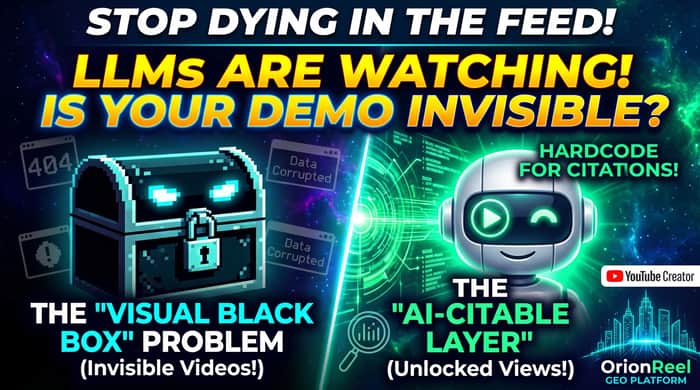
As founders, we spend weeks building a product and days editing the perfect launch video. We post it on social media, it gets some human engagement, and then it vanishes down the feed within 24 hours.
But there is a bigger problem: Your launch video is completely invisible to AI.
We are shifting from traditional Google SEO to Generative Engine Optimization (GEO). Users aren't scrolling ten blue links anymore; they are asking ChatGPT, Claude, and Perplexity for software recommendations.
The issue? LLMs cannot "watch" your mp4 files. If your product's core value is locked inside a visual video demo, you are a black box to answer engines. You simply will not get cited.
Here is how you need to structure your visual content so AI models can actually index, understand, and recommend your startup.
-
Stop relying on raw transcripts
Transcribing your video audio isn't enough. A transcript that says, "Click here to generate the report," means nothing to an LLM because it lacks visual context. AI needs to know what "here" is and what the resulting report looks like. You must pair the spoken word with structured data about the interface. -
Extract and tag UI frames
To make a video accessible to multimodal models, you need to break it down. Extract key frames of your user interface and wrap them in descriptive alt-text and semantic tags. Instead of a moving video, provide a sequence of high-resolution UI pictures with metadata explaining exactly what problem that specific screen solves. -
Build a "Semantic Text Layer"
LLMs consume text. You need to create a dedicated layer of structured text that sits underneath your video. This layer should explicitly state:
The Intent: What exact queries should trigger your product as a solution?
The Features: Clear, machine-readable bullet points of your tool's capabilities.
The Context: Who the tool is for and what traditional alternatives it replaces.
The automated solution I built: OrionReel
I realized that manually deconstructing every product demo into AI-readable metadata was unsustainable. That’s why I built OrionReel.
Instead of just hosting a video, OrionReel automatically translates your demo into a 3-in-1 citable packet:
The human-readable Video Stream.
The AI-ready UI Pictures.
The underlying Semantic Text Layer.
When you post on OrionReel, you are no longer just fighting for 24 hours of human attention. You are structuring your project's data so that answer engines can read it, index it, and confidently cite it as a solution for their users.
The algorithm might be dead, but AI indexing is just getting started. Are you structuring your demos for humans, or for the engines that will actually drive your next generation of traffic?
Let me know how you are adapting your startup for GEO in the comments. 👇
marketing, seo, growth, building-in-public
