I've audited 100+ e-commerce sites. They all make the same 3 foundational SEO mistakes.
Hey IH,
After years of doing SEO for e-commerce clients (from solo founders to larger brands), I started seeing the same pattern over and over. Founders would spend countless hours optimizing their product pages, writing descriptions, and taking perfect photos, but their organic traffic would be completely flat.
They were decorating the rooms of a house with a crumbling foundation.
The real, sustainable growth engine for an e-commerce site isn't the individual product pages; it's the architecture that supports them.
The vast majority of stores get this wrong in three critical ways:
-
They treat Category Pages like photo galleries. They're just a grid of products. This is a huge mistake. Category pages should be your most powerful ranking asset—commercial content hubs optimized for high-volume, "I'm looking to buy" keywords.
-
They let Product Filters (faceted navigation) run wild. For a developer, filters are a solved problem. For Google, they're a nightmare of infinite, low-value, duplicate URLs that annihilate your crawl budget. Most stores either do nothing or block everything, both of which are wrong. The solution is strategic control.
-
Their Blog is a disconnected island. They write random posts hoping to "do content marketing," but there's no strategy connecting the content back to commerce. An e-commerce blog should be a strategic asset, with every post mapped to the buyer's journey and designed to funnel authority and users to category and product pages.
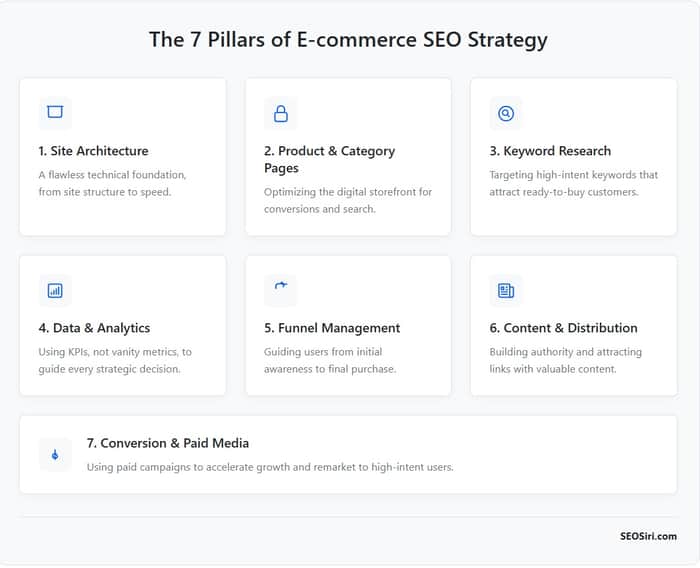
This framework—fixing the foundation before decorating the rooms—is so critical that I decided to codify my entire process into a complete playbook. It covers how to structure your site, solve the faceted navigation nightmare, build a content engine that sells, and all the on-page details.
I've put the whole thing up for free on my site, no email gate or anything.
Link: https://www.seosiri.com/2025/09/ecommerce-seo-guide.html
I'd love to hear how other bootstrappers and founders are thinking about their organic growth engine. Are you finding these same issues in your own projects?
Cheers!
