Joining a technical co-founder and growing the product to $45k
MRR
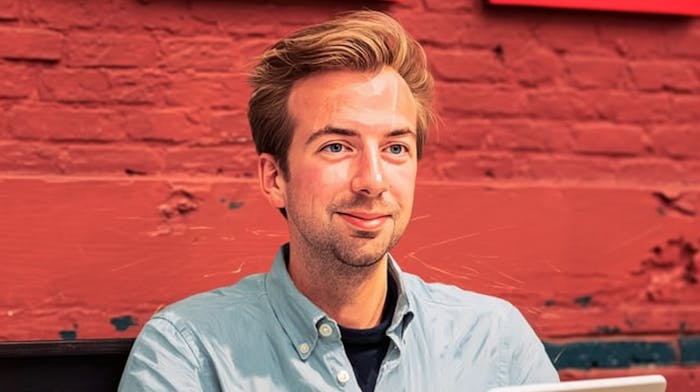
Iron Brands quit a short-lived career in finance to start indie hacking. While networking, he met Adriaan van Rossum and joined Simple Analytics as a late cofounder. Today, it's bringing in $45k MRR — and he's working on two more products to boot.
Here's Iron on how he did it. 👇
A very short career in finance
After I graduated from university with a degree in finance, I felt very confident about my career. This all changed when I got an internship at a financial consultancy. I got all suited up for work, but that only lasted a few weeks. I decided it was not for me.
So I started dabbling with my university mates to start our own thing. That became Fiks, a marketplace for internships. We grew Fiks to 100K ARR before I decided to make a change. It's still going— my old cofounder still runs it.
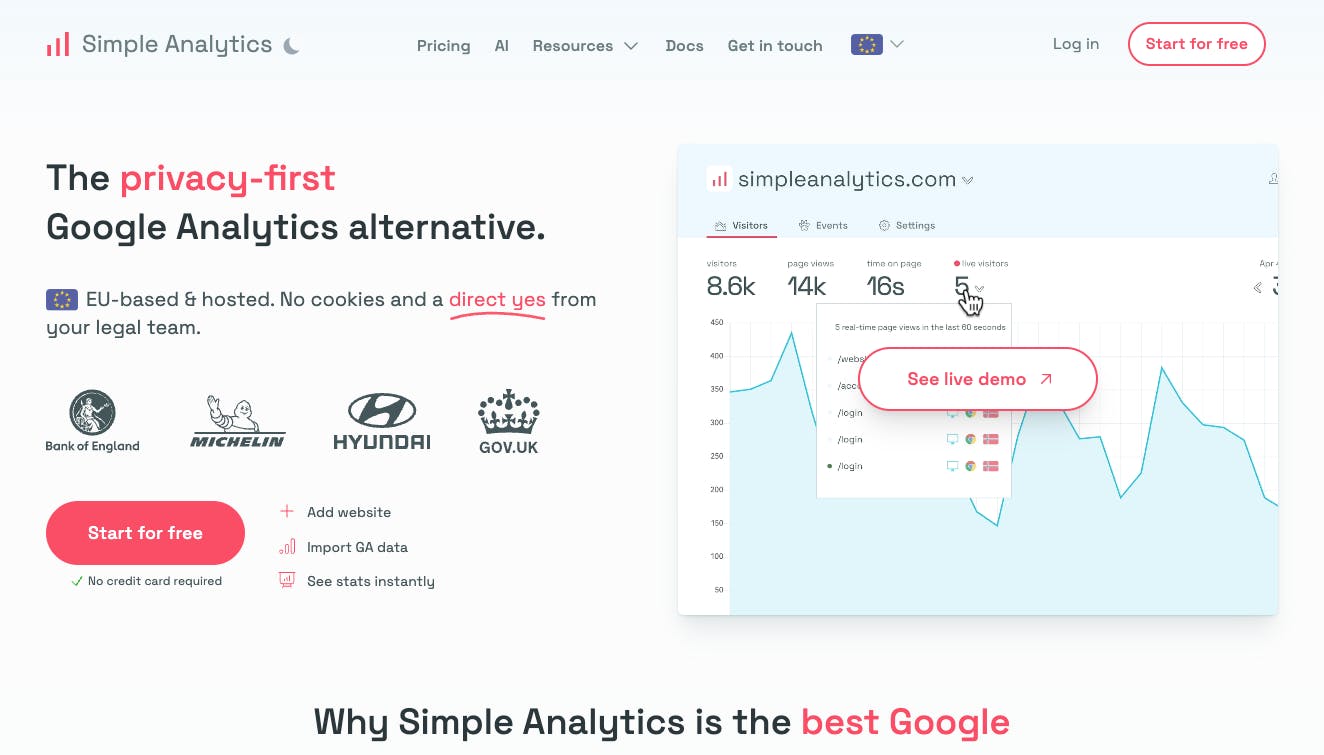
I realized that I liked building so I decided to continue on the path. I moved to Amsterdam and tried to meet other founders and builders. It was at a developer meetup that I met Adriaan, who had founded Simple Analytics a few years before as a solo founder. We decided to partner up, and today, Simple Analytics is at $45k MRR. Here is our open page where we share metrics. We should update the graph, but other than that, everything is up to date.
Launching new projects
While building that, we also launched another company called UniHosted. And two years ago, Adriaan and I decided to partner up with Dries to build a managed-hosting service for UniFi Controller (what? yeah I know).
We've run into some nasty feuds in the industry, so we're a bit more cautious about what we share. Let's just say it's less than Simple Analytics, but still substantial.
And finally, last month, we acquired Leadsontrees.com, which is designed to give alerts about funding announcements. It's a great project with a lot of potential that we are going to rebuild and rebrand together with a third cofounder who can't be named yet.
Leadsontrees had customers when we acquired it, but it was lifetime deals. We quickly changed our pricing to monthly and are now around $250 MRR.
Unlocking the potential of his cofounders
I think my role in creating Simple Analytics and UniHosted is to help unlock Adriaan and Dries' potential. Simple Analytics was already functioning well without me, doing 10K MRR, but in order to grow, a lot needed to be done — in the product as well as on the distribution.
UniHosted was a half-baked product when I met Dries. Together we turned it into a real business with revenue, customers, etc.
I hope the same will happen for Leadonstrees.
Iron's marketing stack
I can't really say a smart thing about our stack. I know we use Vue and Node at Simple Analytics, but that's about it. Here's our marketing stack:
Simple Analytics for analytics
Semrush for SEO
Seogets for organic traffic insights (it's like Google Search Console on steroids)
Substack for newsletters
Mailgun for emails
Nano Banana for visuals
Firecrawl for feeding LLMs
Loom for videos
Hustle and SEO
Going from zero to one is a hustle. You manually start engaging with potential users. Go on Reddit, Twitter, LinkedIn, or even Facebook groups and engage. Talk to them. Help them. The goal is for people to give your product a try.
You'll get feedback from them and improve your product. Getting your very first customers in the door is super important and you should employ every trick in the book to make this happen. Do things that don't scale.
Once that happens, you move to part two. Now, you have to do things that scale. So, instead of manually pursuing users, you need to figure out a sustainable and repeatable growth channel that brings in new users without you needing to push every day.
For us, that channel was SEO:
Answering questions in our niche
Writing "Alternative to" pages
Getting backlinks
Doing programmatic SEO
And focusing on quality
I wrote everything down extensively in two articles:
Reverse trials
We employ a reverse free trial, meaning that when users sign up for Simple Analytics, they can use a full version of our product for 14 days — regardless of which plan they choose.
This is a free trial of our full product with all the features available. After 14 days, we ask them to make a decision. Based on their usage in those first 14 days, we recommend a plan, but they can still opt for any flavor (free, simple, team).
They need to pick a plan to continue using Simple Analytics.
Start as early as possible
Starting as early as possible is actually an advantage.
Some people say that you need to be more experienced before starting your own business, but I disagree. I have a lot of friends who want to start their own businesses, but they are handcuffed. They have a cushy job, drive a car paid for by their employer, just bought a house, and are thinking about having kids. No way are they going back to earning nothing and possible failure. There is just too much at stake now.
Whereas, when I started, I was a student earning nothing, and I continued to earn nothing for a couple of years. My life was basically the same in my first few years of business vs. student life. Sometimes I got a bit jealous of my friend earning a great salary at Deloitte, but now looking back, I'm really happy I picked this route instead of the career ladder.
Make mistakes
You can't just start a business and be good at it. You'll make some really stupid mistakes.
For example, in my first business, we started a marketplace because we didn't have the technical know-how to build a SaaS. Also, we didn't validate anything; We just took a plausible-sounding idea and decided that it would work.
I would change the whole setup for my first business if I could do it over. But I learned a ton.
As long as you look back on what you were doing a year ago and think, "Man, I really was an idiot," you're on the right track.
You're a legend — stay in the game
First, you're a legend for starting the indie hacking path. Most aspiring entrepreneurs and indie hackers never even get to this stage.
Also, I'd say you will probably fail the first time and that's okay. I had a very hard time with my first startup, but I learned so much from it. If I had given up after my first failure, I'd not be where I am now.
So don't give up! Stay in the game!
What's next?
I'm product agnostic, meaning Simple Analytics doesn't feel like my child. It's more Adriaan's child.
The same goes for my other business, UniHosted. I just get a lot of energy from helping technical founders like Adriaan and Dries succeed. That's something I really feel passionate about. So my goal is to help a lot more technical founders bring their ideas to life and turn them into profitable businesses.
Here's my newsletter where I share our business updates (including numbers, etc.). You can also follow me on Twitter and LinkedIn.
And check out Simple Analytics, UniHosted and Leadsontrees.

Leave a Comment
Really liked this arc, pairing a technical cofounder with clear GTM focus is such a force multiplier. The wins felt obvious in hindsight: tight ICP, founder-led sales early, pricing that matches value, and shipping only what moved activation/retention.
Two quick Qs:
What single activation best predicts a paying account for you; first successful workflow, a second user invited, or hitting a weekly usage streak?
If you had to double down on one channel next quarter, would it be founder content, partner integrations, or targeted outreach?
P.S. I’m with Buzz; we design conversion-focused Webflow sites and pragmatic SEO for product launches. Happy to share a 1-page GTM checklist if useful.
This was such an inspiring read, Iron! 🙌 I really liked how you emphasized starting early and learning through mistakes instead of waiting for the “perfect moment.” Your journey from finance to indie hacking shows that clarity comes through action, not overthinking. The part about helping technical cofounders unlock their potential really stood out — that’s such an underrated skill in startups.
Also, your insights on SEO and the reverse trial strategy are gold. Thanks for being so transparent and sharing real numbers
Totally enjoyed going through your journey. It's refreshing to watch someone walk away from the usual job route yet create something that matters - even makes money. Getting on board as a tech cofounder once things were rolling (just like with Simple Analytics) was a sharp choice: you handle sales and scaling, while they tackle coding - fits together well.
Your hustle, then SEO, followed by reverse trials, shaping your growth - this whole journey seems real. Makes me think back: in the beginning, winning isn’t about a flashy tool or luck. Nah - it’s sticking with it, pushing through boring stuff like writing posts, cold emails, optimizing pages. No shortcuts, just steady effort piling up.
I also really respect how honest you are about failing at first, figuring stuff out, then going all in again. Loads of people just highlight wins - yet you talk through every step, which takes guts and actually helps others.
Appreciate you putting this together - it shows actual promise, plus kinda maps things out for folks just getting started. 🎯
Really inspiring journey — thanks for sharing! I love how you turned early career confusion into momentum by building, experimenting, and partnering with the right people. Your story shows the power of starting early, learning through mistakes, and staying in the game long enough for opportunities to compound.
Your approach to growth (hustle → scalable channels → SEO) is super practical, and your reverse trial strategy is smart. Also impressed by how you unlock the strengths of your cofounders — that’s a rare skill.
Excited to see what you build next with Leadsontrees and beyond. Keep sharing the journey — it’s motivating for all founders!
Really impressive journey! I love how you focus on unlocking your cofounders’ potential while also growing products like Simple Analytics and UniHosted. Your approach to going from manual hustle to scalable SEO-driven growth is a perfect example of how early-stage founders should think about traction. Also, the reverse trial idea is clever—giving users the full experience upfront builds trust and accelerates adoption. Lots of actionable lessons here for any indie hacker.
What an excellent and honest post — thanks for sharing this journey! A few thoughts that stood out, and some questions of my own:
What really resonated:
The way you found the right partner from the start — joining a technical founder brought momentum and structure, and it shows how having complementary skills can accelerate growth.
Your emphasis on starting now rather than waiting for “everything to be perfect.” That idea of jumping in early while you still have flexibility is so powerful.
The “reverse free trial” concept you shared — giving full access for a limited time to generate intent and engagement — that’s a smart take I’ll be bookmarking.
Your transparency about the ups and downs — acknowledging mistakes, early experiments that didn’t work, and how those learnings fuelled the long-haul growth.
A few follow-up questions:
When you say you “joined in” on a project that already had traction (e.g., ~$10K MRR), what were the key decision-criteria you used to assess whether that opportunity was worth your time and equity?
In the “reverse free trial”, what activation metric or user behaviour turned out to be the strongest predictor of converting to a paying account?
You mention SEO/programmatic “alternate to” content as part of your growth stack — which specific tactic or channel surprised you by performing better than you expected?
Bottom line: This story is full of practical insights and inspiration. For anyone building SaaS or joining forces with technical co-founders, your narrative offers a roadmap of how to navigate the growth phase, how to distribute roles, and why execution matters more than waiting for “ideal” circumstances. Thanks again for writing it — I’ll be referring back to this as I plan my next steps.
I fell for a crypto scam and lost a lot of money. I felt hopeless and thought I’d never get it back.
Then I found APEX INTERVENTION LTD, and they completely turned things around. Their team was professional, caring, and kept me updated through every step.
Thanks to them, I got my funds back! If you’ve been scammed, don’t lose hope — APEX INTERVENTION LTD is the real deal.
Huge milestone 👏 I’ve been solo-building multiple small tools using Avery lately, and I keep wondering how different the experience would be with a technical co-founder.
What’s been the biggest change since teaming up — speed, quality, or just focus?
Just as lean testing speeds up product-market fit, Shelf Corporation Cost explores how ready-made entities simplify business launch. Structure + speed = startup advantage.
Super inspiring journey, Iron! Love how you emphasized doing things that don’t scale early on — so true for any indie hacker starting out.
Super cool milestone. I’m solo-building a few AI projects right now and keep wondering how different it’d feel with a co-founder. Did your collaboration unlock new product directions or just help you move faster?
Iron Brands left a short finance career to pursue indie hacking. After cofounding Simple Analytics with Adriaan van Rossum, he helped grow it to $45K MRR. He also cofounded UniHosted and acquired Leadsontrees, expanding his indie portfolio. Iron focuses on unlocking cofounders’ potential, using SEO and hustle for growth, and believes in starting early, learning from mistakes, and staying consistent in the game.
Very smart pivoting out of your intended career path, fast. You saved yourself years of misery and self-doubt. Bravo.
Really loved reading this story. The way you explained how the right mix of technical and growth skills can make a co-founder duo so effective really hit home. The “reverse free trial” idea also stood out such a simple change, but it seems like it could make a big difference for onboarding.
Reading this got me thinking about my own projects. I wonder how much more I could achieve if I focused on building the right team and experimenting with early-stage growth strategies like you did. Thanks for sharing these insights.
“That’s inspiring! I’m also building a small Android app myself.”
Love this story — especially the part about starting early and learning by doing. The “stay in the game” mindset is what actually compounds. Thanks for sharing the real journey, not just the wins.
Your journey is truly inspiring! The shift from finance to co-founding and scaling Simple Analytics to where it is today is impressive. I especially love your approach to the reverse free trial—it's not just about conversion, but building trust and strong relationships from the start. It challenges traditional methods and sets a new standard for future founders. Thank you for sharing such valuable insights and bringing fresh strategies to the table!
Did you use any LinkedIn automation tool for marketing?
amazing
Hi! I built an AI tool to recover passwords (aiipassword com), is an AI tool that helps users recover forgotten passwords through guided memory-based suggestions without an email or phone number.
Privacy and limits: nothing you type is stored long‑term. Inputs are processed transiently and never used for training. The tool is strictly for recovering your own accounts. Do not use it on other people’s accounts.
This is a masterclass in timing and positioning! The way you pivoted from finance to co-founding and scaled Simple Analytics to $45k MRR is impressive. I especially appreciate the honesty about joining existing projects vs starting from scratch - that's such valuable insight that more founders need to hear. Your reverse trial strategy is genius!
Интересный вариант развития продукта, воспользуюсь.
It's really intriguing to see how the conversation is evolving around the reverse free trial.” It seems like an effective way to build trust while still prioritizing conversion. This method not only puts the focus back on what truly matters—providing value—but also sets a foundation for stronger customer relationships right from the start. It's a refreshing perspective that challenges traditional approaches and could definitely resonate with many budding SaaS founders.
As for your point about comfort zones, I can relate. It's a delicate balance between financial security and pursuing something that feels meaningful. For many, the drive to create something of their own becomes more compelling than just chasing a paycheck. So, whether you're implementing innovative strategies like the reverse trial or grappling with the need for more fulfilling work, it seems like this journey is all about aligning your values with your actions. That's where real growth happens.
The “reverse free trial” approach is brilliant, it flips the usual freemium logic and creates intent early on. Feels like a great balance between user trust and business sustainability. Definitely something more SaaS founders should try.
Really cool story, Iron. The “reverse trial” idea caught my eye , that’s a clever way to balance value and conversion. Curious, did you notice any patterns in what converts best during those 14 days?
Super inspiring, Iron, love your take on "staying in the game".
Building solo too, the hustle to get customer interactions is real. Focusing on it!
Thanks for the story James, it was really inspiring and has a lot of information.
I have a question, what is the best thing a founder could do if he build a sass without validating the idea first ?
great
Interesting perspective on starting early before it gets too comfortable. I see the opposite side of that too. Some experienced professionals eventually reach a point where comfort itself becomes intolerable because it lacks meaning. That's exactly my situation right now. Being able to access high-paying jobs, in my late 40s, I can no longer stand to work only for money or perks, fulfilling someone else's dream instead of responding to my own calling.
I don’t think passion for a craft and a life task are at the same level. Many of us leap not because we want to “do what we enjoy,” but because we feel an "obligation" to build something that matters, which is a more altruistic perspective than just having a nice lifestyle.
I’m curious if you’ve met founders who left strong corporate positions later in their careers and managed to channel that experience into purpose-driven work rather than chasing early momentum.
The "unlocking potential of technical cofounders" angle is fascinating - that's a positioning I haven't seen articulated this clearly before. Most non-technical founders try to become product managers or learn to code. You leaned into the operational/growth side as your core value proposition.
I'm on the opposite side of this equation right now - technical founder who just launched last week, decent at building but completely lacking on the distribution/growth side. Your journey from Fiks (100K ARR marketplace) to joining Simple Analytics at 10K and scaling it to 45K is basically the playbook I need but in reverse.
The part about "start early before lifestyle inflation handcuffs you" hit hard. I'm in that narrow window right now where I can still earn nothing without everything collapsing, but I can see that window closing in a few years.
For your model of joining existing projects vs starting from scratch - how do you evaluate which technical founders/projects to partner with? Simple Analytics was already at 10K when you joined, so Adriaan had proven something. But UniHosted was "half-baked" and Leadsontrees needed a full rebuild. What's your pattern recognition for "this technical founder is worth betting on" vs "this is going nowhere"?
Also curious about equity splits in these late cofounder situations - do you approach it differently when joining an existing 10K MRR business vs a half-baked idea?
Interesting approach, the grind is real when it comes to such things in terms of user interaction!
Amazing journey - love how you combine technical execution with smart operations to turn ideas into real, profitable products.
At ActlysAI, we’re building a similar foundation: empowering creators and builders to scale faster with AI agents that automate their workflows and integrate seamlessly with tools like Google Docs, Gmail, and Notion - so they can stay focused on what actually moves the business forward.