Kindness isn't data
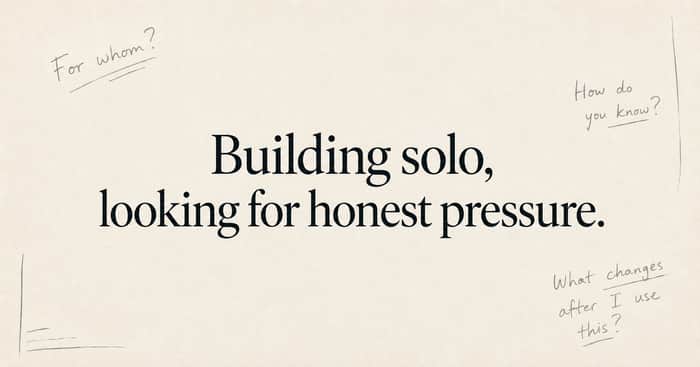
Hi. First post here. I'm Fabri — three months building solo, full-time, no co-founder, no team. I'm Italian and writing in English, so please be patient with the rough edges.
Here's what's real, so this isn't abstract. The thing is live: a SaaS, a Chrome extension, a paid tier already running. I built all of it alone in those three months. I'm not saying that to impress anyone — half of it still scares me — but so you know I'm not asking from the idea stage. It exists. People can pay for it.
For the technical sliver of you: running a multi-agent orchestration solo is about as smooth as a cat in trousers. I'm taming it well enough, but it's the kind of work where every fix surfaces two more questions you didn't know you had.
That's exactly what makes my question harder, not easier.
Because it's the one I think every solo founder hits at least once, usually around 2am — I suppose:
What exactly have I gotten myself into?
Mine has a twist now. It's not "will this ever work" — it works, it's out there. It's "I built it, it's real, and I'm not sure I'm building it for the right people."
What I'm building is niche enough that explaining it to a normal person takes longer than they want to listen. There are early users — the founder pricing exists for a reason — but few, and the signal I get from them is the warm, encouraging kind.
Kindness isn't data.
What I'm watching for is different: a stranger I've never spoken to, using it, writing back unprompted because something in it worked. I haven't seen that yet. The only honest way I've found to know whether the work matters is to put it somewhere people are free to ignore it, and watch what they do.
The part I underestimated wasn't the technical work. It's deciding everything alone. You make ten calls a day with half the information and nobody to push back. You read your own landing page so many times that the familiarity starts to feel like clarity — it isn't. You go invisible for weeks behind a monitor, friends ask what happened to you, and you don't have a good answer, because you're still here. Just not where they can see.
For years my work has been about how people learn together — peer-learning, at Pyragogy. Then to ship this I did the exact opposite: shut myself in a room and decided everything alone. I notice the contradiction. I don't love it.
Someone reading this might ask: you built a tool that adds friction and depth to drafts before they go out — why are you asking other founders to do what your product is supposed to do?
Fair question. Obliqo works on the text, not on the founder. It runs four voices over what I write, from different angles, and hands back what doesn't hold — I ran this post through it before publishing, and it found a contradiction I hadn't seen. But it doesn't tell me which product to build, who it's for, or whether the bet is the right one. That kind of friction doesn't live in a draft. It lives in conversation with people who've been where you are.
I built a tool for pressure on drafts. What I'm missing now is pressure on direction.
So I'm not here for product feedback. I'm asking for something I think is more useful: how did you get through your first months building solo? Not the success story — the muddy middle. The part where you still weren't sure the thing mattered.
Who did you talk to? What kept you from mistaking isolation for focus? Did you ever find, or build, a small group of founders who audited each other's work honestly?
That last one is what I'd want most. Numbers come later. Right now what I'm missing is a few people who get it from the inside.
I'll be in the comments. I'm here to listen more than to talk.
—
(For the curious: Obliqo, at obliqo.pyragogy.org — four AI voices read your draft before you publish, each from a different angle, and hand back what doesn't hold. It pushes back; it doesn't rewrite. Built out of the peer-learning work at pyragogy.org. Happy to get into it in the comments — but that's not why I'm posting.)

This is painfully true for niche utilities. I’m trying to separate encouragement from evidence with Kinetic Override by looking for behavior words: people asking for no-root Android auto clickers, macro recorders, repeated taps/swipes, local profiles, etc. Generic “cool app” feedback feels good, but a specific repeated-workflow complaint is much closer to data.
That's an interesting and cool distinction.
One thing I've discovered recently is that the strongest signal on my side isn't what people say either. It's what they avoid doing.
Almost nobody complains about the signup flow, yet signup itself appears to be one of the least-performed actions on the landing page.
Because Obliqo has a real operating cost, offering an unrestricted free trial would probably be overkill. So the question becomes: how do you measure behavioral intent before someone is willing to create an account?
In software, that signal might be macros, automation, or workarounds. In my case, I'm still trying to understand what the equivalent signal looks like.
mistaking isolation for focus is an absolute killer perspective that every solo builder hits. when you’re deep in the zone managing a complex multi-agent orchestration stack behind a monitor for weeks, the sheer technical execution starts feeling like market progress. it's a brutal reality check to realize it isn't.
kindness from your early network isn't data layer validation—it's just a polite buffer. you're completely right that the only real signal is a total stranger using the tool unprompted because the core text friction solves a deep, painful problem for them, not because they want to support an indie hacker.
navigating the contradiction between your background in peer-learning and the crushing isolation of a solo sprint is incredibly exhausting. finding even two other founders to do raw, weekly audits on each other's pipelines and directional bets without sugarcoating the feedback is a literal sanity saver.
Thanks for reading it so closely Eva— really.
And there's a beautiful irony I have to point out: your comment is the nicest possible illustration of my own title. It agrees with everything, warmly, generously... and that's exactly the "kindness, not data" I was writing about. No offense at all — I'll take the warmth, gladly. But you've kind of proven my point better than I did. 🙂
One thing though, since you read it as pain: the solitude in my post isn't the dark-room kind. It's a choice, not a sentence — turning inward to make something and cutting the noise. That part I don't want rescuing from. The thing I can't see on my own is the other one: when that same solitude quietly stops being focus and turns into hiding behind the work.
So, real question for the solo builders: how did you catch yourself doing that? What was the actual sign?
touché, completely caught me red-handed on that warmth loop callout lol. fair play.
for me, the absolute clearest sign that focus has turned into hiding is when i find myself endlessly refactoring a backend automation scenario or micro-optimizing a database pipeline that already runs perfectly fine. the exact hour i spend tweaking a webhook delay or cleaning up variable syntax that literally zero users will ever notice, i know i'm just running away from the marketing funnel.
spending half a day in the terminal logs feels safe and deeply productive, but it's usually just a subconscious shield against the terrifying silence of a fresh product launch.
That's the data version — thank you.
It's almost word for word my own tell, and honestly you described last night for me: instead of sitting with one uncomfortable thing about my product, I spent the evening hunting for more places to post about it. Felt productive. Wasn't. "A shield against the silence of a launch" — that's exactly it.
This is a strong post because you are describing the real solo-founder gap most tools do not touch: not writing faster, but getting useful resistance before something goes public.
Obliqo feels most interesting when it is framed less as “AI feedback on drafts” and more as a pressure layer for founder communication. Landing pages, launch posts, positioning notes, investor updates, sales emails, product explanations — those are all places where the founder is too close to the work and needs structured pushback before publishing.
One thing I would seriously pressure-test early is the product brand and domain frame. Obliqo has some personality, but obliqo.pyragogy.org makes the product feel attached to a broader project instead of standing as its own focused SaaS. If this becomes a serious tool for founders and creators to pressure-test important writing, the brand may need a cleaner standalone shell before more users, posts, and habits attach to the current setup.
Xevoa .com would fit that direction well because it feels broader than a draft tool, but still works for an AI workflow layer around writing, decisions, feedback, and publishing with more confidence.
Thanks — and the "pressure layer for founder communication" framing is sharp. You're right that the places founders are too close to the work (landing pages, launch posts, positioning) are exactly where structured pushback earns its keep. That's a useful way to put it.
On the domain: I'll pass on the rebrand. obliqo.pyragogy.org isn't a leftover to clean up — Obliqo funds the Pyragogy research it's named after, and that link is deliberate, not accidental. The standalone-SaaS shell is a real question down the line, but it's not a naming or .com problem, and not one I'm solving by buying a domain right now.
Appreciate the read either way.
That makes sense.
If the Pyragogy link is intentional and part of the product’s reason to exist, then keeping Obliqo attached to that world is a stronger choice than treating it like a random subdomain issue.
The standalone question may come later if the product starts pulling in founders who do not understand the research context yet, but I get why it is not a domain decision right now.
Appreciate the clear answer.