Launched a Shopify order tracking app — here's everything I did to get it live
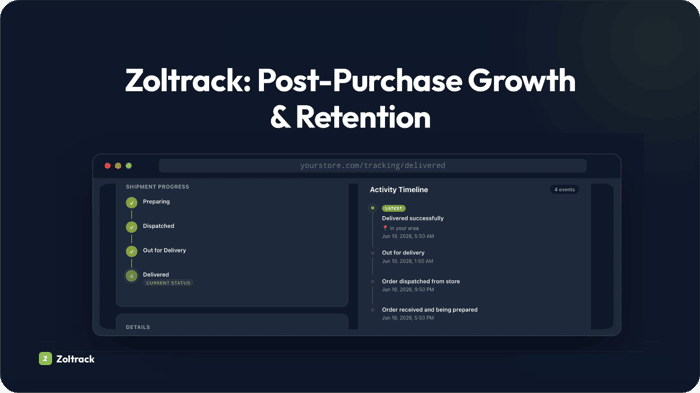
I just launched Zoltrack — a branded order tracking app for Shopify stores.
I'm not a developer. I built this entirely with AI assistance (Claude),
copy-pasting code into VS Code on a Mac. I want to share the full honest story
because most launch posts skip the hard parts.
The problem I'm solving
When a Shopify customer clicks "track my order," they usually land on a generic
UPS or FedEx page. No branding. No customization. A jarring experience right at
the moment they're most anxious about their purchase.
This generates WISMO support tickets ("Where is my order?") which are one of
the top time-wasters for small Shopify merchants.
I built Zoltrack to fix this with branded tracking pages, automatic email
notifications, and real-time analytics.
What I built
- Branded tracking pages (3 templates, live preview builder)
- Email notifications on every status change
- 1,500+ carrier support via API
- Dropshipping mode (hide origin country and carrier)
- Self-delivery mode for local couriers
- Custom order statuses
- Analytics dashboard with delivery rates by carrier
- Full Shopify Billing API integration (3 paid plans)
The honest build story
Building on Shopify as a non-developer is genuinely hard. The documentation
is good but the ecosystem moves fast. App Bridge v4, React Router v7,
Shopify's new web components — all of this changed in the last 12 months
and most tutorials are outdated.
I broke production twice:
- Once from a Prisma migration that wiped session data
- Once from a circular import between email and database modules
Both times I had to debug Vercel serverless logs at midnight.
The part I underestimated most: getting the Shopify billing flow right.
Recurring charges, trial periods, plan upgrades, annual vs monthly —
there are a lot of edge cases and Shopify's sandbox behavior doesn't
always match production.
Current numbers
Just launched. Currently at 0 paying customers, working on getting
first 10 installs. Will share an update post when I hit meaningful milestones.
What I'm targeting next
- Built for Shopify badge (requires meeting Shopify's highest quality standards)
- First 5 reviews on the App Store
- Community-driven feature roadmap via Canny
App: https://apps.shopify.com/zoltrack
Happy to answer questions about building on Shopify as a non-developer,
the AI-assisted development workflow, or anything about the product.

The interesting part here isn’t the tracking pages—it’s the moment of emotional mismatch you’re targeting.
“Where is my order?” isn’t a logistics question, it’s a trust question. Most apps optimize for visibility of shipment data, but the real value is reducing uncertainty at the exact moment customers start doubting the purchase.
Spot on. You just perfectly articulated something I struggled to put into words while building this.
You’re 100% right—"WISMO" is purely a symptom of anxiety, not a lack of data. If a customer sees a cold, sterile tracking page that looks like a logistics spreadsheet, it doesn't actually reassure them; it just reminds them that their money is gone and their item is stuck in a warehouse somewhere.
That’s exactly why I focused heavily on making the tracking page fully customizable and tightly branded to the merchant's store. The goal is to make the post-purchase experience feel like a continuous, safe extension of the brand they already trusted enough to buy from.
When you look at tracking apps through the lens of "reducing customer uncertainty" rather than just "displaying courier APIs," it completely changes how you prioritize the roadmap. Really appreciate this perspective—definitely going to keep this framework in mind as I talk to early adopters!
Glad it resonated.
Your reply made me think there's one strategic decision sitting underneath that post-purchase trust model which becomes much more significant as the product grows, but I don't think I can explain the reasoning properly in a thread without oversimplifying it.
If you're interested, what's the best email to reach you on?
I’d absolutely love to hear your thoughts on that. The underlying architecture and strategy of how this scales is something I’m constantly chewing on right now, so a deeper dive would be incredibly valuable.
You can reach me directly at 'support@zoltrack.xyz'
Looking forward to your email!
Thanks! I’ve just sent it over.
Looking forward to hearing your thoughts whenever you have a chance.