Launched StoreAuditPro — a Shopify app that finds and fixes what's costing you sales
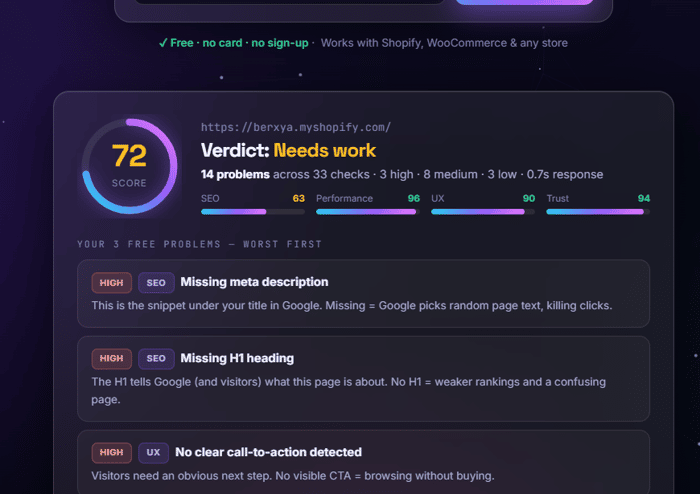
Just launched StoreAuditPro on the Shopify App Store.
It scans a Shopify store across SEO, page speed, UX and trust signals (33 checks total) and shows exactly what's hurting sales — not generic advice, but specific problems pulled from the store's real product and theme content.
For each issue, it prepares a one-click fix with a clear before/after preview. You review and approve it, and it's written directly to your store through the Admin API — nothing changes without your OK, and every applied fix can be undone with one click.
Free plan available, no card required — you can see your store's top 3 problems in about 30 seconds.
Built it myself end-to-end. Would love feedback from anyone here running a Shopify store — what would actually make this useful for you?

Congrats on shipping this—making the issues concrete and reversible is a strong approach. One thing I’d watch with stores that sell across multiple channels is separating theme/UX fixes from listing-content fixes: a change that helps Shopify SEO can hurt a marketplace title or image constraint. A useful next layer might be a small “impact confidence” score plus a before/after conversion or speed snapshot, so owners can validate each fix instead of applying a batch blindly. The one-click rollback sounds especially valuable here.
The before/after preview is a good trust feature, especially for merchants who are wary of automated changes. I’d log which check led to an applied fix and whether the metric moved afterward, then rank the default top three by expected impact rather than severity alone. A rollback history and a small change log would also make multi-store teams more comfortable adopting it.
Two things from building the same shape of tool.
First, you are in a rarer position than the post lets on. You write the fix AND you own the before and after. Almost no audit tool can prove a finding was worth acting on, because the fix and the outcome sit in different systems. You have both. So the thing that turns this from a one-off scan into a subscription is not check number 34, it is "you applied six fixes on 12 March, here is what conversion did after". Audit tools churn because people scan once, fix, and leave.
Second, a caution that cost us a day. We ran an automated contrast audit and it reported 51 failures. Almost all were fake: our CSS used lab() colours and the checker parsed them as RGB. Confident, precise, completely wrong. For a tool that only reports, that is an embarrassing afternoon. For one that writes to a live store, a false positive is a bad edit on someone's shop. The undo button matters more than the check count, and I would measure false positive rate per check before adding the 34th.
This is genuinely one of the most useful comments I've gotten — thank you for taking the time.
On the retention point: completely agree, and it's clarifying. I've been thinking about growth in terms of "add more checks," but you're right that the actual moat is owning both ends — the fix AND the outcome. "You applied 6 fixes, here's what happened after" is a fundamentally different pitch than a scan count. Going to restructure how I think about the roadmap around that.
On false positives — this is the one that actually worries me, and your contrast/lab() example is a perfect illustration of exactly how it happens: confident, precise, wrong. Right now every fix requires manual approval before it touches the store, and everything applied has an undo button — but you're right that "has undo" isn't the same as "measures how often it's wrong." I don't currently track false-positive rate per check type, and I should. That's a real gap, not a hypothetical one — appreciate you naming it plainly instead of letting me find out the hard way.
Congrats on the launch. The one-click, reversible fixes are a strong wedge. For early Shopify users, I’d make the first-run report end with one prioritized fix and a simple before/after metric to watch, so they can see the impact without running another audit. Hope the launch goes well!
Really good point, thank you. Genuinely one of the sharper pieces of feedback I've gotten.
There's already a "next best action" concept on the dashboard — it highlights one prioritized fix with a before/after preview. But you're right that it stops there — it doesn't explicitly say "here's the number to watch" so the merchant can come back later and see if it moved.
Going to think about adding something like that — even just "you fixed X, check back in a week and see if [specific metric] moved" would close the loop you're describing. Appreciate you taking the time to actually think through the UX, not just the pitch.
Congrats on the launch! I like the idea of combining SEO, UX, and trust checks into one audit instead of giving generic advice. The one-click fix workflow sounds interesting because many store owners know they have problems but don't know how to solve them. Wishing you success with StoreAuditPro 🚀
Thanks so much, really appreciate it! 🙏
That's exactly the gap I was trying to close — most audit tools just dump a list of "improve your SEO" advice and leave you to figure out the how. This one tries to close that last mile: show the exact fix, let you approve it, done.
If you ever run a Shopify store (or know someone who does), would genuinely love to hear what it finds for you.
The one-click fix is the interesting wedge. Have merchants applied fixes and then seen measurable improvement in conversion or revenue, or is proving the fixes actually move sales still the main unknown?
Fair question. What it does today is concrete: it finds real, specific issues (missing meta descriptions, empty alt text, broken/missing SEO titles) and writes the fix directly into the store — you see the exact before/after, verified live on the actual product/page, not a mockup.
Those are the same fundamentals Google's own SEO guidance ties to click-through rate and indexing — that part isn't speculative, it's just standard best practice most stores neglect because doing it manually across hundreds of products is tedious.
What I don't have yet is a "we tracked 50 stores for 3 months and revenue went up X%" case study — I just launched, so that data simply doesn't exist yet anywhere on any app on day one. I'm tracking score-over-time per store so that becomes answerable as merchants stick around.