Launching SonginAI: Bringing AI Music Generation to the French Market 🇫🇷
Hi everyone!
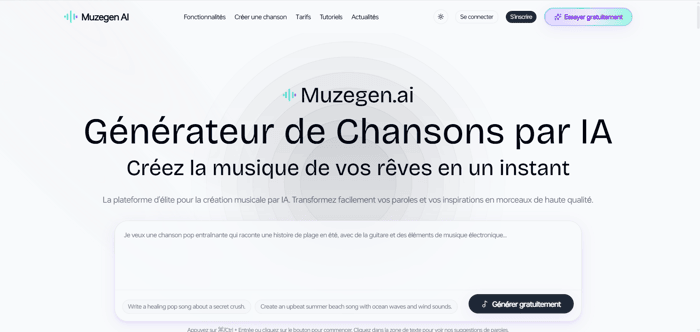
I'm excited to share that we've just launched the French version of SonginAI (muzegen.ai).
As content creators know, finding royalty-free music is a nightmare. We built an AI generator that produces high-quality tracks (WAV/MIDI) in seconds.
Why French market?
We noticed a huge gap in AI music tools specifically localized for francophone creators. To celebrate the launch, I’ve also published a deep dive on Medium about the future of AI sound creation in French.
You can check out our progress and the tool here:
The Tool: https://muzegen.ai/
Our SEO Strategy (Monitor via FrogDR): https://frogdr.com/fr/start
Detailed Guide (French): Detailed Guide (French)
Would love to get some feedback from the Indie Hackers community, especially from French-speaking entrepreneurs!
— Muzegen AI

The methodology confession is the best part, and it generalizes past this one chart: "the data describes your infrastructure before it describes your market." Anyone pulling stats from their own product's DB should tattoo that somewhere. You measured when your crawler ran, not when reviews landed, and caught it. Most people ship the first number.
But the sharper thing is buried in your conclusion, and it's a product, not just an observation. "If the market moved 8% and you're down 40%, the other 32 points are yours" is the whole game, because in your own install chart, seasonality and position-loss look identical, a quiet week with no obvious reason. The founder literally cannot tell them apart from inside their own data. Your cross-market baseline is the only thing that separates them. That's not a blog stat, it's a diagnostic nobody else can run.
So your actual product isn't "August numbers," it's subtract the market from my chart and show me what's left. Market-adjusted install signal. Your soft offer at the end is circling this without naming it: the value isn't the market data, it's the founder's own delta against it. That delta is the difference between "wait it out" and "your listing got beaten," which as you said is the same chart, opposite decision.
For your 501-app cohort, can you already compute a single app's expected-vs-actual gap? Because that gap is the thing people would pay for.
Great insights! You hit the nail on the head regarding the "cross-market baseline."
The data confession was intentional because, as you mentioned, raw stats are hollow without context. For us, that "gap" is exactly what we are trying to close by using FrogDR. It helps us see how our localized French assets perform against general AI music trends.
We are still early in the cohort analysis, but we’re seeing that "market-adjusted signal" you mentioned—native French prompts are yielding much higher retention for local creators compared to generic English models. We’re definitely building this as a diagnostic tool for creators, not just a generator.
Full disclosure first: that comment was written for a different post, an app-store-data one, and landed here by mistake. But you did something better than ignore it, you mapped it onto your own numbers, and the mapping is sharper than my original, so let me push on what you actually found.
"Native French prompts yield much higher retention than generic English models" is a real signal, and it's exactly the kind that needs the same discipline the misfired comment was about, because two very different things could be producing it, and they'd look identical in your chart.
One reading: the retention comes from language, the model genuinely handles French musical and cultural prompt intent better, so French creators get better output and stay. If that's it, your moat is French-language prompt understanding, and you should invest hard there.
The other reading: the retention comes from audience selection, not prompts. A French creator who sought out and stuck with a French-first tool is pre-filtered to be more committed and more underserved, they'd retain better on any competent tool, because they finally found one built for them at all. In that case the prompts are incidental and the real moat is being first to an underserved audience, which is a land-grab, not a language investment. Same retention number, opposite strategy.
That's the market-adjusted-signal move applied to yourself: separate the variable (French prompt quality) from the thing it's tangled with (a committed, underserved user who'd retain anyway). The test that splits them: do your French users retain better than your English users, or better than French users on English tools? The first could be selection. The second is the language edge, real and defensible. Which one are you actually seeing?
The localization angle is interesting, but the bigger question is whether French-language support creates a meaningful advantage beyond translation. It would be interesting to see whether francophone creators actually choose SonginAI for reasons they wouldn't get from the broader AI music platforms.
That’s a very valid question. For us, localization is much deeper than just a translated UI.
Most global platforms struggle with the nuances of French phonetics, slang, and local musical sub-genres (like specific French Rap flows or "Variété Française"). SonginAI is fine-tuned to understand francophone prompts better, resulting in lyrics and rhythms that feel culturally "native" rather than "translated."
Additionally, we align our royalty-free licensing specifically with EU and French content guidelines, which gives our local users more peace of mind regarding copyright strikes on regional platforms.
That makes sense. I’ll be interested to see whether those localization advantages translate into a meaningful reason for francophone creators to choose it.