Launching tomorrow: I built a state-managed 4-agent relay to kill generic AI content.
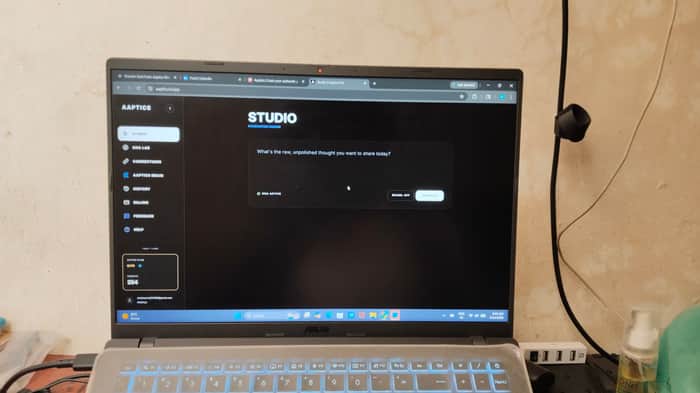
Hey IH community,
Tomorrow at 9:00 AM IST, Aaptics officially goes live. The last few months have been nothing but heads-down engineering, and I wanted to share the architecture behind it with this community first.
The Problem with Single-Prompt AI
Most content tools treat professional identity as an afterthought. When you ask a single LLM to research, strategize, and write all at once, you get that detectable, robotic tone. It simply cannot capture true authenticity.
The Aaptics Architecture
To solve this, I engineered a state-managed 4-agent relay. The core of the system is what I call the Voice DNA Engine.
Instead of jumping straight to generation, the system first analyzes your historical data. It extracts your unique linguistic fingerprint—mapping your exact syntax, sentence rhythm, and vocabulary. Only after your Voice DNA is locked in does the generation pipeline begin.
Tomorrow, we move beyond generic AI slop and focus on high-fidelity, authentic replication.
I’m opening up the platform tomorrow morning. If anyone here wants to test the multi-agent architecture (and grab an early-adopter perk before it hits the public), let me know in the comments and I’ll make sure you get the link!
Let’s build. 🚀

Interesting approach — especially the Voice DNA layer before generation.
Feels like most tools try to fix output quality at the end, not at the input stage like this.
Curious — how stable is the “voice” across longer outputs or multiple sessions?
Spot on. To prevent LLM drift, we extract the Voice DNA into an immutable JSON profile during the first session. For longer outputs, that JSON isn't just a starting prompt—it’s injected as a strict system-level constraint at every node of the 4-agent relay. The Writer agent mathematically cannot deviate from those syntactical rails. Have you experimented with strict state management before?
That’s a solid approach — locking it at the system level makes a lot of sense.
I haven’t gone deep on strict state management like that, but I’ve noticed even when the output is technically consistent, users still judge it more on how “human” or intentional it feels rather than the underlying structure.
Curious — are you seeing users actually notice the difference in voice consistency, or does it show up more in how the content feels compared to typical AI outputs?
The architecture behind a 4-agent relay sounds like a massive step up from the usual "single-prompt slop" we see everywhere. Mapping a user's Voice DNA first is a clever way to solve the authenticity gap that usually makes AI content so easy to spot.
Since you’re launching tomorrow and looking for early adopters to test this multi-agent system, there’s a competition where you can submit Aaptics—entry is $19 and the winner gets a Tokyo trip.
Prize pool just opened at $0. Your odds are the best right now.
When the agents are in that relay, how do you handle the "state-handoff" to ensure the third agent doesn't drift away from the Voice DNA the first agent extracted?
How should we proceed?
Regarding the state-handoff and drift prevention: That was actually the hardest engineering bottleneck.
If you just pass the text down the chain, the Writer agent will inevitably hallucinate and drift back to its base weights. To prevent this, the Voice DNA isn't just passed in the initial prompt—it is injected as an immutable system-level constraint into every node of the relay.
We use strict JSON schemas for the state handoff. The Strategist agent doesn't pass raw text to the Writer; it passes a structured JSON object outlining the hook, transitions, and core arguments. The Writer agent then executes that JSON structure while being mathematically constrained by the Voice DNA variables (syntax, pacing, excluded jargon).
By forcing strict structural handoffs and keeping the Voice DNA in the absolute system context, the generation stays deterministic and prevents the 'drift' you mentioned.
This is super sharp — especially the idea of enforcing Voice DNA at the system level, not just prompts. The JSON handoff makes a lot of sense to reduce drift.
Feels like most people underestimate how quickly things break without strict structure.
We’re exploring something similar around enforcing signal consistency across steps — different layer, but same problem space. Would love to compare notes if you’re open!