Learning Rails at 48: Three Weeks from Product Owner to Solo Founder
The Spark
I was driving home from dropping my daughter at college, listening to DHH on Lex Fridman's podcast.
What got me wasn't just his passion for Ruby or Basecamp's philosophy—it was when he described Ruby as "wonderfully concise and readable." As a trained linguist who's spent 15 years in product, that clicked. Code as language. Elegant. Precise.
I'd coded before. I learned Java 20+ years ago when XML and CMS systems were the future, then picked up Python to hack solutions our IT department wouldn't touch. But this felt different. DHH's conviction that you could build something great without sacrificing work-life balance made me think: I could actually do this.
By the time I got home, I'd opened a terminal.
Three weeks later, I'm launching Vist.
The Product Manager's Curse
Here's the thing about being a product person: you see exactly what needs to exist. You can picture the interface, the flow, the interactions. You write the specs. You watch teams build it.
And then you wait. And people misunderstand. And stakeholders disagree. And three months later you're compromising on the thing you saw so clearly in your head.
The past seven years I've been in UX and product ownership at a multinational. I've loved seeing ideas become reality. But the speed - or lack of it, rather - drove me crazy.
What if I could just... build it myself? Iterate every day? Ship on Friday what I thought of on Monday?
Why a Note App (Of All Things)
Because I have a very real problem.
I run from meeting to meeting at a large company. I need to capture thoughts fast, find them instantly, and convert them to actions without friction.
I've tried everything: Evernote (slow), Obsidian (too much setup), Notion (where do I even save this note?), Bear, Craft, even OneNote. Every six months I'd switch tools because the friction got too high and I'd stop using it.
Same story with tasks. Can't put "Call Thomas about conflict with dev team" in Jira. Tried Todoist (closest), Trello, Microsoft To Do. Nothing stuck.
I wanted: Notes + tasks. Together. Fast. Markdown-native. That's it.
So I built it.
What I'm Actually Building
Vist is what happens when a product person gets tired of waiting.
The pitch: You're in a Zoom call, need to take notes. You open Notion. Where do you save it? Click expand in sidebar, or full page, or wait—are my notes in a database?
Open Vist. Cmd+N for new note. Start typing. Markdown flows. Type [ ] Task @me and boom—linked task appears in your to-do list. Complete it in the note or the task list, doesn't matter. Syncs both ways.
Cmd+K to search. Instant. No spinners.
Simple. Fast. Gets things done.
The differentiator: Deep MCP integration from day one. Your AI assistant (Claude, ChatGPT, etc.) can read your notes, manage your tasks, remember your preferences. It's the persistent memory layer that LLMs are missing.
The conviction: EU-hosted. EU-owned. Your data stays in Europe. GDPR-compliant. In today's geopolitical climate, this isn't a nice-to-have. It's insurance.
What Building Software Taught a Product Manager
Using AI coding agents is surprisingly similar to managing offshore dev teams. Misunderstandings. Iterations. But also moments where the agent surprises you with solutions you'd never have thought of.
The secret? Great user stories. Seeing the product clearly. Knowing where the pain is.
I've been eating my own dog food using Vist since the first working prototype. That keeps me honest.
The TDD revelation: As a product person, I'd written endless specs that got outdated the moment they were finished. TDD changed everything.
Now I write acceptance criteria in Gherkin syntax. Those become executable Cucumber specs. Rspec tests read like plain English documentation. When I wonder what the code does, I run the tests and literally read the specs in the output.
It's spec-driven development that stays current because it has to work.
The Easy and the Hard
What I thought would be hard: Building a Rails app without knowing Ruby.
Reality: Easy. Thanks to Claude Code (and later Gemini with OpenCode), reading the AI's thinking output gave me enough context to read Ruby. And DHH was right—Ruby is supremely readable. It just makes sense.
What kicked my ass: Deployment. DNS, security, firewalls, encryption, server configs. Even with AI help, I've had headaches.
What's Next
I'm launching with MCP from day one. Originally I planned to wait, collect feedback first. But I started using Vist myself and realized: I need this integration now. Why would my users be different?
Beyond that: wiki-style linking, backlinks, syntax highlighting for code blocks, more keyboard shortcuts. Then AI-assisted features directly in Vist.
The Fear
Biggest fear? That nobody tries it. I'd be fine with people trying it and hating it - that's feedback. But launching into silence? That would suck.
Which is probably why I'm here, talking to you instead of endlessly tweaking until it's "perfect."
So push me. Support me. Help me ship.
The Ask
My ideal first 100 users are product managers, product owners, senior developers. People who need to think fast, link things together, and don't have time for fancy constructs. Early AI adopters who want their Claude subscription to actually remember their preferences.
My questions for you:
- Does this resonate? Are there people like me out there who'd pay 5 euros per month for fast notes + tasks + deep AI integration?
- What's the minimum you'd need to see before parting with a coffee's worth of money monthly?
I'm building in public. Currently working on the MCP server implementation and polishing the editor.
Waitlist: usevist.dev
Let me know what you think. What am I missing? What should I ship first?

The jump from product ownership to actually building is wild. I made a similar switch - accounting background, got tired of speccing things I couldn't execute on, and started building tooling for my own problems.
The TDD-as-living-spec resonates. In my world (bookkeeping), the equivalent was realising that business rules change constantly, and written documentation is always out of date by the time ink dries. Tests that enforce the actual behaviour are the only reliable source of truth.
One thing that helped me with the deployment headaches: treating infrastructure as something you ship once and iterate slowly. Get the simplest possible deployment working first, even if it's embarrassingly basic. You can always add complexity later when you understand what you actually need. Most of the DNS/security/firewall pain comes from trying to solve problems you don't have yet.
Keyboard-first navigation is underrated. Most productivity apps treat it as an afterthought. If Cmd+K and Cmd+N work flawlessly on day one, you've already beaten half the competition.
It's wild, how TDD solves so many problems even now.
Anecdotally -- my father is an OG programmer (think punch cards, the computer taking up half the basement in the hospital where he got his first job) and when I started talking about how much fun I had writing my own little scripts and so on maybe ten years ago, he pushed me right into "write gherkin style tests as living specs"... and now I see countless social media posts about how much easier it is to get coding agents to do a good job if you have good specs and force them to test their work...
And thanks to my dad, I started out doing just that, and got great results from the get go.
I'll now dive right back into designing keyboard-based user flows.
Love the build, and launching with MCP is a bold move ✅😄
Nuance: “deep AI integration” is a magnet, but it also creates expectation debt fast. If the assistant misses one task, misfiles one note, or feels flaky, trust collapses harder than in a normal notes app. The silent failure is worse than a visible error 😅
Quick 25-min test: ship a tiny “Golden Set” of 20 scenarios and run it weekly:
If it fails any of those, surface it clearly and recover gracefully. That’s how you earn the “I can rely on this” feeling.
What’s the scariest failure case you’re designing around: wrong recall, missed tasks, or privacy trust?
Thanks for the insight, @GrowthLaunch. To be entirely clear, I won't have an assistant embedded in the app in the MVP/launch phase, but users will be able to ask their assistant of choice to file those notes using the MCP tools I'm providing.
MCP scenarios and testing
Setting up a test battery for this is actually a very good idea. I have Rspec unit tests for the MCP API of course, but actually running end-to-end tests every week using Claude, for example, would be quite interesting!
My implementation today already covers the basic scenarios you covered, and I'm currently defining what else I want to include on go live. Cleaning up stale tasks is a big candidate...
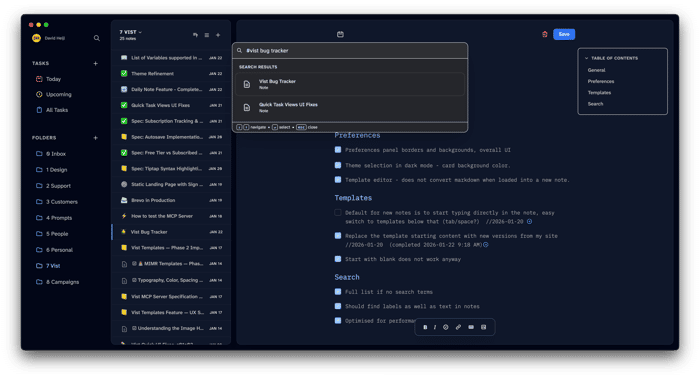
By the way, here's your first example captured on my dev machine just now!
Scary failures
I guess wrong recall, missed tasks, are all scary, but the biggest danger is deletion of the wrong data. I guess that means I need to implement version history and recovery next!
This resonates hard. The "Product Manager's Curse" section is painfully accurate — seeing exactly what needs to exist, but being stuck in the spec-to-build-to-compromise cycle.
The TDD-as-living-documentation angle is underrated. Most specs become outdated the moment they're written. Having tests that are the spec is a forcing function for keeping them honest.
On your questions:
€5/mo for fast notes + tasks + AI integration feels right for the target user (product people who already pay for multiple tools). The MCP angle is interesting — "persistent memory for your AI assistant" is a clear pitch.
For me, the minimum would be: keyboard-first navigation actually working (not just marketed), instant search, and reliable sync. The task-in-note linking you described sounds like the killer feature — if that's smooth, I'd try it.
One thought on launch silence fear:
The DHH listener → Rails learner → solo founder pipeline is a compelling origin story. That narrative might be worth leaning into for your launch content. It's specific enough to filter for the right audience.
What's your timeline for the MCP integration? That's the part I'd want to see demoed.
Thanks for the thoughtful reply, @yamamoto7.
About TDD and documentation - fascinating, isn't it? It is something that almost threatens to derail me from my focus on bringing Vist to market, to be honest - it just feels like there's more options there, especially with AI to back things (this is my past as a tech doc consultant catching up with me, I suppose).
Thanks for the feedback on pricing. It looks like 5 EUR per month really is feasible from a cost point of view, so it's good to hear that it sounds doable. We all pay for so many subscriptions already...
If you have any more insight on how keyboard navigation would work for you, that would really help. Are you thinking of vim-style keyboard shortcuts, or a more generic vscode-style set of shortcuts? I've only implemented a handful of shortcuts up until now, because I'm in doubt as to which direction to take for MVP.
Looking at what would make sense to me personally, I'm thinking I will need to enable flows like:
Of course, as I'm typing this, I realize I need to say you would not have to use this particular flow at all if the task you wanted to complete originated from your current note, because then you'd just tick the checklist box in the markdown note to complete the linked task!
MCP integration works on my local dev - not as full featured as I'd like, but all the basics are there already.
If you'd be willing to give it a test drive given what you've heard, feel free to drop your email on the waitlist, and I'll invite you to test free of charge as soon as I've fully deployed everything -- I hope to go live with the MVP in a week or two.
For keyboard navigation: I'd lean toward vscode-style over vim-style for broader appeal. Vim keybindings are powerful but niche — your target users (PMs, product owners) likely aren't vim users.
The flow you described makes sense:
That's intuitive. The key is discoverability — maybe a small
?shortcut that shows available commands in context.For MVP, I'd prioritize:
Cmd+K(search) — already coveredCmd+N(new note)Cmd+Enter(complete task / submit)Esc(exit editing mode)Everything else can be iterated based on usage patterns.
Good point about completing tasks directly in markdown — that's the frictionless path. The task view shortcuts become secondary.
I'll check out the waitlist. Curious to see MCP in action.
Hey! Vist is now available to try, with a generous free plan on which you can try out the MCP yourself! https://usevist.dev
And just ping me if you have any more suggestions!
That’s awesome input. Hope to see you on the waitlist soon!
Impressive! Going from product owner to solo founder in three weeks shows how much you can achieve when you focus and iterate fast.
At IssyLinks, we help startups and businesses build high-converting websites, web & mobile apps, branding, promotional videos, automation workflows, and digital marketing to launch and grow smarter. If anyone wants examples or guidance, just search “IssyLinks” on your browser!
Love this — especially the “product manager’s curse” part. Notes + tasks in one fast flow (with real AI memory) is a pain I’ve felt for years too.
Let me know if you want to try it - available now ;-)
The deployment pain is real. Everyone talks about how easy it is to build with AI now, but the DNS/SSL/firewall dance still kicks everyone's ass. That part hasn't been "solved" yet.
Your point about using AI agents being like managing offshore teams is interesting — the skill transfers. Clear specs and knowing what you're actually building matters more than coding ability.
The €5/mo pricing feels right for people who already pay for 3-4 productivity tools and hate all of them. The MCP angle could be your moat though. Most note apps are racing to add "AI features" but treating notes as a memory layer for external AI assistants is a different positioning.
Thanks for the feedback. The app is now available if you're interested in trying out the all in one notes/tasks/memory system...
Totally agree — opinionated tools that do one thing fast always win over bloated ones. Are you building something in this space yourself or more on the user side?
This resonates a lot. The frustration of seeing the product clearly but having to wait weeks (or months) for it to materialise is real.
I also like how tightly scoped this is — notes + tasks, fast, opinionated. In my experience, tools that reduce friction in high-context work tend to stick, even if they’re “simple” on the surface.
Thanks, @FDControl! Tight and fast is exactly what I am aiming for. Don't do everything, but get the core thing right. No bloat. Just efficiency.
(well, that's the dream, at least!)
Your story is super motivational for those who want to make the move to dev at any age. I really like the idea of MCP integration from day one
Of course, if you're motivated and eager to learn, it's never too late to learn a new skillset - I really believe that. Some cliches are just true.
Thanks for the comment!
This story hits close to home. Similar path here — content team lead, zero coding background, got frustrated with juggling multiple productivity apps.
The "Product Manager's Curse" section is spot on. Seeing exactly what you need but not being able to build it yourself is maddening.
I used Claude + Cursor instead of Rails, but the experience is the same — AI as a coding partner that you iterate with. Built SelfOS (tasks + goals + habits in one place), shipped to App Store and Google Play. ~60 downloads, 6 paying subscribers in first 2 weeks.
What resonated most: "What if I could just... build it myself? Iterate every day? Ship on Friday what I thought of on Monday?"
That speed is addictive. No stakeholder meetings, no compromises, no waiting.
On your questions:
The MCP integration angle is interesting — curious how that plays out in practice.
Good luck with the launch! The "building in public at 48" narrative is compelling.
SelfOS sounds interesting — tasks, goals and habits in one place is a hard UX problem to get right. 6 paying subscribers in 2 weeks from a content background is honestly impressive. What's the biggest technical challenge you're running into now for scaling it?
Great question - scaling has definitely brought some interesting technical challenges.
Early on, one of the biggest issues I ran into was localStorage filling up too quickly. Since users can upload custom images inside the app, storing them directly caused storage limits to be hit much faster than expected. I had to rethink the approach and switch to storing image paths instead of full image data, which required restructuring how assets were handled internally.
Backup and restore flows were another tricky part - especially migrating user images correctly without breaking references. Edge cases there took more time than I initially anticipated.
Refactoring was also a major milestone. When I started building with AI, the project was essentially a monolith. As the feature set grew, I had to split it into proper modules and folders. That refactor broke quite a few functions along the way, so stabilizing the architecture while continuing to ship features was a learning curve.
The next big challenge will be widgets and backend integration. I’m planning to introduce a cloud layer (likely Supabase) to handle sync and future scalability, but I want to do it carefully without losing the app’s speed and simplicity.
That sounds interesting, you definitely have to move to supabase with their s3 image storage handling, Avoid using localstorage for this case.
I run a small dev team and we've done this migration path specifically.
Happy to discuss and collaborate.
hamza@scrum-stack.com
Thanks for the offer! I'm planning the Supabase migration for after the current release cycle (focusing on a promo this week).
Curious about your approach — I'll reach out via email to learn more about what collaboration could look like.
Yes, looking forward to discuss things in detail, Thanks!
Thanks. Love the feedback! I'll see how my app survives its first week, I am really beginning to use it myself now (and boy, it's been busy, juggling the day job, home life and building Vist) and so far so good... although it's a bit unfair to future users that I can just go, "oh, why don't task view filters stay active when I switch to a note and come back" and then implement it 30 minutes later ;-)
Also -- congrats on actually releasing something, and getting people to pay for it. That's huge!
Ha, that "30 minutes later" superpower is real — I do the same thing. Found a bug while brushing teeth? Fixed before breakfast.
The downside: you start noticing UX issues EVERYWHERE. Other apps become painful to use 😅
Thanks for the kind words! And good luck with Vist launch — the "building at 48" angle will definitely resonate with the PH crowd. Drop a link here when you launch, happy to support!
I just launched to my waitlist users, so if you're still interested in having a look: https://usevist.dev is the place to be.
Looks clean! When's the PH launch planned? Happy to support when you go live
Still not really sure, would like to work on my onboarding a little more...
Awesome, will do that for sure!