Learnings From Growing Newsletter to 104 Subs in 1 Week
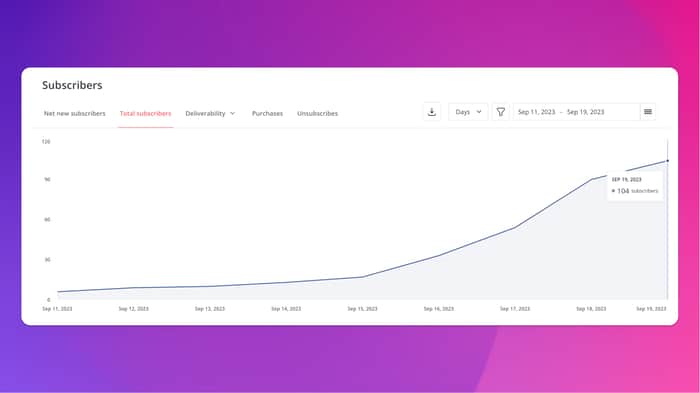
Spoiler: 80.7% are from paid ads. But was it worth it?
Mighty is the 4th newsletter I'm trying to get off the ground. My previous attempts included sharing business ideas, product management frameworks, and landing page tips.
As you can see, I've tried many things. None took off. After six months, my best newsletter (Ideas to Makers) sat at 200 subs. It killed my motivation to keep going.
I love newsletters, both as a format and as a business. This time, I decided to commit most of my time to growth.
You see, in the past, I've chosen time-consuming formats that left little time to promote my newsletter. Having learned from my mistakes, I've decided to design a structure that takes less time but provides enough value to my readers.
Mighty is a combination of curation and original content. Throughout the week, I collect under-the-radar growth tactics and tools (something I've been doing even before I started the newsletter). The original content is interviews with the founders behind these tools and tactics. The focus is on how they got their first customers, what has worked for their growth, etc.
It takes me about 2 hours to reach out, run the interview, and edit it for publishing. That's a lot better than with my past newsletters.
With the format set, I could focus most of my time on exploring growth channels. Here's what I tried and the results I got so far.
1. ConvertKit Creator Network
I'm running my newsletter on ConvertKit. They have a recommendation network where creators can recommend newsletters to new subscribers.
The biggest challenge is finding creators that will recommend you. I've got three people recommending me at the time of writing.
My first partner is Sinem Gunel. I connected with her through AudienceSwaps (a service for matching creators for cross-promotion).
Besides realizing we live in two cities right next to each other, we also realized that we both have our audience bubbles. For me, it's the indie hacker community here, and on X. For her, it is Medium.
She's got a much bigger audience but was kind enough to add me to her recommendations. Personal connections go a long way.
Sinem has been my newsletter's first significant growth source, generating 11 subscribers.

I've since reached out to friends on X and added Ayush, Darren, and I'm working on adding a few more.
Verdict:
How well this channel performs depends on who recommends you. Out of my four recommendations, only Sinem is generating subscribers. But I'll keep developing this channel because it's a great way to connect with other creators and help each other out.
2. Digital Products
Over the past two years, I've released a few free and paid digital products. Two have been doing better than the rest – IdeaPad, a Notion system for capturing product ideas, and the User Interview Toolkit to help you run better user interviews.
IdeaPad has got decent SEO traffic thanks to a short article I wrote a while back describing how I use it. This was just luck, but why not take advantage of it?

I also got the User Interview Toolkit listed in Notion's official template database, which sends steady traffic my way.
Using the Gumroad - ConvertKit integration, I set up an automation that sends every customer a thank you email with three mighty growth tools to advertise my newsletter.

Of the five downloads of IdeaPad, I generated 2 Mighty subscribers.
The rest of my products have no downloads for the tracked period.
Verdict:
Theoretically, a person who receives free value before signing up is a great subscriber. So far, my two subscribers are engaged readers, both opening and clicking. But, I need more data to conclude if this is a scalable source.
3. Paid Ads on Refind
The last channel I've tried is paid ads on Refind, a content discovery platform with a popular Chrome extension.
I wanted to try ads for a while now. I know there's a split opinion in the indie community, but I do not need to flex that all my subscribers are organic.
With that said, paying for subscribers must make business sense.
I plan to monetize my newsletter through ads and by selling more digital products. If I get engaged subscribers from a paid source, I could get a return on my investment by charging more for my ads.
The key word here is engaged subscribers.
So, how engaged are subscribers coming from Refind?
My latest issue got 33 opens; 19 came from Refind—one of those unsubscribed.
When sending the issue, I had 83 subscribers coming from Refind altogether. So, the 19 that engaged equal a 22.9% success rate.
My CTA was $1.87. I paid 83x1.87=$155.21 for 83 subscribers. But my actual cost per engaged subscriber is $8.17 (155.21/19).
This data is based on one issue alone, and more Refind subscribers could engage in the future. However, it's just as likely they won't. I'll keep monitoring this.
I had a low overall click rate of 5.1%, but the most engaged people came from Refind. One person clicked almost all links and even left an emoji reaction in my feedback widget.
Verdict:
As a source of subscribers, Refind works. I don't yet know if 22.9% is a good success rate for a paid source. I'll try out ads in other places and compare them with Refind. I've also gotten good click-rate engagement + my very first testimonial, which I'll proudly feature on my landing page.

What's next?
-
Free email course
I've come across @kevon's course on building an audience through free email courses. I want to put one together and see what results this brings. -
Publishing content
My friend Sinem has introduced me to the world of Medium publishing. She's written an intro to Medium. I'll publish content (including this write-up) on Medium and plug my newsletter. -
More paid ads
As mentioned previously, I'll be trying out more paid channels. I've got a few lined up. Meco (a newsletter reader) has an affiliate program, The Sample, which offers 'paid-forwards,' I've also contacted a few creators offering ads in their newsletters. -
Improving my open and click rates
My open rate could be better, but it is okay. My goal is to get above 45%. However, my click rate of 5.1% is abysmal. I'll send another issue with the same format to establish a benchmark. If the number stays the same, I'll play around with the structure and content to make it more engaging.
I'll check back in a few weeks with new learnings from growing Mighty.

Paid or not as long as it bring in customer it should be fine. One bad thing about paid is you need to have good funnel to convert your customer to subscriber. Else the paid have will have a lot of leak and make you less profits most of the time straight up losing money.
I would recommend you to read Traffic Secrete by Russell Brunson. I think that will help you a lot because in that book he talked about how to grow email using ads by building good funnel, how to engage with email subscriber and then how to convert them into paying customer.
I would also suggest you to still do organic traffic method as usually organic traffic can help you validate your funnel.
Things like SEO blog and website blog will really be beneficial in long run. So just do those things so you can harvest the profit later. For SEO blog I would recommend you to try automated SEO analysis as it can make your SEO research faster and writing faster and more efficient. For example creativeblogtopic.com which you just need to specific your niche and target customer and it will automate the seo for you
Any method you are using getting funnel right will really be helpful and Russell Brunson have 3 triplet books talking about internet marketing end to end I would suggest you to read it ( just read the pdf lol : )
Thanks! I will give Traffic Secrets a look for sure. One thing I probably didn't explain well is that Refind has a great feature, where users subscribe to my newsletter directly through Refind with one click. So, that takes away the funnel drop issue. But it's still very relevant for any other paid channel.
Hey -- I really appreciate your willingness to share your experience in this fine-grained detail. It's that kind of info that really helps others (like me!). Just curious: what are you using for mailing Mighty? I didn't know about Refind -- might be useful for a project or two I've got in mind. Continued good fortune with Mighty!
I think he wrote ConvertKit in the article.
Yes, that's right, I'm using ConvertKit.