Leaving his VC-backed company to bootstrap a product to $1M ARR in 10 months

Miquel Palet left his successful, VC-backed company to build a product focused on developers. Now, Zernio is making $1M ARR.
Here's Miquel on how he did it. 👇
Leaving a successful business
I've been building companies since I was 18. I dropped out of university in my final year to build a Spanish edtech company called Ucademy (now 120+ employees) via the VC route. I left after three years to build another company, this time in the software space.
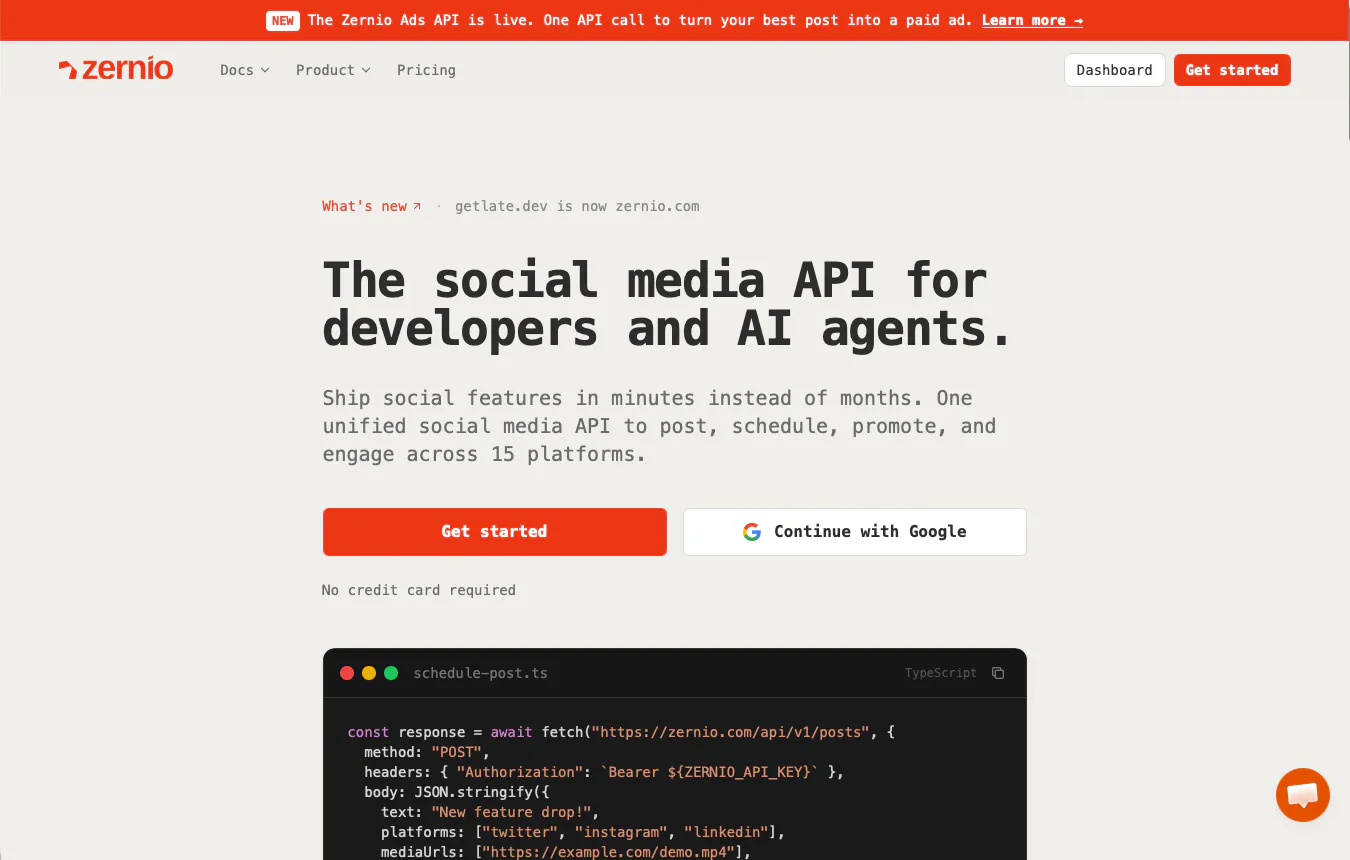
That was ten months ago. Zernio is a social media API for developers to build social integrations in minutes instead of months. It covers everything from posting to analytics to DMs to advertising.
I wanted to build a product focused on developers because I could more easily sell to myself than to a profile I didn't understand. It seemed like everyone built on social media, but nobody focused on developers — they focused on end users. So I decided to try it, and it worked well from day one.
We have been doubling our MRR MoM since we started. As we get bigger, keeping that pace becomes more difficult, but we're still growing fast. We just crossed 1M ARR a month ago.
Building v1.0 in a weekend
We built the initial product in a weekend. Building the basic integrations was easy. Securing all required approved scopes then took around a month, with some taking up to six months.
For the first version, we decided to include only the five biggest social media integrations instead of covering everything. Currently, we have 20+ platforms.
Zernio runs on Next.js 14 (App Router) with MongoDB and Tinybird for data, deployed on Vercel. We use Axiom for logs, Crisp for support, and Fumadocs for documentation. Cloudflare hosts some infrastructure components.
Nailing the infrastructure from the start is crucial when scaling an infrastructure product. We didn't do this — we opted for simplicity. If I were starting over, I'd do it differently.
As we scaled, we had to migrate some key things into Tinybird for analytics data because we handled a huge amount of data, and MongoDB was too slow and expensive for it. The same applied to Vercel; we had to migrate some parts to Cloudflare queues that Vercel couldn't handle using its serverless functions.
A SaaS model
We offer three monthly plans: Starter ($19), Accelerate ($49), and Unlimited ($999). Developers typically begin with a lower plan and scale as they require more capability.
Each plan allows connecting more social accounts; the Unlimited plan offers unlimited account connections. Unlimited plans typically serve SaaS companies with many users, and Build plans are for people testing or trying out integrations.
Our product is fully self-serve, and we do not have demos, so users just sign up and test the product on the free plan, upgrading if they hit limits.
SEO and paid advertising
We mainly acquire users through SEO and paid advertising. For both, we target BOFu keywords, like 'social media API'. These don't need many searches because they convert extremely well. Each visitor is looking for our exact solution. We've been running this strategy since day one.
Nowadays, we also acquire users through feature launches, YouTube videos, and creator partnerships.
Still, we find it difficult to attribute much of our growth, so we never know exactly where our users come from.
Build a team early
Building a team was the best single decision I've made — and it's uncommon in the indie space. Relying on people better than you, I think, is a big advantage in the long run.
We currently have a team of four developers and one marketer. One developer focuses on customer support. Great customer support is a huge advantage, as we can iterate much faster on customer feedback and give excellent service.
Focus on customers and acquisition
Here's my advice: Ignore most of the noise on social media and focus on your customers and acquisition.
Personally, I always start with paid acquisition — ads — from the beginning. If you have the budget and it doesn't require a large investment, you need to start appearing in front of your potential clients.
What's next?
From here, I want to keep growing our team, adding new products, and doubling down on what's already working.
To learn more about Zernio, check out zernio.com. To learn how we're building it and what we're learning, follow me on LinkedIn and X.

Leave a Comment
INSPIRING STORY!! 10 months from zero to $1M ARR while bootstrapping is genuinely rare. Curious what the hardest part was finding the first customers or keeping momentum once it started working?
Reaching $1M ARR in just 10 months purely on a self-serve model is absolute next-level performance 🔥 🔥 🔥
The migration from Vercel to Cloudflare queues makes total sense. I've run into similar serverless limits when handling high-concurrency tasks and ended up relying heavily on Cloudflare Workers and distributed bucket architectures just to keep things stable and cost-effective. MongoDB definitely hits a wall when the analytics data gets heavy. Did you find the transition to Tinybird smooth for handling that specific load?
The BOFu point is underrated. Most founders chase broad keywords for months wondering why traffic doesn't convert. Targeting "social media API" from day one means every visitor already knows they have the problem- you're just closing, not educating. The team-early point also hits differently when you're building infrastructure. Support tickets and API edge cases pile up fast and one person can't handle both product and users without things breaking. Congrats on the milestone.
The part about building for developers because “I could more easily sell to myself” really stood out to me.
I’m coming at this from a completely different direction as an artist rather than a technical founder, but I’ve recently realised a workflow frustration I’ve had for years inside layered creative apps may actually be a real product problem worth exploring.
It’s genuinely encouraging seeing how many people are now able to build solutions around problems they’ve personally experienced rather than needing huge teams or funding from day one.
Curious whether many other founders here started from frustration with an existing tool rather than intentionally setting out to build a company.
wow, interesting
So I started looking for an alternative and found this site: I installed it—and finally everything became clear: the battery level displays properly, you can set up notifications, and there’s a handy widget.
I really like your articles.... If you are looking for leads to help boost your sales and marketing... I have lists of high networth investors and could tailor customers that could either invest or boost customer sales. We have also helped founders get featured on Forbes, Bloomberg and many more. shoot me a message on telegram @caseyimafidon
The point about “nailing infrastructure from the start” vs choosing simplicity early really stood out.
I think a lot of technical founders underestimate how different infrastructure products become once real usage arrives. Things that feel perfectly fine at small scale suddenly become operational bottlenecks very quickly.
Also interesting to read that you focused on BOFu acquisition from day one instead of chasing broad awareness first. That seems especially effective for developer-focused products where intent matters more than volume.
Really valuable breakdown overall.
I could more easily sell to myself than to a profile I didn't understand." — this is smart, and also a specific kind of shortcut that works better in some markets than others.
The markets where it works cleanest: developer tools, devops, infrastructure. The buyer speaks your language, the pain is technical, the ROI is measurable by the person signing the check.
The markets where it breaks down: anything where the person with the pain isn't the person with the budget. In the B2B deployments we've done — auto retail, medical devices, operations-heavy industries — the technical pain is real, but the buyer is a COO or VP of Ops who thinks in headcount and margin, not in API calls and latency. Selling to yourself only works if your version of "yourself" has both the pain and the purchase authority.
sometimes taking a risk is worth it
This's the exact reality check every solo founder needs to read once a week.Over-engineering is just a comfortable hiding place to avoid fear of rejection from the actual market.Thanks for calling this out.
The BOFu point stood out most to me.
Targeting a small set of high-intent keywords from day one feels very different from the usual “publish a lot and hope traffic compounds” SEO advice. It is less about volume and more about being present at the exact moment someone is already looking for the category.
Curious how you decided which BOFu keywords were worth pursuing early — search volume, CPC, conversion intent, or just direct customer language from the first users?
Is infrastructure simplicity at the beginning better than scalability planning from day one?
The part that stood out to me is the shift from VC-funded growth to bootstrapped survival. Those are completely different sports. With VC money you can buy time and acquisition. Bootstrapped, every client has to come from a repeatable input you actually control — outreach, content, referrals — and you feel the gap immediately when one of those stalls. I came from 10 years of phone sales into building something small, and the hardest adjustment wasn't the work, it was learning to treat client acquisition like a tracked process instead of a hope. Curious whether Miquel had a single channel that carried most of the early revenue, or if it was diversified from the start — that's usually the difference between a plateau and a ceiling.
The attribution problem Miquel flags - 'we find it difficult to attribute much of our growth, so we never know exactly where our users come from' - is about to get harder for developer-focused API products.
Developers are increasingly using AI assistants to evaluate infrastructure choices. 'What's the best social media API for building X?' is increasingly going to Claude, ChatGPT, or Perplexity before it hits Google. That discovery channel doesn't show up in any attribution model. A developer who found Zernio through an AI recommendation still clicks through Google Ads and converts on the keyword they searched after they already knew what they wanted.
The companies that will benefit from this shift are the ones already generating the kind of source material that trains or informs AI responses - detailed changelog posts, GitHub activity, developer case studies, and integration-specific documentation. Zernio's 'feature launches' and creator partnerships create exactly this kind of signal, even if the ROI shows up indirectly.
The attribution blind spot is probably understating how much already comes through that path. It becomes a meaningful growth lever when you treat it intentionally rather than as residual. We're tracking this closely at 3vo.ai.
Honestly, I look at the website and I can't tell exactly what the tool brings to me.
The amount of AI comments here is wild.
10 months to $1M bootstrapped. rare enough. leaving a working 120-person company to do it - that's the actually interesting part.
The speed gap between bootstrapped and VC-backed is real —
but the hidden advantage is decision velocity.
Corporate overhead doesn't just slow you down operationally.
It slows down learning. When you can test → fail → adjust in 48 hours
instead of 3 sprints, your learning curve compounds differently.
The operators I've seen move fastest all had one thing in common:
they picked one distribution channel and went deep before
touching a second. Not two channels at 50% — one channel at 100%.
What was the single channel that drove your first $100K ARR?
This is the case study most bootstrappers need to read twice. Miquel chose his buyer profile on purpose: developers, not marketers, because everyone was already chasing the marketer. That single choice probably did 70% of the work. From the SocialPost.ai side I see this clearly. The social media tooling space is saturated for end users, but the infrastructure layer underneath is still wide open, and developers pay for predictable APIs with great docs. The other thing worth underlining: leaving a VC-backed business to bootstrap is harder than most people realize. VC pace bakes in assumptions about burn, growth multiples, and exit timing that quietly make a sub-10M outcome look like failure. Going back to bootstrapping after living in that world is a deliberate choice to redefine what winning looks like. Doubling MRR every month for ten months says the market is rewarding clean execution against a real gap.
Miquel - 'building a team was the best single decision' resonates hard. One thing I'm curious about: when you went from solo to 4 devs + marketer, how much time did the onboarding paperwork eat up? Contractor agreements, NDAs, scope-of-work docs - especially moving fast at your pace, that overhead can quietly become a bottleneck.
I'm researching how bootstrapped founders handle the legal/SOP layer when they scale quickly without an ops function. Your 10-month sprint from 0 to M ARR feels like exactly the pressure-test scenario we're trying to understand. If you'd be up for a quick 20-minute conversation: calendly.com/lior-solomon/30min
Congrats on the milestone - the Zernio social API angle is genuinely interesting.
The contrast between a VC-backed path and a focused bootstrap execution is really interesting here. Speed to $1M ARR in 10 months usually comes down to clarity of problem, tight feedback loops, and disciplined prioritization rather than just resources.
Walking away from a funded setup to pursue that focus shows a strong understanding of where real leverage comes from.
Building a v1.0 in a single weekend is an incredible feat of focus. I really resonated with the point about not over-engineering early on. As developers, we often get stuck on scalability before we even have users, but your transition from MongoDB to Tinybird proves that having 'scaling pain' is actually the best problem to have because it means you've found product-market fit. Thanks for the transparency on the stack!
great..
Leaving a working, funded company for a bootstrapped one in ten months is a rare datapoint. What I would love to know is whether the constraint that pushed you out — the metric or the org shape — actually disappeared on the other side, or just changed name. Most founders I know who made this jump describe the same loop: the previous-game incentives stop being the enemy and start being the defaults. The interesting thing is not the leap itself but how long the old reflexes keep firing in the new context.
The “small team moving fast” advantage feels incredibly real right now.
We’re currently just 3 people building our own privacy-first AI platform — 2 developers and 1 business-focused founder — and honestly, the speed advantage compared to larger organizations is massive. We’re shipping new features almost daily at the moment because decisions, feedback, and implementation all happen in the same room.
I also really related to the point about building for users you actually understand yourself. Most of our product direction came directly from problems we personally experienced while using AI internally for sensitive company workflows and development.
BEST RECOVERY HACKER CRYPTOCURRENCY /BANK ACCT RECOVERY/ MARK WIZARD HACKERS RECOVERY
I became a victim of a romance scam that led me to invest $654,000 in Tether USDT on a fake site. After realising I had been scammed, I felt utterly hopeless and desperate for help. I began searching for a hacker online and came across Wizard Hackers Recovery. His professionalism and expertise gave me hope. Wizard Hackers Recovery worked to recover my lost funds, and I’m thrilled to say he succeeded! I am incredibly grateful for their assistance and highly recommend their services to anyone in a similar situation or any issues you can connect with them Thank you,
Email: :Markwizard 23 @ gmailcom
WHATSAPP +4915218465599
TELEGRAM : @ wizardhackersrecovery
There's something so satisfying about seeing an all-green make blueprint.Automating the invisble work is honestly the only way to stay sane as a solopreneur.Nice work on the modular setup.
The VC → bootstrap shift is usually framed as a freedom story, but the harder part is the operating shift. VC environments let you guess and iterate. Bootstrap forces you to know before you spend. Same founder, completely different decision-making.
$1M ARR in 10 months is fast even by bootstrap standards. Curious whether the speed came from the idea being unusually clear from day one, or whether 10 months of deciding faster, scope smaller, just compounded into something the VC environment was quietly slowing down.
Interesting, for SEO how do you ensure that you are ranking high for a broad category? Do you have any criteria or channels you decide to aquire creators from and the criteria you have for to shortlist them?
FInally what were the things that you needed to unlearn from VC backed startup days? I am also in the same boat and need to unlearn
The 'build a team early' advice resonates deeply. So many indie hackers try to do everything solo, but you're right — it's a huge advantage in the long run. Quick question: Looking back, would you have spent more on paid ads earlier to accelerate growth, or did organic (SEO) serve you well in the early days? I'm splitting my time between organic channels and wondering if I should be more aggressive with ads.
On the attribution gap: a lot of BOFu SEO traffic actually started as a YouTube view, a developer forum mention, or a creator partnership three weeks earlier. Last-click attribution underweights the brand work that's compounding for you. Self-reported "how did you hear about us" on signup beats analytics tools for that one. We use it at SocialPost and it changed how we allocate spend.
The team-early point is the one most indie founders skip past. Bootstrapping doesn't mean alone, it means owning the cap table.
You've gotten such a beautiful product out there, I am so impressed by how polished the product, documentation and the image is.
One thing I wanted to point out though, regarding hiring early. It's very difficult if you're a solo founder. Most of the funding comes from the current job and hiring one person can easily eat into that.
Do you outsource or build team overseas? What do you suggest?
Great strory, I've noticed you did SEO, and here is a question: Did you try AIEO? Right now if you avoiding or simply not using AI optimization in search you loose too much to your competitors.
Seeing success stories like this warms my heart and its a testament to what is possible in the ai era. Takes a lot to leave a vc backed company then bootstrap your own company to over 1m love to hear it keep going. P.s if you ever want to save on stripe billing fees let me know we are building chaching.io many founders just like you who bootstrap their product love to save thousands a year.
The Tinybird migration is the right call — analytical queries on event data need a columnar store, and MongoDB's document model starts to fight you hard once you need windowed aggregations or cross-event joins for funnel analysis. The attribution gap you mentioned ("we never know exactly where our users come from") is actually solvable now that you're on a proper analytical layer, but it requires designing your event schema intentionally: track source, medium, campaign, and a consistent user/session ID from first touch all the way through payment, then write attribution queries against that. Without that schema, even great tooling gives you guesses rather than signal. The moment your infra supports real analytical queries is exactly the moment you can stop attributing growth to "SEO probably" and start measuring channel efficiency at each funnel stage with actual numbers. If optimizing the SQL/query layer for this kind of attribution and funnel work is useful, I put together a handbook specifically for it: https://growthwithshehroz.gumroad.com/l/dyipm
This is the kind of story that feels increasingly relevant right now.
Leaving a VC-backed path to build something sustainable, profitable, and customer-driven takes a very different mindset than chasing hypergrowth. Hitting $1M ARR in 10 months is impressive, but what stood out more to me was the clarity around ownership, speed, and focus.
A lot of founders underestimate how powerful small teams + fast execution + tight customer feedback loops can be.
Also a good reminder that distribution and positioning often matter more than endlessly polishing the product.
Really enjoyed this one. Massive respect for taking the leap and making it work.
The reason bootstrap-to-$1M-in-10-months stories matter more than they used
to: in the 2026 environment, founders who can demonstrate 10 months of
capital efficiency are getting better term sheets than those who burned $5M
on the same trajectory. Bootstrapping is not just a financing choice
anymore, it is positioning.
What I take from this kind of story: the decisions that compound are
usually about who you say no to, not what you say yes to. Saying no to a
$50k enterprise deal that requires custom development you do not want to
maintain is hard but predicts whether you are still solo at $5M ARR or
drowning in support tickets.
Nice story!
Awesome story man. Hopefully one day I will get there too!
Huge congrats on this milestone 🎉 Going from leaving a VC-backed company to building a bootstrapped product to $1M ARR in just 10 months is seriously impressive. Stories like this are such a strong reminder that founders don’t always need massive funding rounds to build something meaningful and fast-growing. Also love how inspiring this is for founders who just launched their products. Early-stage building can feel slow and uncertain, but examples like yours show what can happen with focus, execution, and staying close to customer problems. The indie hacking / bootstrap path is very alive.
Really interesting breakdown—especially the part about committing fully after leaving a structured environment.
One thing I’ve been thinking about is how much of the early success comes down to choosing the right problem scope rather than execution speed alone.
I’ve seen this come up a lot when people leave VC-backed environments—there’s almost an advantage in constraint once you remove overhead.
Curious how you decided what not to pursue in the early phase, since that seems like where most founders either overbuild or lose focus.
Crazy story. Leaving a VC-backed company to bootstrap instead of taking the “safe” path takes serious conviction. What stood out most was how focused the growth strategy was from day one — especially targeting high-intent BOFu keywords and treating distribution as seriously as the product itself.
Also loved the point about building a team early. A lot of indie founders romanticize doing everything solo, but having strong support + fast feedback loops clearly became a competitive advantage here. Going from weekend MVP to $1M ARR in 10 months is wild. Huge respect to Miquel and the Zernio team 🚀
Wow, this is so interesting, my takeaway is always first of all Know Your Customer (KYc), I do see a lot of SaaS founders say you build it for general use of a specific niche but your product goes way deeper made for 'devs'. Severally, I fell into that trap of being a solo-indie-hacker and used to be overwhelmed by customer queries until I get burried in responding to queries before I realize, I'm 4hours in and instead of just looking for people to do that work as I concentrate on building and also look for a marketer. So I concur 100% when you say a team is almost inevitable.
Great story
The 1 to 6 month approval queue for platform scopes is the most underrated piece of this story. We deal with the same gating at SocialPost.ai. Anyone can build the posting layer in a weekend, but sitting through Meta's app review or LinkedIn's partnership program is the moat code can't replicate. The other thing worth pulling out is the VC-to-bootstrap reversal. Most founders default to VC equals growth, but for an infrastructure product with predictable per-seat economics, bootstrap math wins because you avoid the multiple expansion treadmill. Also fully agree on paid from day one. BOFu keywords have low volume but the people typing them know exactly what they want, you're not educating, you're closing. Ten months to $1M ARR with a team of five is the result that should make a lot of solo founders rethink the "army of one" default.
Cool!
Really inspiring journey by Miquel. What stood out to me most was the focus on solving a developer-first problem instead of chasing trends. Building v1 in a weekend, validating quickly, and then scaling through BOFu SEO + paid acquisition is a great reminder that distribution matters just as much as the product itself.
Also loved the point about building a team early — many founders underestimate how much strong support and fast iteration impact growth. Going from simple infrastructure choices to scaling challenges with Tinybird and Cloudflare is a very relatable SaaS journey.
Congrats on hitting $1M ARR with Zernio 🚀
Built in a weekend. Crossed $1M ARR. Doubling MoM. That's insane momentum.
Quick question — you said you target BOFU keywords like 'social media API' because they convert well even with low search volume. How did you find those keywords initially? Just gut feel? Or did you use a specific tool/process?
Also curious — you mentioned building a team early is uncommon in indie space. At what MRR did you hire your first person? And what role?
I'm building Bexra — Helping entrepreneurs find, build & grow. Still pre-launch. Your 'sell to yourself' point resonates. I'm building for people like me (confused aspiring founders).
Thanks for sharing. This is one of the most impressive launch stories I've read here.
The VC-to-bootstrap reversal is pretty rare - most people go the other direction. Curious what made him confident that path would work better for this particular product?
this is actually niche. i wish you include how you got the idea
"Amazing story! Very inspiring. I'm also building my first SaaS product."
Nice execution.
building for devs you actually understand + shipping in a weekend already puts you ahead of most people
but honestly the bigger thing here is distribution
going after BOFU keywords + running ads from day one is what most devs skip
a lot of people build APIs and just wait for users… you didn’t
infra issues later is kinda expected when you move this fast tbh, probably a fair trade for hitting revenue early
Looks very interesting
building v1 in a weekend and still hitting $1M ARR shows how much speed and focus matter early
also like the point about selling to yourself - makes everything clearer from day one
The “built v1 in a weekend, then spent months on approvals” part really stood out.
It feels like a lot of modern products are like this now: the first version can be built fast, but the real moat is in the boring operational layers — permissions, compliance, reliability, support, and distribution.
Also liked the BOFu keyword point. Low-volume, high-intent traffic is underrated, especially when the user already knows the pain.
Great breakdown.
An inspiring journey. Relying on people better than you - hit me hard. The toughest job - building a team
Strong execution comes from clarity: he built for a user he understands (developers), targeted high-intent demand (BOFu keywords), and removed friction with a self-serve SaaS.
Fast MVP + early team helped them scale quickly, but weak attribution and scrappy infra could become challenges later.
Big takeaway: tight ICP + focused distribution + speed wins.
it is very useful info. thanks
impressive work man.
The detail about social media platforms taking 1-6 months for scope approvals is the kind of friction that gets glossed over in growth stories, but it's the actual moat. A weekend build is replicable. Sitting through six months of TikTok review queues is not. Curious whether you front-loaded all 5 integrations through approval in parallel or staggered them based on which platforms responded fastest. Also fascinating that the dev-only ICP worked from day one when most early-stage founders try to broaden their ICP too quickly.
Solid breakdown, especially the part about BOFu keywords and self-serve.
One thing that stood out is how fast you shipped vs how messy infra got later. Feels like that tradeoff is becoming the default now, especially with AI speeding up builds.
Curious, looking back, do you think getting infra right early would’ve slowed you down enough to hurt growth, or was the migration pain later actually worse?
Also interesting how you leaned into paid from day one. Most indie builders avoid it, but your point about showing up where intent already exists makes a lot of sense.
Great execution overall, this is a clean example of picking a clear ICP and going deep on it.
As someone who runs a marketing agency that posts to 6+ platforms daily for multiple clients, unified social media APIs are something I think about constantly. The platform fragmentation is brutal. Every few months another API breaks, another scope gets deprecated, another rate limit changes without warning.
The fact that securing approved scopes took months for some platforms is the underrated moat here. Anyone can build the posting layer. Almost nobody has the patience to navigate Meta's app review process, LinkedIn's partnership program, or TikTok's developer portal. That compliance barrier is probably worth more than the code itself long-term.
The "sell to yourself" principle is underrated advice for picking what to build. I see so many founders build products for audiences they don't understand and then wonder why their marketing doesn't resonate. Miquel understood developers because he is one. That shortens every feedback loop from product to positioning to distribution.
The SEO plus paid advertising growth combo at this stage is interesting too. Most developer tools rely almost entirely on community and word of mouth. Paid acquisition for dev tools is notoriously hard because the intent signals are diffuse. Would be curious what the CAC looks like compared to PLG-driven growth.
That's really informative.
Amazing story, you write very understandably along with the priority on speed.
enjoyed the read and wishing you the best.
Really interesting breakdown — the part about building v1 in a weekend and then spending months on approvals hits hard. It’s a good reminder that speed gets you started, but the real bottlenecks show up later at scale. Also liked the focus on BOFu keywords instead of chasing traffic — low volume but high intent is clearly working here. Curious how sustainable paid acquisition stays as costs rise, though.
“This is really helpful”
nicw
Super inspiring story. What really stood out is how quickly you validated the idea — building v1 in a weekend and focusing on real customer demand instead of overbuilding. Also love the emphasis on SEO + paid acquisition from day one. A great reminder that distribution matters just as much as the product.
I still can’t believe this is real, but I actually won the lottery jackpot! It feels like a dream come true. For years, I would occasionally play without expecting much, just hoping that one day luck would finally be on my side—and it finally happened when I came across a testimony on how Dr Benjamin the great spell caster had helped alot of people win, so I reached out to him, he told me what to do and I followed his instructions, after 48 hours he gave some numbers to play, I did played the numbers as instructed.
The moment I checked my numbers and realized they all matched, my heart started racing. I had to double-check multiple times because I couldn’t believe what I was seeing. Winning the Powerball jackpot of $107,000,000,00. This has completely changed my life. It’s given me financial freedom, peace of mind, and the opportunity to support my family and invest in my future. Here are his contact information.
Whatsapp: +18588585788
This appears to be a misleading and potentially harmful claim. Lottery outcomes are purely random, and there is no such thing as a “spell caster” who can influence results. Stories like this are often used to promote scams and exploit people’s hopes. Readers should stay cautious, avoid contacting such individuals, and rely only on legitimate and verifiable sources.
Looks simple, but this is really about clarity and execution. Small MVP, high-intent users, early monetization no fluff.
Also interesting to see bootstrapping beat the VC route here.
Good reminder: fundamentals still win.
Really impressive execution—especially going from a weekend MVP to $1M ARR in under a year. The focus on BOFu keywords and self-serve onboarding stands out.
Curious—early on, what gave you confidence that developers would convert without demos? Was it usage signals, specific feedback, or just testing pricing early?
The thing nobody talks about with this kind of bootstrapped run: paid ads from day one only works because BOFu queries convert. "social media API" searcher knows exactly what they want. Most founders pick top-of-funnel keywords, burn cash, and conclude paid doesn't work for them.
Congrats for the project, do you offer any free trial? Thanks
Great question — honestly, starting simple was 100% worth it.
It helped validate demand fast and get real users in early. The bottlenecks (MongoDB/Vercel) only showed up once growth kicked in, which was actually a good problem to have.
ghgghgh
sometimes taking a risk is worth it
Really inspiring journey. Leaving a VC-backed path to bootstrap and hitting $1M ARR in just 10 months is impressive. Shows that focus, speed, and solving a real problem matter more than funding.
impressive work man
great carry on buddy
wow, interesting
Solid project!
Super interesting story — especially the part about going from “built v1 in a weekend” to handling infra limitations pretty quickly. What stood out to me is that you intentionally didn’t over-engineer at the start, even though you’re building an infrastructure product. A lot of devs (myself included) tend to do the opposite and get stuck before launch.
Curious how you think about that trade-off now:
– you mentioned MongoDB and Vercel becoming bottlenecks
– and later moving parts to Tinybird and Cloudflare queues
Do you feel that starting simple actually accelerated your growth enough to justify the later migrations?
Or do you think a slightly more “scalable by design” v1 would have saved meaningful pain?
Also +1 on BOFu SEO — going after “social media API” type queries from day one is a very underrated move. Feels obvious in hindsight, but most people avoid it because of low volume.
Great breakdown overall
Great question — honestly, starting simple was 100% worth it.
It helped validate demand fast and get real users in early. The bottlenecks (MongoDB/Vercel) only showed up once growth kicked in, which was actually a good problem to have.
If I had over-engineered from day one, I probably would’ve delayed launch and missed that early momentum. The migrations were painful at times, but they were guided by real usage, not assumptions — and that made a big difference.
So in hindsight, I’d still choose speed over scalability early on.
I actually heard about Zernio before reading this.
What was your first hire?
Guessing it is the engineer. He did mention he has 4 developers.
That question about onboarding paperwork eating up time is real and I don't think it gets answered enough. When you're hiring 5 people in 10 months while simultaneously closing API platform deals, the legal layer (contractor agreements, NDAs, scope-of-work docs for your dev team, client API T&Cs) can easily eat 20-40% of a founder's week if you're templating from scratch each time.
Miquel - curious whether you built standardized agreements early or handled it deal-by-deal. I'm currently running research on exactly this: how fast-scaling bootstrappers handle the contract/legal infrastructure as they scale a technical team. The pattern I keep seeing is founders hit 00K-M ARR and realize their legal layer is held together with duct tape.
If you're open to it, would love 20 minutes to hear how you managed this at Zernio. Pure research, no pitch - happy to share back what I learn across founders.