Love or Arranged Marriage? What Numerology Can and Cannot Tell You
For most people, marriage is a deeply personal decision. For entrepreneurs and professionals, it can also intersect with work, family expectations, lifestyle choices and long-term plans.
That is one reason questions such as “Will I have a love marriage or an arranged marriage?” continue to attract attention online.
Numerology-based tools attempt to answer that question by analysing numbers associated with a person, usually their date of birth and sometimes their name or other personal information. A Love or Arranged Marriage Calculator then turns those calculations into an interpretation.
The result can be interesting. But it is worth understanding what such a calculator actually measures—and what it cannot.
What Is a Love or Arranged Marriage Calculator?
A Love or Arranged Marriage Calculator is an online numerology tool designed to provide an interpretation about a person's possible marriage pattern.
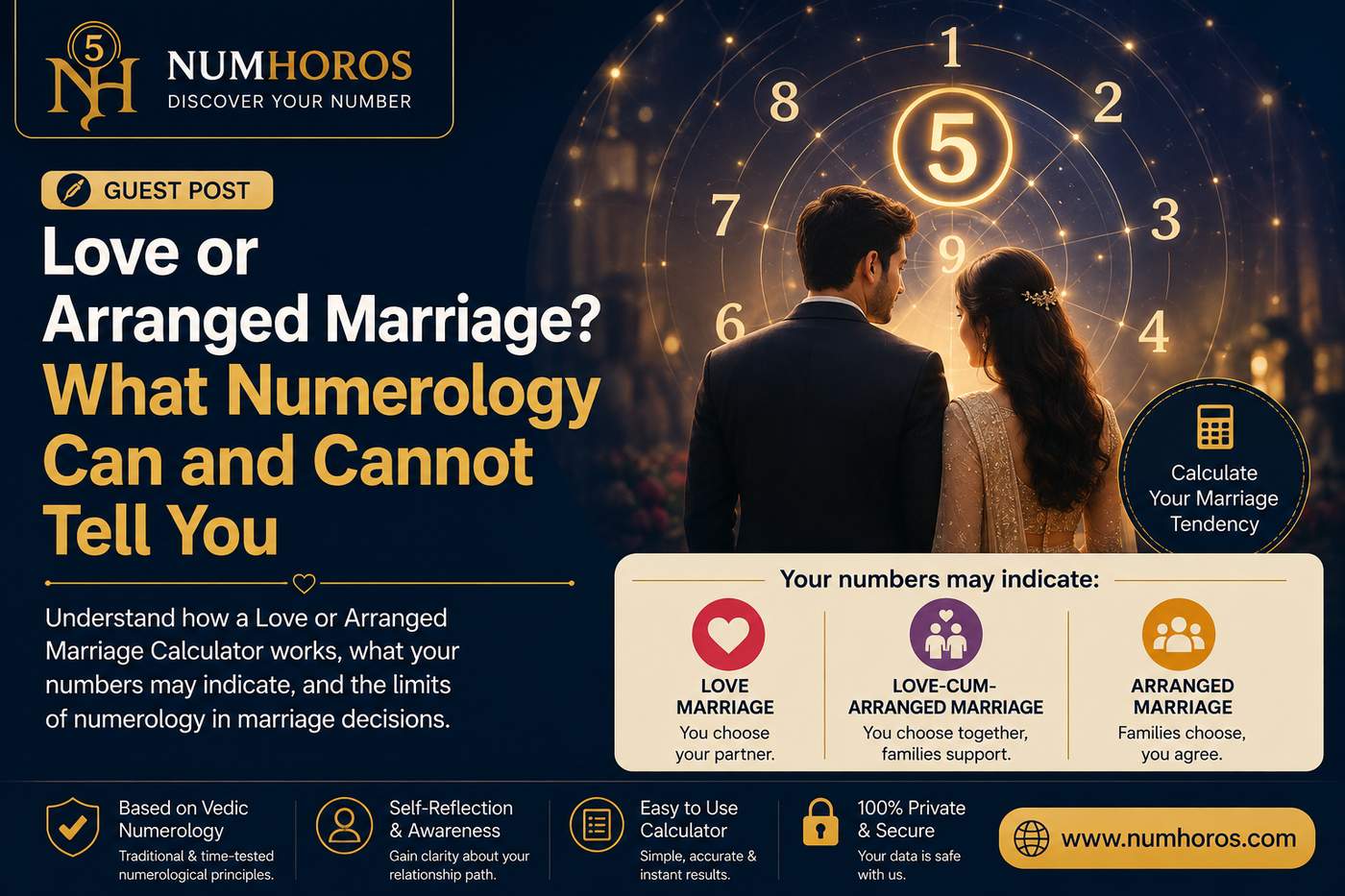
Depending on the system, it may classify the result as:
Love marriage
Arranged marriage
Love-cum-arranged marriage
A stronger or weaker tendency toward one of these paths
The exact methodology varies.
Some calculators rely primarily on date-of-birth numerology. Others may combine name numerology, planetary associations, compatibility numbers or traditional numerological systems.
That difference is important because there isn't a single universally accepted formula for this type of calculation.
Two calculators can therefore give different results without either one necessarily making a mathematical mistake. They may simply be applying different rules.
How Does the Calculation Work?
A simple numerology calculation usually starts with the digits in a person's birth date.
Consider a fictional example:
15 August 1998
Written numerically:
15-08-1998
Add the digits:
1 + 5 + 0 + 8 + 1 + 9 + 9 + 8 = 41
Reduce the result:
4 + 1 = 5
The resulting number may then be interpreted according to the numerology system used by the calculator.
This is the easy part.
The more complicated part is interpreting what that number supposedly represents in terms of relationships, personality or life choices.
That's why a useful calculator should explain its methodology rather than simply displaying a label such as “Love Marriage.”
Can a Calculator Really Predict Your Marriage?
This is where expectations need to be realistic.
Numerology is a traditional belief system, and there is no established scientific evidence that a birth date can determine whether someone will have a love or arranged marriage.
So the output should not be treated as a guaranteed prediction.
Instead, numerology can be approached as a framework for reflection.
For example, if a reading describes someone as highly independent, that person might think about whether independence plays an important role in their relationship decisions.
If another interpretation emphasises family involvement, the person may consider how much family expectations influence their choices.
The number doesn't make the decision.
It simply gives the person another lens through which to think about it.
Love Marriage vs. Arranged Marriage Is More Complicated Than Two Categories
Modern relationships don't always fit neatly into two boxes.
Consider someone who meets their partner through work or social media, dates for several years and eventually introduces the partner to their family.
Is that a love marriage?
Usually, yes.
But what if the family becomes heavily involved in selecting the wedding arrangements and negotiating the match?
The situation starts looking more like a combination of the two.
This is why love-cum-arranged marriage has become a useful description for many modern relationships.
The couple may choose each other, while the families still play an important role in the process.
A calculator may simplify this into one category, but real relationships contain far more context.
What Should You Look for in a Numerology Calculator?
Not every online calculator works in the same way.
Before trusting a result, look at the methodology.
Check the inputs
Does the calculator use only your date of birth?
Does it also require your name?
Does it compare your numbers with another person's information?
Knowing the inputs helps you understand what the result actually represents.
Check the numerology system
Different traditions can use different calculations and interpretations.
A calculator that clearly explains its approach is easier to evaluate than one that simply produces a percentage or prediction.
Look at the explanation
A useful result should tell you why it reached its conclusion.
If the only output is:
“80% chance of love marriage”
there is little context for understanding how that number was produced.
An explanation is much more useful than an unexplained score.
A Realistic Scenario
Imagine a startup founder who is in a long-term relationship.
The founder's parents prefer an arranged marriage, while the couple wants to marry based on their existing relationship.
The founder comes across a numerology calculator and receives a result suggesting a love-marriage tendency.
It might feel reassuring.
But the calculator hasn't answered the difficult questions.
Will both families support the relationship?
Do the couple agree on where they want to live?
How will they handle finances?
Do they have similar expectations about careers?
How will they deal with disagreements?
Those questions cannot be answered by reducing a birth date to a single number.
The numerology result can be interesting, but the actual relationship still needs an honest conversation.
Why This Matters Even More for Entrepreneurs
Founders and independent professionals often make major decisions around uncertainty.
They evaluate markets, customers, investments, hiring decisions and product ideas without having complete information.
That mindset can sometimes carry over into personal decisions.
When an online calculator produces a simple answer to a complicated question, the certainty can be appealing.
But personal relationships don't work like business dashboards.
There is no single metric that can tell you whether two people will build a successful life together.
Even within the startup world, experienced founders generally learn that assumptions need to be tested against reality. The same principle is useful here.
A numerological interpretation can be a conversation starter.
It shouldn't become the decision-maker.
Numerology Can Be Part of a Bigger Traditional Framework
Numerology is often discussed alongside astrology and other traditional systems.
For example, Vedic astrology may examine planetary positions and houses associated with relationships and marriage, while numerology works with numbers derived from names or dates.
These are different approaches, even when websites combine them.
Readers interested in the broader relationship between these traditions can explore Vedic astrology reading and numerology prediction.
The important thing is to understand which system is being used rather than treating all astrology and numerology calculators as if they followed one universal formula.
What Does This Have to Do With Other Numerology Tools?
The same principle appears in other types of numerology.
A person's name can be interpreted numerologically. Birth dates can be reduced to core numbers. Even a mobile number can be analysed according to certain numerological systems.
For example, people interested in mobile-number numerology can learn how a mobile number numerology calculator calculates and interprets a phone number.
In each case, the process has two separate parts:
Calculation → Interpretation
The calculation can usually be explained mathematically.
The interpretation belongs to the belief system being used.
Keeping that distinction clear makes the subject much easier to understand.
The Biggest Mistake: Letting the Result Make the Decision
Suppose a person receives an “arranged marriage” result even though they are already in a healthy relationship.
Should they end the relationship?
Obviously not.
Likewise, if someone receives a “love marriage” result, that doesn't mean every romantic relationship they enter is destined to become marriage.
The most important relationship factors remain practical ones:
Mutual respect
Communication
Trust
Shared goals
Emotional maturity
Financial expectations
Family boundaries
Personal values
Willingness to compromise
A calculator cannot measure these things accurately.
That's why numerology should remain one small perspective rather than the foundation of a major life decision.
What About Compatibility Calculators?
Some numerology tools go a step further and compare two people.
The calculation may examine numbers associated with both individuals and then interpret similarities or differences.
This can be useful as a conversation starter.
Imagine that a compatibility reading describes one person as more independent and another as more family-oriented.
Rather than treating the result as proof of incompatibility, the couple could ask:
“Is this actually something we experience in our relationship?”
If the answer is yes, they have found a useful topic to discuss.
That is a much healthier application of numerology than assuming a number has already decided the outcome.
Should You Try a Love or Arranged Marriage Calculator?
If you are interested in numerology, trying a calculator can be a harmless way to explore the tradition.
Just keep the result in perspective.
A good approach is to use the calculator for curiosity or self-reflection and then compare the interpretation with what you actually know about your relationship.
If you want to explore the calculation yourself, you can use a Love or Arranged Marriage Calculator and see how the result is presented.
Then ask a more useful question:
Does the interpretation give me something worth thinking about?
That question is more productive than asking whether a number can control the future.
Frequently Asked Questions
How does a Love or Arranged Marriage Calculator work?
Most calculators use numerological calculations based on information such as a person's date of birth. Some also incorporate names or other numbers before interpreting the result according to a particular system.
Can numerology guarantee a love marriage?
No. Numerology cannot scientifically guarantee a future marriage outcome. Its interpretations should be treated as traditional or reflective rather than certain predictions.
Why do different numerology calculators give different answers?
Different calculators can use different numerology systems, inputs and calculation rules. Their interpretations may therefore vary.
What is a love-cum-arranged marriage?
It generally describes a marriage where the couple develops a relationship independently but the families also become involved in the process.
Should I make a marriage decision based on a calculator?
No single online calculator should make an important relationship decision for you. Consider compatibility, communication, values, consent, family expectations and practical circumstances as well.
Is numerology the same as astrology?
No. Numerology and astrology are separate traditional systems. Some practitioners combine them, but their methods and concepts are different.
A Number Can Start a Conversation, But It Can't Have One for You
That's perhaps the most useful way to approach marriage numerology.
A calculator can turn a birth date into a number. A numerologist can attach an interpretation to that number. But a relationship is built through conversations, decisions and experiences between two people.
For someone curious about traditional numerology, a Love or Arranged Marriage Calculator can be an interesting starting point.
Just don't confuse a starting point with a final answer.
The number may give you something to think about. What you do with that thought is still up to you.

