M3U IPTV Explained: Risks, Legality & Best Alternatives (2026)
Is M3U IPTV legal in the USA? Learn how it works, the real risks, and the best legal streaming alternatives for 2026. Full guide + comparison table.
🎯 Skip to Best Legal Options:
🎯 Skip to Best Legal Options:
Introduction
If you've searched for "M3U IPTV USA," you've probably landed on dozens of websites promising 10,000+ live channels, every premium sports package, and every pay-per-view event for a flat $10–$20 a month. On the surface, it looks like the ultimate cord-cutting hack. Cable and satellite bills routinely run $80–$150 a month, so a service claiming to offer the same (or more) for a fraction of the price seems too good to pass up.
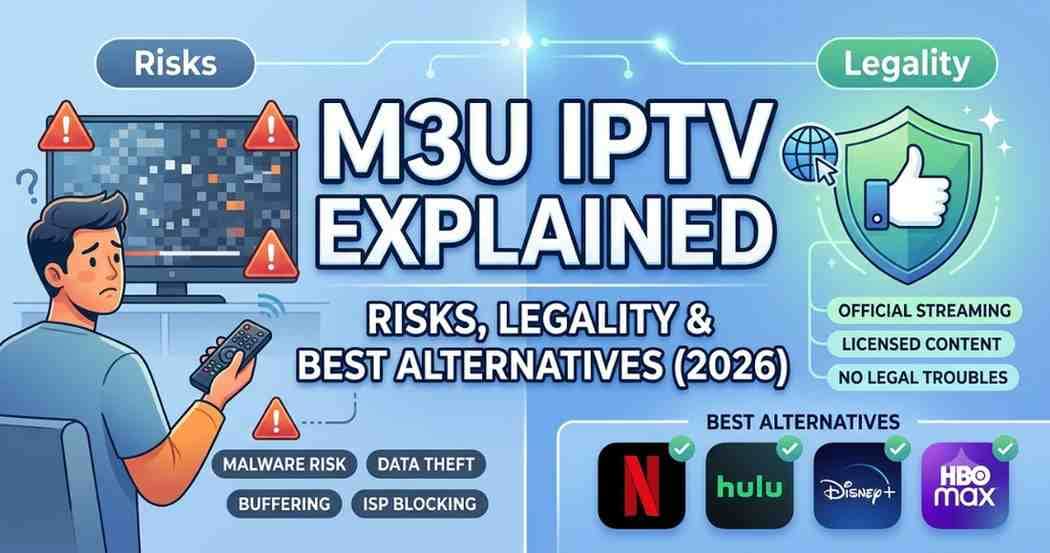
But here's the problem: it usually is too good to be true. Before you hand over your card details to an unfamiliar "IPTV reseller" website, it's worth understanding exactly what M3U IPTV is, how the technology actually works, why the overwhelming majority of services marketed this way operate outside the law, and — most importantly — what genuinely safe, legal alternatives exist that can deliver similar convenience without the risk to your money, your data, or your legal standing.
🚀 Compare Legal Plans Now
This guide is written specifically for everyday streamers, students and learners on a budget, freelancers who need reliable background TV or news access, and small business owners who want to offer live sports or entertainment to customers without exposing themselves to copyright liability. By the end, you'll understand the technology, the legal landscape in 2026, and a complete, practical roadmap for choosing a streaming setup you won't have to worry about.
What Is "M3U IPTV USA"
M3U stands for "MPEG version 3.0 URL" — it's a simple, plain-text playlist file format that was originally designed for MP3 audio playlists in the late 1990s. Over time, the format was adapted to reference video and live-stream URLs instead of just audio files, which is why it became the backbone of most IPTV (Internet Protocol Television) applications.
An "M3U IPTV USA" service, in the way it's most commonly marketed online, refers to a subscription where a third-party provider gives you either:
A direct M3U playlist link (a URL you paste into a media player app), or
A branded app that has the M3U playlist built in
...that streams US cable, satellite, and premium sports channels over your internet connection instead of through a traditional cable box or satellite dish.
How M3U IPTV Technically Works
Understanding the mechanics helps explain both why it's popular and why it's risky:
Source acquisition: A provider captures or receives live channel feeds — sometimes through legitimate subscriptions that are then re-streamed without authorization, and sometimes through direct unauthorized access to broadcast signals.
Server hosting: Those feeds are encoded and hosted on remote servers, often in countries with lax IP enforcement.
Playlist generation: The provider creates an M3U (or M3U8, its more modern variant for adaptive streaming) file listing every channel and its corresponding stream URL.
Playback via app: You load this playlist into a third-party IPTV player — common examples include generic "IPTV Smart Player" type apps, sometimes sideloaded outside official app stores.
Live streaming: The player fetches each stream in real time and plays it, similar to how a legitimate streaming app would function.
Technically, this pipeline is identical to how licensed IPTV works. The difference isn't the technology — it's the licensing.
💡 Find Your Best Match
Legal vs. Unauthorized M3U IPTV: The Critical Distinction
Not all IPTV is illegal. In fact, IPTV as a delivery technology is used by many fully licensed companies:
Telecom-operated IPTV, such as services offered by major internet providers that deliver cable-equivalent channels over their own broadband infrastructure under direct licensing agreements with content owners.
Licensed streaming aggregators like YouTube TV, Hulu + Live TV, and Fubo, which use similar streaming delivery methods but have paid the actual rights holders for retransmission rights.
The problem is specifically with services generically marketed as "M3U IPTV USA" for rock-bottom prices. These almost always rebroadcast premium content — ESPN, HBO, Showtime, live NFL/NBA/MLB games, pay-per-view boxing, and first-run movies — without paying any licensing fees to the actual content owners. That is copyright infringement under U.S. law (and under most international copyright frameworks), regardless of how the marketing website frames it ("for educational use only," "not affiliated with any network," etc. — these disclaimers carry no legal weight).
Why the "$15/Month, 10,000 Channels" Offer Doesn't Add Up
Legitimate broadcasters pay enormous licensing fees for content — a single regional sports network license can cost a legal streaming provider tens of millions of dollars a year. When you see a service offering every major sports package, every premium channel, and thousands of international channels for less than the price of a single legitimate premium add-on, the math simply doesn't work unless licensing fees aren't being paid at all.
Why It Matters in 2026
Streaming enforcement has intensified significantly over the past two years, and 2026 marks a turning point in several important ways:
Payment Processor Crackdowns
Payment processors and app stores have dramatically tightened their policies around unauthorized IPTV resellers. Many services that operated for years have had their payment gateways shut down abruptly, causing subscribers to lose access with zero notice and zero refunds. If you paid annually, that money is typically gone for good.
Rights Holder Enforcement
ISPs and rights holders — especially major sports leagues and premium content owners — are now actively monitoring streaming traffic patterns and issuing takedown requests at a much higher volume than in previous years. Several high-profile IPTV reseller networks have been shut down through coordinated legal action, sometimes with law enforcement involvement in the countries where servers are hosted.
Rising Malware Risk
Malware risks in sideloaded IPTV APKs (Android app files installed outside the official Play Store) have increased substantially. Security researchers have documented multiple cases of "premium IPTV" apps that request excessive device permissions, harvest personal data, or install background processes that consume device resources or display intrusive ads. Because these apps aren't vetted by any official app store, there's no accountability if something goes wrong.
The Price Gap Has Closed
Legal streaming bundles have become far more price-competitive than they were five years ago. Bundled deals, ad-supported tiers, and free FAST (Free Ad-Supported Streaming TV) channels mean the cost gap that once made illegal IPTV attractive has narrowed considerably — while the risk has only grown.
What This Means for You
For learners on tight budgets, freelancers who can't afford downtime or a compromised device, and small business owners who could face direct liability for publicly displaying unlicensed content, the risk-to-reward ratio of unauthorized IPTV has clearly shifted in the wrong direction. Understanding this now — before signing up for a random "IPTV USA" service — can save you money, stress, and potential legal headaches.
Key Benefits of Choosing Legal Streaming Alternatives

Switching to (or starting with) a properly licensed service comes with advantages that go well beyond just "staying out of trouble":
No sudden service blackouts. Legal providers can't be shut down overnight by a copyright claim, so you won't lose access to the Super Bowl halfway through the fourth quarter.
Data and device safety. No unofficial APKs requesting camera, microphone, or contact list permissions for no clear reason.
Reliable customer support. Real companies with real support teams, chat lines, and documented refund/cancellation policies.
Consistent HD/4K quality. Properly licensed streams are delivered through content delivery networks (CDNs) built for reliability, so you're far less likely to see buffering or dropped frames during a big game.
No legal exposure. Whether you're an individual viewer or a business owner streaming publicly, you're covered by the platform's actual licensing agreements.
Predictable billing. No sudden price hikes disguised as "server maintenance fees" and no disappearing companies.
Better accessibility features. Closed captioning, multi-language audio, and accessibility tools are typically far more robust on licensed platforms.
Top Legal Providers & Tools for US Live TV Streaming
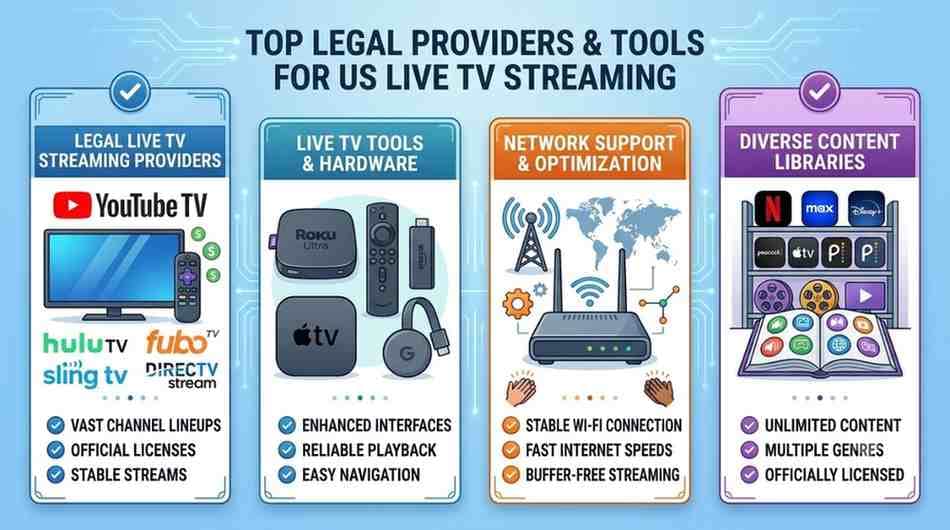
Below are the leading legitimate options as of 2026, each suited to slightly different needs.
1. YouTube TV
YouTube TV offers a live TV bundle with 100+ channels, unlimited cloud DVR storage, and support for up to three simultaneous streams per household. It includes major broadcast networks, cable news, and a strong regional sports network lineup in most markets.
2. Hulu + Live TV
This service combines Hulu's massive on-demand library (including next-day access to many network shows) with a live channel package and access to Disney+ and ESPN+ as part of the bundle.
3. Fubo
Fubo is built specifically for sports fans, with an especially deep lineup of regional sports networks, soccer leagues, and international sports content alongside standard entertainment channels.
📺 View Pricing & Features
4. Sling TV
Sling is the budget-conscious option, letting you build a customized channel package (Sling Orange, Sling Blue, or both) rather than paying for a large bundle of channels you don't watch.
5. DirecTV Stream
DirecTV Stream offers a cable-like channel lineup delivered entirely over the internet, with no satellite dish or equipment installation required, and strong DVR and multi-device support.
6. Local Network & Free Ad-Supported Apps (FAST Channels)
Apps like Pluto TV, Tubi, The Roku Channel, and PBS offer completely free, fully legal live and on-demand content, supported by ads instead of subscription fees. These are an excellent zero-cost starting point.
7. Philo
Philo is a low-cost, entertainment-focused live TV bundle (no local or sports channels) ideal for people who mainly want lifestyle, reality, and cable entertainment channels at a lower price point.
8. ESPN+ and League-Specific Apps
For sports fans who only want specific leagues, standalone apps like ESPN+, NBA League Pass, and MLB.TV offer legal, direct-from-source access without needing a full live TV bundle.
Pricing & Plan Disclaimer
The prices listed in the comparison table are approximate and may vary depending on the subscription plan you choose, your country or region, and any ongoing promotional offers. Features such as live sports coverage, Cloud DVR storage, simultaneous streams, and channel availability can also differ between plans. Streaming services regularly update their pricing, packages, and features, so the information in this table is intended for general comparison only. Before subscribing, always visit the provider's official website to verify the latest pricing, available plans, included features, and current promotional discounts.
Features to Look For in a Legal Streaming Service
When comparing services, don't just look at the price tag. These features determine whether a service will actually fit your daily habits.
Channel Lineup
Does the package include the specific local affiliates, news networks, and premium channels you actually watch regularly? A cheaper plan with the wrong channels isn't actually a good deal.
DVR Storage and Retention
Check both the total cloud DVR storage hours and how long recordings are retained before automatic deletion — this varies significantly between providers.
Device Compatibility
Confirm support for your specific devices: Smart TVs (Samsung, LG, etc.), Roku, Amazon Fire Stick, Apple TV, Chromecast, mobile apps, and web browsers.
Simultaneous Streams and Multi-Room Support
If you have a family or run a small office, check how many devices can stream at once, and whether there's a home-vs-away streaming restriction (some services limit certain channels to your home Wi-Fi network only).
Contract Flexibility
Look for month-to-month plans with no long-term contract, so you can pause or cancel seasonally (for example, canceling a sports-heavy plan in the off-season).
Picture Quality and Bandwidth Requirements
Check whether 4K or HDR content is available, and what minimum internet speed is recommended — this matters especially for households with multiple simultaneous streams.
Parental Controls
If you have kids, look for robust profile-based parental controls and content restrictions.
Pricing Table (2026 Snapshot)
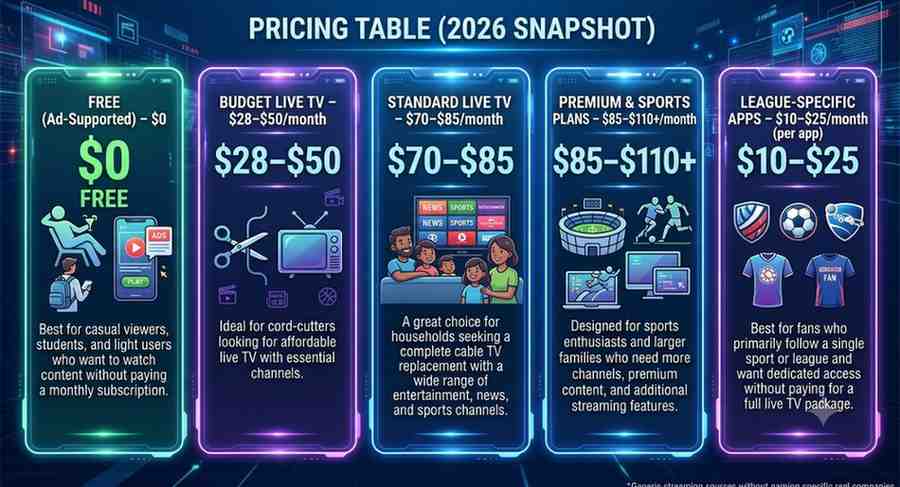
Free (Ad-Supported) – $0
Best for casual viewers, students, and light users who want to watch content without paying a monthly subscription.Budget Live TV – $28–$50/month
Ideal for cord-cutters looking for affordable live TV with essential channels.Standard Live TV – $70–$85/month
A great choice for households seeking a complete cable TV replacement with a wide range of entertainment, news, and sports channels.Premium & Sports Plans – $85–$110+/month
Designed for sports enthusiasts and larger families who need more channels, premium content, and additional streaming features.League-Specific Apps – $10–$25/month (per app)
Best for fans who primarily follow a single sport or league and want dedicated access without paying for a full live TV package.Use Cases
For Learners and Students
Students and self-learners on tight budgets can rely almost entirely on free, ad-supported apps like Pluto TV and Tubi for casual entertainment, combined with free educational platforms like PBS for documentaries and learning content — all without spending a dollar.
For Freelancers
Freelancers who want reliable background TV, news, or light entertainment while working from home benefit most from budget live TV plans (Sling or Philo) that don't require a long-term contract, so the subscription can be paused during slower months.
For Remote Workers Who Travel
Cloud-based legal services can typically be accessed from anywhere in the country (and sometimes internationally with a VPN restriction caveat), making them more travel-friendly than a fixed cable box.
For Small Businesses (Bars, Offices, Waiting Rooms)
Small business owners who want to show live sports or entertainment to customers or employees need a commercial streaming license — a completely separate category of subscription from consumer plans. Providers such as DirecTV for Business offer packages specifically designed and licensed for public venues.
For Families
Larger households benefit from services with high simultaneous stream limits and profile-based parental controls, such as YouTube TV or DirecTV Stream.
Best For
Best for sports fans: Fubo — deepest regional sports network coverage.
Best for families: DirecTV Stream — high stream limits and unlimited DVR.
Best for budget cord-cutting: Sling TV — customizable, lower-cost packages.
Best free option: Pluto TV — zero cost, no signup required for many channels.
Best all-around value: YouTube TV — broad channel lineup with unlimited DVR.
Best for entertainment-only viewers: Philo — low price, no sports/local news bloat.
Best for single-sport fans: League-specific apps like NBA League Pass or MLB.TV.
Pros and Cons
Legal Streaming Services
Pros:
Fully licensed, zero legal risk for personal use
Consistent uptime and reliable stream quality
Real customer support with documented policies
Regular content updates and feature improvements
Transparent, predictable billing
Cons:
Higher monthly cost compared to advertised pirated IPTV pricing
Some regional blackout restrictions apply to certain sports content
Multiple subscriptions may be needed to cover all desired channels
Unauthorized "M3U IPTV" Services
Pros:
Lower advertised upfront price
Large advertised channel counts, including international content
Cons:
Frequent, unannounced shutdowns with no refund policy
Malware and privacy risks from unofficial sideloaded apps
Direct copyright infringement exposure
No accountability or support if streams fail during major live events
Payment information shared with unverified, often offshore, companies
No consumer protection laws effectively covering these transactions
Best Alternatives
If cost is your main concern, the smartest approach isn't a single all-in-one subscription — it's a layered strategy:
Start with free ad-supported apps (Pluto TV, Tubi, The Roku Channel) to cover general entertainment at zero cost.
Add one budget live TV plan (Sling or Philo) for local news and cable staples.
Add a single sports-focused subscription (Fubo or a league-specific app like ESPN+) only during the season you actually watch.
Cancel and re-subscribe seasonally rather than keeping every service running year-round.
This layered approach typically costs less than a single unauthorized IPTV subscription's advertised price — with none of the risk.
Future Trends in Live TV Streaming (2026 and Beyond)
Deeper Bundling
Bundled subscriptions combining streaming, mobile phone plans, and home broadband are becoming standard offerings from major providers, often at a discount versus buying each separately.
AI-Personalized Program Guides
AI-personalized channel guides are increasingly replacing traditional electronic program guides (EPGs), surfacing content based on viewing habits rather than a static channel grid.
Stronger Anti-Piracy Enforcement
Expect continued and stronger enforcement at the ISP and payment-processor level, making unauthorized IPTV services increasingly unstable and short-lived.
Growth of FAST Channels
FAST channels (Free Ad-Supported Streaming TV) continue to expand rapidly, with major studios launching their own free, ad-supported channels — giving cost-conscious viewers more free legal options than ever before.
Consolidation of Streaming Apps
Expect continued consolidation, with some smaller streaming services merging or shutting down, making it more important to periodically review which subscriptions actually deliver value for your household.
How to Spot a Scam or Unauthorized IPTV Service

Even if you're not actively looking for an unauthorized IPTV provider, it's useful to know the warning signs, since many of these services are aggressively marketed through social media ads, YouTube comments, and search engine ads that can appear alongside legitimate results.
Red Flag #1: Unrealistic Channel Counts
Any service advertising "10,000+ channels" or "every sports package included" for under $20/month should be treated with suspicion. No legitimately licensed service can offer that volume of premium content at that price, because the underlying licensing costs simply don't support it.
Red Flag #2: Payment Only via Crypto, Gift Cards, or Wire Transfer
Legitimate streaming companies accept standard credit cards and offer transparent billing through recognized payment processors. Providers that only accept cryptocurrency, prepaid gift cards, or direct bank transfers are a major warning sign, since these payment methods are difficult to dispute or refund.
Red Flag #3: No Verifiable Company Information
Check for a real business name, physical address, and terms of service. Many unauthorized IPTV sites use anonymous domain registrations and provide no verifiable corporate identity.
Red Flag #4: App Downloads Outside Official App Stores
If a service requires you to sideload an APK file instead of downloading from the Apple App Store, Google Play, or Roku Channel Store, treat this as a serious red flag. Official app stores perform basic security vetting that sideloaded apps skip entirely.
Red Flag #5: Aggressive Reseller/Referral Programs
Many unauthorized IPTV operations rely heavily on multi-level referral programs, offering commissions for recruiting new subscribers. Legitimate streaming services rarely operate this way, since it isn't a sustainable business model for a licensed media company.
A Simple Decision Framework for Choosing Your Streaming Setup
If you're not sure where to start, walk through these four questions:
What do I actually watch regularly? List your must-have channels — local news, specific sports leagues, premium cable shows — before comparing any pricing.
How many people and devices need access at once? This determines whether you need a higher simultaneous-stream limit or can get by with a single-stream free app.
Is my viewing seasonal? If you mainly watch football in the fall or a specific sport during its season, a month-to-month plan you can pause is far more cost-effective than an annual commitment.
Am I streaming for personal use or public display? If it's for a business, bar, or any public venue, you need a commercial license — not a consumer subscription, regardless of how convenient a personal plan might seem.
Answering these honestly will usually point you toward a combination of one or two paid services plus a free FAST channel app, rather than a single expensive bundle or a risky unauthorized IPTV subscription.
Watching US Content Legally From Outside the USA
Since interest in "M3U IPTV USA" content isn't limited to US residents, it's worth addressing international viewers directly. If you're outside the United States and want legal access to US channels and shows:
Check native availability first. Many US shows and live sports are already licensed to local streaming platforms in your country under different branding — search for the show or league plus your country name before assuming you need a US-specific workaround.
Use official international versions. Services like Paramount+, Max, and Peacock have expanded international availability in many regions with fully licensed local pricing.
Avoid geo-unblocking combined with unauthorized IPTV. Using a VPN to access a legitimate US streaming service you're not subscribed to (or don't have regional rights for) can violate that platform's terms of service, separate from the IPTV piracy issue entirely.
Look for official league passes. Sports leagues increasingly offer direct-to-consumer international streaming passes (like NBA League Pass International or NFL Game Pass) that are built specifically for viewers outside the US and are fully legal.
This approach gives international viewers, freelancers working across time zones, and global small business owners a legitimate path to US content without relying on unauthorized IPTV resellers.
Conclusion
"M3U IPTV USA" services promise enormous value at a fraction of cable prices, but in 2026 the risks — legal exposure, malware, sudden shutdowns with no refunds, and unreliable streams during the moments that matter most — clearly outweigh the short-term savings. Legal alternatives like YouTube TV, Fubo, Sling, Philo, and free FAST channels now offer nearly the same convenience and channel variety with none of that risk.
For learners managing a tight budget, freelancers who need dependable background TV, and small business owners who could face direct liability for public display of unlicensed content, choosing a properly licensed service isn't just the safer choice — it's usually the smarter one financially, once you account for the layered, seasonal subscription strategy outlined above. Take the time to match your actual viewing habits to the right combination of free and paid legal services, and you'll get reliable, guilt-free streaming without ever needing to gamble on a random "M3U IPTV USA" reseller.
FAQs
Is M3U IPTV legal in the USA?
The M3U file format itself is legal technology used by many licensed platforms. However, most services that use it to stream premium cable and sports channels without a broadcasting license are operating illegally.
Can I get in trouble for using unauthorized IPTV?
Enforcement usually targets sellers and distributors rather than individual viewers, but risks for users include malware exposure, stolen payment data, and sudden loss of paid service. Some jurisdictions have also pursued action against end users.
What's the cheapest legal alternative to IPTV?
Free ad-supported services like Pluto TV, Tubi, and The Roku Channel are completely legal and cost nothing to use.
Do I need a special license to stream sports in my business (bar, office)?
Yes. Public display of licensed content, especially live sports, generally requires a commercial streaming agreement. Residential consumer subscriptions are not licensed for use in public venues.
Which legal service is best for live sports?
Fubo is widely considered the strongest option for regional and national sports coverage in 2026, with league-specific apps as a good supplement for single-sport fans.
Can I combine multiple legal streaming services instead of one big bundle?
Yes, and it's often the smartest approach — layering a free service, one budget live TV plan, and a seasonal sports add-on frequently costs less overall than a single premium bundle while still covering everything you actually watch.
Are M3U playlists themselves dangerous to use?
The file format is not inherently dangerous, but the source matters. Loading a playlist from an unverified, unauthorized provider carries the same risks as installing any unverified software — including malware and data theft.
Will legal streaming ever be as cheap as unauthorized IPTV?
The price gap has already narrowed significantly thanks to free FAST channels and flexible budget plans. Full price parity with unauthorized services is unlikely since licensing fees are a real cost, but a well-planned combination of free and low-cost legal services can come close.
What happens if an unauthorized IPTV service shuts down after I've paid for a year?
In most cases, there is no refund process, since these are unregulated transactions with offshore or unverified companies. This is one of the most common complaints reported by former subscribers.
How do I know if a streaming service is actually licensed?
Licensed services are typically listed in official app stores (Apple App Store, Google Play, Roku Channel Store), have verifiable company information, transparent pricing, and public customer support channels — all things unauthorized IPTV resellers generally lack.

